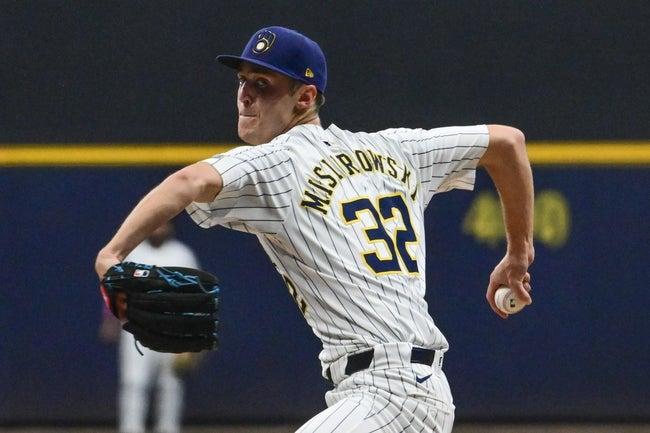
I keep staring at Drew Rasmussen’s 3.6 K/9 rate against Jacob Misiorowski’s dominant 19.8 K/9 from their season debuts, and this Milwaukee moneyline price doesn’t reflect what should be a clear pitching advantage at American Family Field.
Drew Rasmussen vs Jacob Misiorowski: Tampa Bay at Milwaukee Betting Preview
The market sees two pitchers with identical 1.80 ERAs and sets Milwaukee as a moderate home favorite, but that surface-level equality masks a significant gap in stuff. While both starters logged five innings in their 2026 debuts, Misiorowski struck out 11 batters compared to Rasmussen’s two punchouts. That’s not a small difference in approach—it’s the difference between dominant stuff and soft contact pitching.
Milwaukee opened this season by taking three of four games, showing better offensive production early with an +18 run differential compared to the Rays’ +2. With Tampa Bay missing key contributors Gavin Lux (.269 average, .724 OPS in 2025) and Taylor Walls (.220 average, .599 OPS in 2025) on the injured list, their lineup depth takes another hit against a pitcher who’s already shown elite strikeout ability.
Game Info & Betting Lines
- Date/Time: Wednesday, April 1, 2026 at 1:40 PM ET
- Venue: American Family Field (Park Factor: 1.00)
- Probable Starters: Drew Rasmussen (TB) vs Jacob Misiorowski (MIL)
- Moneyline: Tampa Bay Rays +119 / Milwaukee Brewers -143
- Run Line: Milwaukee -1.5 (+153) / Tampa Bay +1.5 (-186)
- Total: 7 (Over -112 / Under -108)
Why This Number Is Close
The market has legitimate reasons for keeping this line tight. Both pitchers posted identical 1.80 ERAs in their season debuts, and early-season sample sizes make any statistical comparison tenuous at best. Tampa Bay just exploded for runs in recent games, showing their offense can break out despite missing key pieces.
Milwaukee’s home field advantage gets baked into every line, but American Family Field’s neutral 1.00 park factor doesn’t create the type of environmental edge that would justify laying heavy chalk. The Brewers also lost Jackson Chourio (.270 average, 21 homers in 2025) to the injured list, removing their most dynamic offensive threat.
However, the market appears to be treating those matching ERAs as equal performance when the underlying metrics tell a different story. Strikeout rate has proven more predictive than early-season ERA, and Misiorowski’s 19.8 K/9 suggests the kind of swing-and-miss stuff that translates regardless of sample size.
What Separates the Pitching
This isn’t about comparing two similar arms—it’s about contrasting completely different approaches to getting outs. Misiorowski dominated with 11 strikeouts in five innings, showing the type of plus stuff that generates swings and misses even against major league hitters. His 1.0 WHIP came via strikeouts rather than defensive help.
Rasmussen took the opposite path to his 1.80 ERA, recording just two strikeouts while relying on contact management and his defense. That 0.8 WHIP looks impressive until you realize it came with a pedestrian 3.6 K/9 rate that leaves him vulnerable to offensive explosions. When hitters make contact consistently, margin for error shrinks dramatically.
The gap becomes more pronounced when you consider Tampa Bay’s lineup limitations. Without Lux and Walls, they’re leaning on Justyn-Henry Malloy (.221 average in 2025) and Stuart Fairchild (.216 average) for offensive production. These are exactly the type of hitters who struggle against power arms but can find success against contact pitchers.
Milwaukee’s offense should get production from contributors like Eric Haase (.229 average, .647 OPS in 2025) after Tuesday’s strong showing in their 6-2 victory. Against Rasmussen’s contact-heavy approach, they have multiple opportunities to break through with runners in scoring position.
The Pushback
The biggest concern here is treating five-inning samples as predictive gospel. Both pitchers have identical ERAs for a reason—early-season numbers can mislead, and Misiorowski’s 11 strikeouts could represent one dominant outing rather than sustainable stuff. If his control wavers or Tampa Bay’s hitters adjust to his approach, that strikeout advantage evaporates quickly.
Tampa Bay just scored multiple runs in their recent games, showing they’re capable of breaking out against quality pitching. When their lineup gets going, the Rays can manufacture runs even with depth chart players stepping into larger roles. Matt Thaiss (.218 average in 2025) and others have shown ability to contribute in key spots.
The line also accounts for Milwaukee playing at home, and laying -143 on a team with early-season question marks feels steep. But the strikeout differential represents a meaningful edge that the market hasn’t fully priced, and Milwaukee’s superior run differential (+18 vs +2) suggests better overall performance through four games.
Run Environment & Game Shape
The 7-run total expects a moderate scoring environment, which actually amplifies the pitching edge rather than diminishing it. In lower-scoring games, the team with the more reliable starter typically has better win probability, especially when that starter can miss bats consistently.
I’m backing the strikeout differential and taking Milwaukee -143 on the moneyline. Misiorowski’s swing-and-miss stuff gives him a higher floor against a Tampa Bay lineup missing two of their more reliable contributors, and that edge justifies laying the chalk at home.