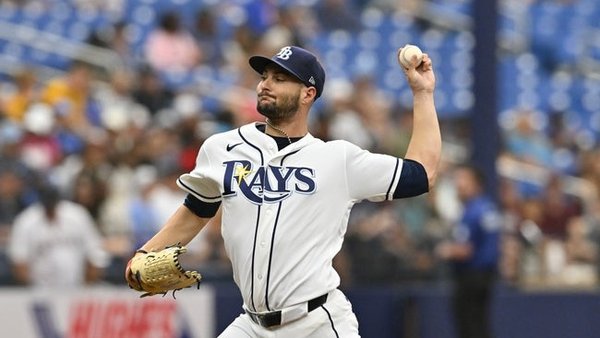
Brandon Young has surrendered 15 home runs in 117.2 innings — a 1.15 HR/9 rate — and he’s drawing a Rays lineup with 134 team home runs this season. Camden Yards carries a park factor of 1.01, so there’s no suppression working in Baltimore’s favor. The Rays sit at -125 on the moneyline despite a 14-game edge in the standings and Shane McClanahan on the mound — the price treats this like a coin flip the matchup doesn’t support.
Shane McClanahan vs. Brandon Young: Tampa Bay Rays at Baltimore Orioles Betting Preview
Baltimore bounced back last night with a 5-3 win over Tampa Bay — Pete Alonso doing most of the damage with a go-ahead two-run homer that extended his hitting streak to a career-high 13 games. That result matters for framing, but it doesn’t change what Saturday’s game actually is: a significant pitching gap dressed up in a price that feels closer than it should.
The core argument here is straightforward. Shane McClanahan is a measurably cleaner pitcher than Brandon Young across every meaningful metric — ERA, WHIP, and most importantly, home runs allowed. Tampa Bay’s roster quality (76-52, +43 run differential) against Baltimore’s (62-67, -34 run differential) represents one of the largest quality gaps you’ll find in a division game. The Rays’ -125 moneyline prices in some of that gap, but not all of it.
The market is balancing the Orioles’ home field, Young’s 9-3 record, and Alonso’s searing recent form against a Tampa Bay club that’s gone 4-6 in its last 10. That’s the surface tension. Underneath it, the structural edge belongs to the road team.
Game Info & Betting Lines
- Date/Time: Saturday, August 22, 2026 | 7:05 PM ET
- Venue: Oriole Park at Camden Yards (Park Factor: 1.01 — effectively neutral)
- TV: MLB.TV, Rays.TV, MASN
- Probable Starters: Shane McClanahan (9-6, 3.25 ERA) vs. Brandon Young (9-3, 3.52 ERA)
- Moneyline: Tampa Bay Rays -125 / Baltimore Orioles +116
- Run Line: Tampa Bay Rays -1.5 (+128) / Baltimore Orioles +1.5 (-155)
- Total: 8.0 (Over -108 / Under -112)
Why This Number Is Close
The market is doing real work here. Young’s 9-3 record gives Baltimore’s number legitimate credibility — wins matter for public perception, and a home team with a winning pitcher draws money. Add Alonso’s 13-game hitting streak and the fact that Baltimore just took Game 1 of this series, and you have a reasonable case for a short underdog. The +116 on the Orioles isn’t a gift line; it reflects genuine variables the market is pricing.
But here’s where I think the number is slightly off: it’s leaning too hard on Young’s record and not enough on his underlying profile. A 1.35 WHIP and 15 home runs allowed in 117.2 innings (1.15 HR/9) are not the ingredients of a pitcher who should be favored by venue alone. Camden Yards carries a park factor of 1.01 — essentially neutral — so there’s no meaningful suppression effect working in Young’s favor.
Meanwhile, McClanahan’s -125 moneyline sits comfortably under the -130 juice ceiling I use as a value threshold. You’re getting a legitimate ace at an accessible price. The Rays’ overall pitching staff (3.87 ERA, 1.17 WHIP) versus Baltimore’s (4.22 ERA, 1.35 WHIP) is a sustained team-level edge that reinforces the starter gap. The market is close — but it’s slightly wrong on the magnitude of the pitching difference.
What Separates the Pitching
The clearest way to see the gap between these two starters is to look at what each pitcher does with runners on base and how often he invites trouble. McClanahan’s 1.12 WHIP against Young’s 1.35 WHIP isn’t a marginal difference — it’s the difference between a pitcher who consistently works ahead and one who regularly navigates traffic.
McClanahan’s arsenal tells the story. His changeup — deployed 29.1% of the time at 86.8 mph — generates a 38.3% whiff rate and holds hitters to a .222 xwOBA. That’s an elite put-away pitch, and it’s the reason his K/9 of 8.27 is meaningful rather than empty strikeout accumulation. His four-seamer sits at 95.4 mph at 38.9% usage, and while the xwOBA against it is .385 — the highest of his offerings — the changeup tunnels off it effectively enough to keep hitters off-balance. Against a Baltimore lineup where Holliday carries a 24.8% whiff rate and Tyler O’Neill sits at 27.2% whiff, McClanahan’s strikeout profile is a real weapon.
Young’s best pitch is his slider — 41.7% whiff rate at 84.2 mph — and it’s genuinely dangerous in two-strike counts. But his four-seamer (40.2% usage, 94.3 mph) allows a .336 xwOBA, and his sinker gives up a .355 xwOBA with just an 8.5% whiff rate. Against a Tampa Bay lineup featuring Junior Caminero (xwOBA .413, 8.1% barrel rate, 35 HR) and Jonathan Aranda (xwOBA .413), that sinker-heavy profile is a liability. Caminero, in particular, is exactly the type of hard-contact threat — 35.2% hard-hit rate — who punishes pitchers with elevated HR rates. Young has allowed 8 more home runs than McClanahan in 15 more innings. At a neutral park, that arithmetic matters.
The Pushback
I won’t paper over it: Pete Alonso is the most dangerous variable in this game, and his recent form makes him genuinely scary. He’s on a career-high 13-game hitting streak, batting .480 during the stretch, and he just went deep off Tampa Bay’s pitching last night for his 30th homer of the season. His season xwOBA is .485 with a 7.1% barrel rate — that’s legitimate elite contact quality, not a streak masking a bad hitter.
The BvP history against McClanahan specifically is mixed rather than reassuring: in 10 plate appearances, Alonso is hitting .300 with 1 home run and 3 strikeouts. That one home run tells you the threat is real. His season-long xwOBA against all left-handed pitchers is .453 — a strong split that confirms he doesn’t have a platoon weakness McClanahan can exploit with the changeup alone. The strikeout rate (23.0% overall) gives McClanahan a path, but Alonso has shown he can make contact against left-handed velocity when he’s locked in, and right now he is very locked in.
The rest of the Baltimore lineup also has teeth. Encarnacion-Strand (.462 xwOBA), Basallo (.421), and Mayo (.425) are legitimate hard-contact bats who can make a lead evaporate in a hurry. I come back to the same place every time I look at this roster: Baltimore is dangerous enough offensively that this game can go wrong. That’s real. It’s why I’m not treating this as a high-confidence spot.
Rejected Angle: Rays -1.5 Run Line (+128)
The market is dangling the Rays -1.5 at positive juice (+128), and I understand the temptation. If McClanahan pitches to his profile and Young’s HR rate catches up with him, covering a run and a half is absolutely in play. But I’m not going there, and here’s why.
The numbers project this game as a dead-even contest — both teams at 4.6 runs. That’s not a projection that screams dominant Rays win; it’s a coin flip with a slight pitching lean. When the score projection is that tight, asking for a run-line cover adds meaningful variance without a corresponding edge. The pitching advantage I’m buying is real, but it’s a win-probability edge, not a margin-of-victory edge. Pete Alonso alone — one swing in the middle innings — can swing two runs and flip a cover. I trust McClanahan to give Tampa Bay a better chance to win the game. I don’t trust the run differential to be predictably clean enough to hang a cover requirement on it. The moneyline is the cleaner expression of this edge. The run line at +128 looks attractive but asks you to pay for precision the data doesn’t support.
Run Environment & Game Shape
The total is set at 8.0, and the numbers project 9.2 combined runs — which tells you the market is sitting below where the underlying offense projects. Baltimore’s lineup has hit 157 team home runs this season; Tampa Bay has 134. Both offenses carry real pop, and neither pitcher is the type who suppresses run environments dramatically on his own.
The key shape factor here is how quickly these games can escalate. Young’s 1.15 HR/9 rate means one crooked inning from the Rays is a reasonable expectation rather than an outlier. McClanahan’s cleaner WHIP (1.12 vs. 1.35) suggests he’s more likely to strand baserunners when Baltimore does get on, but with Alonso batting second and the lineup depth Baltimore has shown, no lead is safe until the final out.
Tampa Bay’s relief corps has been a strength all season — the team’s 3.87 ERA and 1.17 WHIP are staff-wide numbers, not carried entirely by McClanahan. Baltimore’s bullpen has had more volatility, particularly with Keegan Akin and Ryan Helsley both on the 60-day IL. If this game goes deep into the middle relievers, the Rays have the structural bullpen advantage to close it out. That’s a secondary but real layer of support for the moneyline play.
The Pick
Everything I’ve laid out points the same direction. McClanahan is the better pitcher in this game by a measurable margin. The Rays are the better team by a substantial margin — 14 games in the standings, a +77 run differential swing. The price at -125 is under my juice ceiling and represents fair-to-slightly-undervalued on a club with a legitimate starting pitching edge.
Alonso is the reason I’m not more aggressive. He’s hot, he’s dangerous against lefties, and his BvP history (10 PA, .300 AVG, 1 HR vs. McClanahan) confirms he can make contact in this specific matchup. But one dangerous hitter doesn’t erase a team-wide structural edge, and the moneyline gives us the cleanest way to back that edge without needing a specific margin of victory.
Bet: Tampa Bay Rays moneyline -125 | 2 units | Moderate confidence