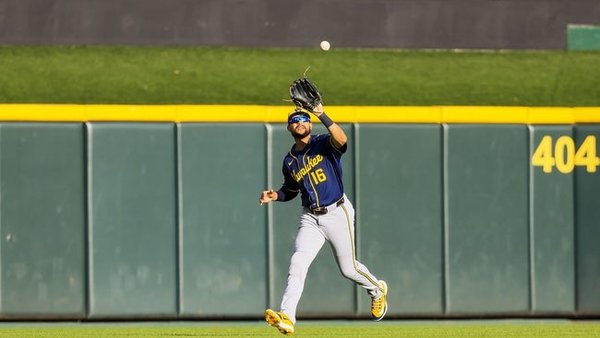
Brandon Sproat’s 13 home runs allowed in 69.2 innings sets up a volatile run environment, yet the total sits at 9 with the Over priced at even money — a number that doesn’t fully account for the Brewers’ elite late-inning bullpen waiting behind him. The projected combined score of 9.3 barely clears the posted total, leaving almost no cushion on either side of this line.
Rhett Lowder vs Brandon Sproat: Cincinnati Reds at Milwaukee Brewers Betting Preview
The Brewers are the right team in this series. Their 51-31 record, league-best team ERA of 3.40, and elite bullpen anchored by Aaron Ashby and Trevor Megill make them the clear favorite — and the -172 moneyline reflects every bit of that. But at that price, you’re laying heavy juice on a team facing a starter with a 5.43 ERA who has surrendered 13 home runs in 69.2 innings. The margin can get messy fast. The Brewers moneyline is simply not the right expression of this edge.
The better question isn’t who wins — Milwaukee almost certainly does. It’s how many runs cross the plate. The total is posted at 9, and the numbers project a combined score of 9.3. That’s a razor-thin gap. When you factor in a neutral dome environment, a Cincinnati offense running on fumes (.699 OPS, -53 run differential), and the best bullpen in this dataset ready to shut the door, the Under at -122 is the cleanest number on the board.
Yesterday’s game finished 5-3 for a combined 8 — today’s matchup presents a similar shape with a slightly different wrinkle in the starters’ profiles.
Game Info & Betting Lines
- Date/Time: Tuesday, June 30, 2026 | 7:40 PM ET
- Venue: American Family Field (Dome) | Park Factor: 1.00 (neutral)
- Probable Starters: Rhett Lowder (CIN, 3-5, 4.81 ERA) vs Brandon Sproat (MIL, 2-4, 5.43 ERA)
- Moneyline: Cincinnati Reds +144 / Milwaukee Brewers -172
- Run Line: Milwaukee Brewers -1.5 (+126) / Cincinnati Reds +1.5 (-152)
- Total: 9 (Over +100 / Under -122)
Why This Number Is Close
The market has set the total at 9 for a reason. Both starters carry ERAs above 4.80. Neither commands an elite strikeout profile that screams shutdown performance. Sproat, in particular, has been homer-prone — 13 long balls in 69.2 innings — and the Reds have slugged 101 home runs this season. Elly De La Cruz (.819 OPS) put the Reds up 3-0 in the fifth inning last night with a two-run homer off Robert Gasser — his 13th of the season. The Over is priced at even money (+100), which tells you the market is not heavily leaning toward the low-scoring outcome.
The case for the Over is real: two vulnerable starters, a Brewers offense that leads this dataset with 423 runs scored, and a Reds lineup capable of the sudden big inning when De La Cruz or JJ Bleday (.858 OPS) gets into one. If either starter exits before the fifth inning, the bullpens absorb innings and the game total can escalate quickly.
Where the market is slightly off is in how much weight it’s giving the offensive upside. The Reds’ underlying numbers are genuinely weak — .699 OPS, .228 batting average, 783 strikeouts — and the projected combined score of 9.3 barely clears the posted total. That 0.3-run margin of error favors the Under when you add the dome’s neutral park factor (no wind, no weather inflation) and a Brewers bullpen that posted a clean inning last night with Ashby (11-1) and Megill (11 saves) both available again.
What Separates the Pitching
Neither starter tonight inspires confidence in isolation, but they create different types of innings — and that distinction matters for the total.
Rhett Lowder operates with a four-pitch mix anchored by a sinker (29.7% usage, 92.6 mph) that generates soft contact — that sinker carries a 5.7% whiff rate but a troubling .408 xwOBA, meaning when Brewers hitters make contact, they hit it hard. His best weapon is a slider (25.6% usage, .297 xwOBA, 34.8% whiff), which can neutralize right-handed hitters, but Lowder’s 7.4 K/9 limits his ability to escape trouble through strikeouts. The Brewers’ top of the order — Chourio (.416 xwOBA) and Brice Turang (.424 xwOBA against right-handers at .464) — match up well against Lowder’s profile. William Contreras is 4-for-6 lifetime in BvP with a home run. Lowder’s 1.4655 WHIP tells you baserunners are a near-certainty, but whether they score depends on sequencing, not dominant stuff.
Brandon Sproat brings more swing-and-miss from the jump. His 96.7 mph four-seam fastball holds a 22.0% whiff rate and a 25.0% put-away rate, and his sweeper — deployed nearly 10% of the time — posts a 42.1% whiff rate with a suppressed .240 xwOBA. That’s a legitimate put-away pitch. His 9.4 K/9 against a Cincinnati lineup that has struck out 783 times this season is the key suppressor. In the BvP sample, Sal Stewart is 0-for-7 with four strikeouts against Sproat, and Spencer Steer is 0-for-2. Elly De La Cruz (.482 xwOBA vs right-handers) is the legitimate danger zone — 8.8% barrel rate, 34.0% hard-hit rate — but he’s 1-for-7 with three strikeouts in limited BvP exposure against Sproat. The gap between the two arms isn’t about dominance; Sproat’s strikeout upside against a weak-contact Reds lineup is the key suppressor on the Cincinnati side of the ledger.
The Bullpen Asymmetry That Seals It
This is where the Under thesis has its firmest footing. The Brewers’ back end is the best unit in this dataset: Aaron Ashby at 11-1, Trevor Megill with 11 saves in 13 opportunities. Last night, Ashby tossed a scoreless eighth and Megill closed out a perfect ninth. Both are available again tonight. When Milwaukee’s starter exits — and with a 5.43 ERA, Sproat may not last deep — the Brewers hand the ball to one of the most reliable late-inning combinations in the league.
The Reds’ bullpen situation is the mirror image. Graham Ashcraft, Tony Santillan, and Emilio Pagan are all on the injured list. Sam Moll took the loss last night. The depth is thin, and if Lowder runs into trouble early, Cincinnati’s options behind him are limited in both quality and quantity. But here’s the structural point: a depleted Reds pen doesn’t automatically mean runs. If the Brewers bullpen is shutting down the Reds in the late innings on the other end, the back-half run scoring gets compressed regardless of who Cincinnati trots out.
Rejected Angles: Brewers ML and Run Line
The Brewers moneyline at -172 is simply too expensive. Yes, the win probability strongly favors Milwaukee, and yes, the roster construction is clearly superior. But laying -172 against a starter with a 5.43 ERA and 13 home runs allowed means one bad inning from Sproat can swing the game, and you’ve already committed substantial juice. The return doesn’t justify the risk when the total offers a cleaner edge at a more reasonable price.
The Brewers run line at -1.5 (+126) is more interesting on paper — you’re getting plus money on the favorite to win by two or more — but the starting pitching on both sides makes a close, low-scoring game entirely plausible. Sproat’s homer rate means the Reds could be within a run or two deep into the game, and a late swing off an overextended Reds reliever could make the margin closer than the run line requires. The juice is right, but the margin risk isn’t worth it when the Under captures the thesis more directly.
The Pushback
The real risk in this ticket is Sproat’s homer rate. Thirteen long balls in 69.2 innings is not a small-sample anomaly — it’s a pattern. The Reds have 101 home runs as a team, and De La Cruz (.482 xwOBA vs right-handers, 8.8% barrel rate) is capable of going deep on any count. JJ Bleday at .858 OPS has been one of Cincinnati’s most reliable offensive threats. One multi-run inning off Sproat before the Brewers bullpen takes over blows the total.
De La Cruz in particular is worth watching. He’s in his sixth game back from a hamstring injury and already hit his 13th homer last night. He is clearly not hampered, and his .480 xwOBA heading into tonight is a genuine threat to any right-handed starter. The Reds also have real power depth — Sal Stewart leads the team with 15 home runs, and Bleday is right behind at 13. If Sproat’s cutter (.381 xwOBA, 20.8% whiff) doesn’t locate well early, this lineup is capable of the crooked number.
The Brewers offense is no slouch either. Jackson Chourio (.877 OPS, .416 xwOBA) and Jake Bauers (.862 OPS) give them legitimate middle-of-the-order pop against Lowder’s sinker-heavy approach that gets hit hard when contacted. Andrew Vaughn (.927 OPS) is the hottest bat in this dataset. If Lowder can’t get ahead in counts and leans on the sinker (.408 xwOBA), this Brewers lineup will make him pay.
These are real counterarguments. The Under is a lean, not a lock — but the structural elements consistently point lower.
Run Environment & Game Shape
American Family Field’s dome eliminates the variables that inflate totals in outdoor parks. No wind, no weather delay risk, no humidity swings. The park factor of 1.00 means what you see in the projected lines is what you should expect: a controlled environment where the pitching and lineup quality determine the total, not external conditions. The absence of atmospheric noise cuts both ways, but when the thesis is already built on pitching and bullpen quality rather than weather exploitation, a neutral dome is exactly the setting where this Under holds its shape.
The projected combined score of 9.3 sits just above the posted total of 9. That gap is narrow enough that the Brewers’ bullpen advantage — the single clearest structural edge in this game — tips the balance. Milwaukee closes games. Cincinnati can’t match it inning-for-inning in the late frames. In a dome with no weather to push scoring in either direction, that bullpen asymmetry is the deciding factor in whether this game finishes at 8 or 11.
The Pick
The case for the Under isn’t that both starters are great — they’re not. It’s that the back end of this game belongs to one of the best bullpens in baseball, the Reds offense is structurally weak, and the dome removes the environmental variables that could push scoring beyond what the lineups can actually produce on their own. The 9.3 projection barely clears the number, and in this setting, I’ll take the lean toward the lower side.
Bet: Under 9 at -122 | 1 unit | Lean confidence