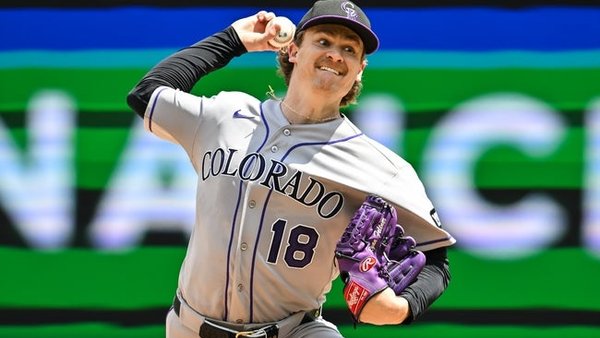
Hunter Greene’s 6.97 ERA and 1.45 WHIP walk into the highest run-inflation park in baseball, opposite a Feltner who has surrendered 11 home runs in 63.1 innings. The total sits at 11 — a number that prices in altitude but may not fully account for the specific volatility stacked on both sides of this mound matchup.
Hunter Greene vs. Ryan Feltner: Cincinnati Reds at Colorado Rockies Betting Preview
Yesterday’s numbers correctly identified value on the over in this series — the 12.5 combined total went over, with the Rockies routing the Reds 10-3 in a game that felt inevitable by the third inning. Today, the market has set the total at 11, and while books have factored in the altitude and the Coors environment, I think there’s a specific pitching dynamic they may be underweighting in their number.
The core argument here is simple: two struggling pitchers, one catastrophically depleted bullpen, and a park factor of 1.38 — the single highest run-inflation environment in Major League Baseball. The numbers project 12.6 combined runs against a posted total of 11. That’s a 1.6-run gap, and when every structural signal in the game points in the same direction, that’s not a number I want to ignore.
This is a scoring environment bet. The Reds moneyline at -142 is too expensive to touch, and the run line requires margin certainty from a wildly volatile starter. The total is the cleanest expression of what this game is likely to be — a high-scoring Sunday afternoon at altitude.
Game Info & Betting Lines
- Date/Time: Sunday, July 19, 2026 | 3:10 PM ET
- Venue: Coors Field | Park Factor: 1.38 (highest in MLB — extreme hitter-friendly)
- TV: MLB.TV, Rockies.TV, Reds.TV
- Probable Starters: Hunter Greene (CIN) vs. Ryan Feltner (COL)
- Moneyline: Cincinnati Reds -142 / Colorado Rockies +120
- Run Line: Cincinnati Reds -1.5 (+108) / Colorado Rockies +1.5 (-130)
- Total: 11 (Over -110 / Under -110)
Why This Number Is Off
Books know Coors. They price it in every night. The posted total of 11 already reflects the altitude, the thin air, and the run inflation that Coors Field routinely produces. So the legitimate case for the market is straightforward: this number isn’t naive. It’s a deliberate acknowledgment that runs come easier in Denver, and the counter-argument has to be more specific than “it’s Coors.”
Here’s where I think the market is slightly wrong. The 11 handle likely models an average Coors Field game with two functional starting pitchers. What it may not fully account for is the specific combination of Hunter Greene’s 6.97 ERA and 1.45 WHIP through 10.1 innings — extreme volatility that goes beyond normal Coors inflation — layered on top of a Colorado bullpen that has lost five relief arms to the IL. When Greene exits, and he could exit early, the Reds are handing the ball to a depleted corps. That’s not a normal game shape. The 1.6-run gap between the 12.6 run projection and the posted 11 represents meaningful directional pressure, and the structure of this particular game amplifies it further.
The market is balancing both sides competently. I just think the Greene wildcard, in this park, against this bullpen situation, tips the scale toward the over more than the posted number reflects.
What Separates the Pitching
Put these two starters side by side and the gap is significant — though in different ways than a typical pitching matchup.
Hunter Greene brings elite raw stuff: his four-seam fastball sits at 99.0 mph and he uses it 54.4% of the time, while his slider generates a remarkable 54.1% whiff rate with a .282 xwOBA against. On paper, that’s a frontline arsenal. In practice, his 6.97 ERA and 1.45 WHIP through 10.1 innings reflect the volatility that comes with a pitcher who hasn’t yet found command consistency. His sinker is a pitch he simply cannot rely on — used just 4.9% of the time, it carries a .749 xwOBA against, a number that signals real contact damage on the rare occasions hitters do see it. At Coors, where even well-located pitches carry differently, that margin for error shrinks further. Colorado’s lineup features multiple bats above .850 OPS — Moniak at .886, Rumfield at .870, Goodman at .853 — and McCarthy (.303 AVG) leads off. These aren’t easy outs against any pitcher, let alone one struggling to post consistent outings.
Ryan Feltner is a different kind of risk. He’s a more stable arm with 63.1 innings of work and a 4.55 ERA, but his calling card problem is the home run. Feltner has surrendered 11 HR in 63.1 IP — a 1.56 HR/9 rate that would be concerning at any park. At Coors, with the ball carrying in afternoon July heat, that fly-ball vulnerability becomes a live weapon for Cincinnati’s lineup. Elly De La Cruz (.477 xwOBA vs. RHP) and Sal Stewart (.409 xwOBA) sit near the top of the order. Feltner’s four-seam fastball carries a .428 xwOBA against — hitters are doing real damage to it — and his slider generates only a 25.2% whiff rate, well below Greene’s breaking-ball dominance. Neither arm looks like a run-suppressor today.
The Pushback
I want to be honest about the arguments against this play, because they’re real.
First, Greene’s ERA is a small-sample number. Ten-plus innings is barely a month of work, and a 6.97 ERA over that stretch can be driven by one or two bad outings rather than a systemic problem. It’s entirely possible Greene settles in today, the slider dominates Colorado’s lineup, and he posts six innings of three-run ball. That’s within his capability given the raw arsenal data.
Second, overs at Coors can trap bettors into lazy thinking. The park inflates runs on average, but plenty of Coors games land under their posted total — particularly when pitching matchups are respected by the market and both starters are operating at reasonable efficiency. The 11 handle isn’t a gift; it’s a number that reflects real information.
Third, blowouts are a structural enemy of the over. If Greene implodes early — say, gives up six in two innings — Colorado’s bullpen may coast through the remaining frames with a comfortable lead, limiting Cincinnati’s run opportunities in the back half of the game. A 10-3 blowout can finish under a total just as easily as it can push through one.
Still, I come back to the convergence: the park factor, Greene’s documented early-season volatility, a Feltner HR/9 rate that is nearly impossible to survive in Denver heat, and a Colorado bullpen that has lost five arms to the IL. Any one of those factors alone wouldn’t move me off the number. All four pointing in the same direction, in a park with a 1.38 run factor, is a different story. The small-sample ERA caveat is legitimate — but the conditions surrounding this specific game amplify the downside risk so substantially that I’m comfortable backing the over even acknowledging that Greene could outperform his current line. The blowout concern is real, but it cuts both ways: if Cincinnati’s bats tag Feltner early, Colorado’s depleted bullpen is the next line of defense, and that’s not a reliable firewall. I’ll take the structural edge.
Pick: Over 11 (-110) — 2 units. The thesis is straightforward: a 1.38 park factor, a Greene ERA that screams early-inning volatility, and a Rockies bullpen stripped of five arms by injury combine to create a scoring environment that this total simply doesn’t fully price in. Play the environment.