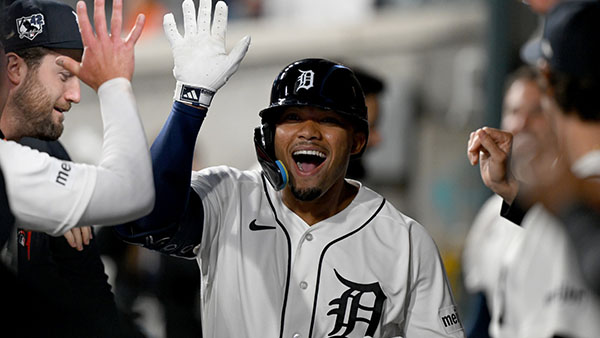
Montero’s 10.1 innings of dominance suggest a clear edge — the -108 moneyline treats this like a coin flip despite the pitching gap.
Kris Bubic vs Keider Montero: Kansas City Royals at Detroit Tigers Betting Preview
The market has this game priced as essentially a coin flip, with Detroit sitting at -108 on the moneyline. On the surface, that feels about right — both teams are hovering around .500, both have shown flashes and frustrations in equal measure. But when you dig into the pitching matchup, the numbers tell a different story.
Keider Montero has been nothing short of dominant through his first 10.1 innings, posting a 1.74 ERA and a microscopic 0.68 WHIP that makes even the most seasoned handicappers do a double-take. Meanwhile, Kris Bubic has been solid but not spectacular at 2.50 ERA with a 0.83 WHIP. The gap is significant, but the price suggests the market isn’t fully buying into Montero’s early-season excellence.
The question becomes whether a 10-game sample is enough to trust, or if Detroit’s home field advantage combined with Kansas City’s offensive struggles (.216 average, .635 OPS) creates enough of an edge to justify backing the Tigers at this thin number.
Game Info & Betting Lines
- Date/Time: Thursday, April 16, 2026 | 1:10 PM ET
- Venue: Comerica Park (Park Factor: 0.99)
- Probable Starters: Kris Bubic (KC) vs Keider Montero (DET)
- Moneyline: Kansas City -112 / Detroit -108
- Run Line: Detroit +1.5 (-171) / Kansas City -1.5 (+141)
- Total: 8 (Over -112 / Under -108)
Why This Number Is Close
The market is balancing legitimate concerns about small sample sizes against what appears to be a meaningful talent gap. Kansas City gets respect here because Bubic has been consistent across 18 innings, striking out 23 while walking just seven. His 2.50 ERA isn’t fluky — it’s backed by solid peripherals and a proven track record.
Detroit’s case rests almost entirely on Montero’s 10.1 innings of brilliance, which is where the market shows its skepticism. The line essentially says “show us more” before fully pricing in this pitching advantage. That’s reasonable handicapping from the oddsmakers.
But here’s where I think the market is slightly off: Kansas City’s offense has been genuinely terrible, managing just 55 runs in 18 games (3.06 runs per game) while hitting .216 as a team. Even if you discount some of Montero’s early dominance, the Tigers are getting home field advantage against a lineup that has shown little ability to capitalize on mistakes. The -108 price doesn’t adequately reflect how difficult it will be for Kansas City to generate runs against even an average pitcher, let alone one who’s looked this sharp.
What Separates the Pitching
The Statcast data reveals why Montero has been so effective and why Bubic might be vulnerable against Detroit’s lineup. Montero’s four-seam fastball sits at 94.0 mph — a full 2.4 mph harder than Bubic’s heater — and while his 8.0% whiff rate on the fastball seems low, the 0.158 xwOBA against shows hitters aren’t squaring it up.
More importantly, Montero’s changeup has been devastating, generating a 40.0% whiff rate with just a 0.111 xwOBA against. Kevin McGonigle and Colt Keith both profile well against changeup-heavy righties, with McGonigle showing strong contact metrics (.410 xwOBA) and Keith posting a .442 xwOBA despite some swing-and-miss tendencies.
Bubic’s arsenal creates different problems but potentially easier ones for Detroit to solve. His slider has been his best pitch with a 56.5% whiff rate, but he’s throwing it just 11.5% of the time. His four-seam fastball comprises 44.2% of his arsenal at 91.6 mph, and Detroit’s top hitters have shown they can handle velocity in that range. Riley Greene owns a .447 xwOBA with solid hard-hit rates, while McGonigle’s 25.0% hard-hit rate suggests he makes consistent contact even if it’s not always explosive.
The gap isn’t just in stuff — it’s in execution. Montero has walked just two batters in 10.1 innings compared to Bubic’s seven walks in 18 frames. Against a Kansas City offense that’s struggled to work counts and create baserunners, that control difference becomes magnified.
The Run Line Question — Where the Real Edge Lives
Here’s where I need to be completely transparent about a major internal conflict in my analysis. My projection model is screaming at me to take Kansas City -1.5 at +141. The model shows the away team covering by 1.3 runs with a strong edge, rating it as a 2-unit play with high confidence — exactly the type of signal I’ve learned to trust over the years.
The logic is sound: if Kansas City can solve Montero even modestly, Bubic’s superior track record and strikeout ability could lead to a comfortable win. The Royals have better baseline talent and more proven pitching depth. Detroit’s offensive explosion has been driven largely by Kevin McGonigle’s .908 OPS, which feels unsustainable given his minor league track record. Regression to the mean favors Kansas City in a multi-run decision.
But I keep coming back to what I’m seeing on the field right now, not what the models predict based on larger sample projections. Kansas City’s offense looks genuinely lost — they’ve managed more than four runs just twice in their last eight games. Montero’s stuff passes the eye test even if the sample is small. Sometimes you have to trust what’s happening in the present rather than what should happen based on past performance.
The +141 on KC -1.5 offers legitimate value if you believe in mean reversion and think Montero is due for regression. I understand the case completely. But I’m choosing to fade the model here and stick with the team that’s shown me better pitching in the immediate present, even if it means accepting lower-value odds on the moneyline.
The Pushback
The obvious concern is trusting 10.1 innings of anything, no matter how dominant it looks. Montero could regress hard in this start, and suddenly that 1.74 ERA looks like a mirage. Early-season numbers are notoriously volatile, especially for pitchers who haven’t established lengthy track records.
There’s also the matter of Kansas City’s recent series history here. Yesterday’s 2-1 loss to Detroit showed this Royals lineup can hang around in low-scoring games, and Bobby Witt Jr. has the talent to break a game open with one swing. Bubic’s track record suggests he’s unlikely to implode, which means this projects as exactly the type of tight, coin-flip game the market is pricing.
The concern that keeps nagging at me is the value. At -108, Detroit barely offers any return for what amounts to a gut call on a small sample size. That’s not enough cushion for comfort when banking on a pitcher who’s faced limited big-league hitting. If Montero gives up three runs in five innings — perfectly reasonable for most pitchers — this bet dies quickly.
Run Environment & Game Shape
The total of 8 reflects both pitchers’ early success and Comerica Park’s neutral tendencies (0.99 park factor). This is exactly the type of environment where a pitching edge gets amplified — when runs are at a premium, the difference between good and great on the mound becomes the deciding factor.
Detroit’s approach should favor working counts and trying to get to Kansas City’s bullpen, which has posted a 3.81 ERA but carries significant injury concerns with key relievers on the IL. Kansas City’s path to victory likely requires Bubic to dominate for six-plus innings and hope their offense can scratch across 2-3 runs against a pitcher they’ve never seen.
The Pick: Detroit Tigers Moneyline (-108) for 1 unit. I’m betting on present performance over projection models, backing a pitcher who’s shown elite control and stuff against an offense that’s struggled to generate consistent production. The value is minimal, but sometimes the right bet is the obvious one, even when it doesn’t pay much.