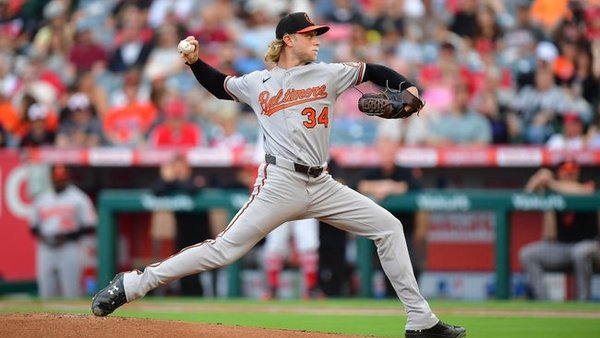
Shane Baz’s four-seamer sits at 96.1 mph but carries a .358 xwOBA against and a 13.1% whiff rate — velocity without the results to back it up. Sean Burke’s 2.01 WAR dwarfs Baz’s 0.59, the Orioles are 39-46 with a -26 run differential, and Baltimore is still priced at -134. The number hasn’t followed the pitching profiles.
Sean Burke vs Shane Baz: Chicago White Sox at Baltimore Orioles Betting Preview
The market has set Baltimore as a -134 home favorite, which is reasonable on the surface — home field, familiar mound, a lineup with Pete Alonso anchoring the middle of the order. But when you start pulling the thread on what actually separates these two clubs, the case for Chicago at plus money becomes harder to dismiss. This isn’t a matchup where the favorite deserves a significant price edge. It’s a coin-flip game where one side is offering you a meaningful return.
The core argument is straightforward: Sean Burke is pitching better than Shane Baz, the White Sox own a better record and a positive run differential, and the Baltimore rotation has been gutted by injuries. That combination creates value on the road side at +114. The numbers project a literal 4.6–4.6 tie, which means we’re essentially being paid to take the coin flip rather than laying juice on it.
Both offenses arrive here with recent scoring droughts relative to their season baselines, and the injury report on both sides adds noise. But at the price available, Chicago’s moneyline is the number worth backing.
Game Info & Betting Lines
- Date/Time: Monday, June 29, 2026 | 6:35 PM ET
- Venue: Oriole Park at Camden Yards | Park Factor: 1.01 (essentially neutral)
- Probable Starters: Sean Burke (CHW, 5-4, 3.71 ERA) vs Shane Baz (BAL, 4-8, 4.31 ERA)
- Moneyline: Chicago White Sox +114 / Baltimore Orioles -134
- Run Line: Baltimore Orioles -1.5 (+155) / Chicago White Sox +1.5 (-188)
- Total: 9 (Over -110 / Under -110)
Why This Number Is Off
The market is doing what it typically does: leaning on home-field inertia and name recognition. Baltimore was a playoff-contending club not long ago, and the books price them accordingly at Camden Yards. The -134 is defensible if you squint — Baz is throwing at home, the Orioles have hitters who can do damage, and the White Sox are a road club with injury concerns.
But here’s the problem: Baltimore’s -26 run differential tells you this team is not executing at a level that justifies even a modest favorite’s price. A -26 run differential at 39-46 isn’t a team on a bad streak — it’s a team that has been consistently outscored over a meaningful sample. The White Sox, meanwhile, are 43-39 with a +18 run differential. That’s not a massive gap in raw numbers, but the directional difference is significant.
The market is also absorbing some home-team bias around Baltimore’s partial roster advantages without fully pricing the starter gap. Burke’s 2.01 WAR against Baz’s 0.59 WAR is a stark contrast — that’s not a minor edge, that’s one of the widest starter quality gaps you’ll find in an AL game this week. The line doesn’t fully reflect it, which is where the value lives.
What Separates the Pitching
Pull up the Statcast numbers and the gap between these two starters becomes concrete. Burke’s four-seam fastball sits at 94.5 mph and generates a .305 xwOBA — that’s a pitch that misses bats at a 19.8% whiff rate. His slider is even sharper at a 30.4% whiff rate and .286 xwOBA, and his knuckle curve adds another layer at 22.4% whiff with a .278 xwOBA against. Burke creates swings and misses at multiple levels of the strike zone, and his 87 strikeouts in 87.1 innings reflect that. His 1.21 WHIP is the mark of a starter who controls traffic on the bases.
Baz, by contrast, has velocity — his four-seamer sits at 96.1 mph — but the results don’t match the raw stuff. That fastball carries a .358 xwOBA against and a 13.1% whiff rate, which is underwhelming for a pitch that hard. His knuckle curve (32.7% usage) is legitimately good at a 28.7% whiff and .278 xwOBA, but his changeup is a liability — .482 xwOBA against and only a 13.0% whiff rate. His 4-8 record and 4.31 ERA with a 1.38 WHIP reflect a starter who gives up hard contact when he doesn’t locate.
Now look at how the Chicago lineup aligns against Baz’s arsenal. Miguel Vargas carries a .432 xwOBA overall and a .395 mark specifically against right-handers like Baz. Kyle Teel is at .527 xwOBA against RHP — an elite contact quality number. Colson Montgomery posts a .438 xwOBA against righties. That’s a top-of-the-order built to do damage against the kind of pitcher Baz is — above-average velo but exposed when he elevates the changeup or leaves the fastball flat. Burke, meanwhile, faces a Baltimore lineup whose top hitters present a more manageable threat tier. Gunnar Henderson carries a .384 xwOBA against right-handed pitching specifically — relevant here since Burke throws from the right side — and while that’s a legitimate number to respect, it’s a step below the contact quality Chicago’s top three are putting up against Baz. Adley Rutschman checks in at .376 xwOBA overall (.378 vs RHP), and Pete Alonso (.464 xwOBA, .485 vs RHP) is the legitimate danger bat in this order. That said, BvP history shows Alonso 0-for-2 with a strikeout in his limited looks against Burke, and Burke’s slider (.286 xwOBA, 30.4% whiff) is exactly the pitch that gives power hitters trouble when it’s located down and away.
The Pushback
The biggest concern here isn’t the pitching — it’s Munetaka Murakami. The White Sox first baseman is on the 10-day IL with a hamstring injury, and losing a guy with a .938 OPS and 20 home runs in 200 at-bats hurts the ceiling of this offense. Jacob Gonzalez slides into the lineup at first base, and while Gonzalez has shown flashes, he’s not a like-for-like replacement for one of the more dangerous bats in the AL.
The Baltimore bullpen is also worth noting. Ryan Helsley has been shaky — 0-4 on the season — and the Orioles dropped back-to-back close games to Washington over the weekend, including a loss where Helsley surrendered the walk-off in the tenth. A short outing from Baz could expose that bullpen depth problem quickly, but it also means Baltimore’s late-inning options are more question mark than lock.
Camden Yards carries a 1.01 park factor, so there’s no meaningful run-environment edge for the home side. But the Orioles do tend to play better at home than their overall record suggests, and the crowd factor in a division game isn’t nothing. I’m not dismissing Baltimore’s chances here — the 50.9% away win probability I’m working from acknowledges this is genuinely close. The argument isn’t that Chicago is a clear favorite. It’s that Chicago at +114 is being underpriced on a night where the starter and standings both favor the road side.
Run Environment & Game Shape
With the total set at 9 and a park factor of 1.01, Camden Yards is playing as a near-neutral environment tonight. Both offenses have the capability to score — Chicago’s .738 OPS and 116 home runs speak to a lineup that can do damage in bunches, while Baltimore’s Alonso-anchored middle of the order gives them a thunder bat even when the lineup around him is inconsistent. The projected 4.6–4.6 split makes sense: two offenses that are roughly equivalent on paper, separated more by their starters than by their lineups.
Game shape matters here too. Burke has logged 87.1 innings at a 1.21 WHIP, which suggests he can work deep into games efficiently. If he gives Chicago six or seven quality innings tonight, the White Sox don’t need to lean heavily on a bullpen that has its own wear concerns. Baz, at 94 innings pitched with a 1.38 WHIP, has more of a history of traffic — runners on base, elevated pitch counts, and early exits. In a game projected this close, the starter who controls his pitch count better has a real edge on winning percentage, not just ERA.
The one-run game context matters for Chicago specifically. The White Sox are 17-10 in one-run games this season — that’s not a fluke sample, that’s a team that competes and executes in close games. Against a Baltimore side that has been losing the close ones (two straight walk-off losses to Washington over the weekend), that situational edge tilts further toward the road side.
The play: Chicago White Sox ML +114, 2 units. This is a moderate-confidence lean built on a real starter gap, a significant standings and run differential advantage, and a price that doesn’t reflect either. The coin-flip game projection means you’re getting paid to take what the numbers say is the better side. That’s the bet.