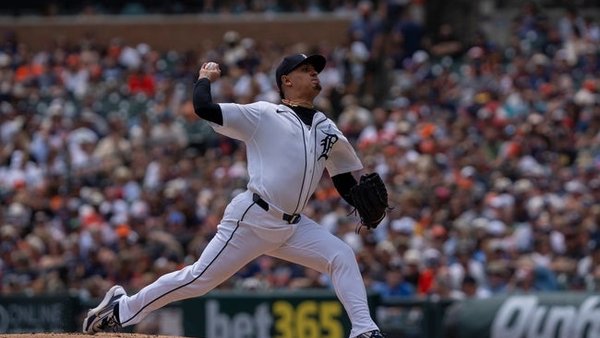
Keider Montero’s 3.34 ERA and 1.015 WHIP over 110.1 innings faces Gage Jump’s 1.397 WHIP and a depleted Oakland lineup missing three regulars to injury — yet the Tigers are priced at -110, essentially even money. A 1.75-run team ERA gap and 11 straight series losses for the Athletics point in one direction; the number hasn’t followed.
Keider Montero vs Gage Jump: Detroit Tigers at Athletics Betting Preview
After Detroit dismantled Sacramento 13-1 on Friday and 8-6 on Saturday, the series finale sets up as the most straightforward pitching matchup of the three games. Keider Montero takes the ball for Detroit against Gage Jump, and the gap between those two arms is real — not marginal. The market has priced this at -110 Tigers, essentially a coin flip, and I think that’s a gift.
The Athletics are in genuine freefall. A 2-8 record over their last 10 games, 11 straight series losses — a run that has happened only twice in the franchise’s last 110 seasons — and a roster now missing Shea Langeliers, Zack Gelof, and Joshua Kuroda-Grauer to the injured list. Detroit’s pitching staff ERA of 3.62 against Oakland’s 5.37 represents one of the wider staff gaps you’ll find in any single matchup this season. The price should reflect that. It doesn’t.
The Skubal trade deadline news will draw attention as background noise, but Skubal isn’t pitching today. Montero is, and the Tigers have been playing inspired baseball in this series regardless of the front-office turbulence. This is about who’s taking the mound and what kind of team is sitting in the opposing dugout.
Game Info & Betting Lines
- Date/Time: Sunday, August 2, 2026 | 4:05 PM ET
- Venue: Sutter Health Park | Park Factor: 0.93 (slight run suppressor)
- Probable Starters: Keider Montero (DET) vs Gage Jump (OAK)
- Moneyline: Detroit Tigers -110 / Athletics +102
- Run Line: Athletics +1.5 (-150) / Detroit Tigers -1.5 (+125)
- Total: 11 (Over -115 / Under -105)
Why This Number Is Off
The market is doing its job — balancing sharp action, public perception, and genuine uncertainty. A flat 4.2–4.2 projected score is a legitimate reason for the -110 price. Lines that weigh recent volatility, injury-replacement lineups, and early-season variance will narrow a game like this toward 50/50. I understand why the line landed here.
But here’s where I part ways: the even projected score flattens out what should be a meaningful pitching gap. Montero carries a 3.34 ERA and 1.015 WHIP across 110.1 innings — this isn’t a small sample. Jump’s 4.00 ERA and 1.397 WHIP over 63 innings tells a different story about contact quality and command. Detroit’s team ERA of 3.62 versus Oakland’s 5.37 is a structural advantage that gets discounted when both offenses project similarly on paper.
The concern is valid: Oakland’s lineup, even depleted, can create noise in any single game. They scored six runs Saturday. But that game also saw them benefit from Detroit’s bullpen workload after Skubal’s farewell start the night before. Today, Montero goes fresh against a lineup missing three of its better hitters. The -110 moneyline doesn’t account for that compounding disadvantage. That’s where the edge lives.
What Separates the Pitching
Montero and Jump are genuinely different pitchers operating in different tiers, and the Statcast data makes that distinction concrete. Montero works with a four-pitch mix led by a 94.3 mph four-seamer (30.7% usage, .321 xwOBA against) and complemented by a slider sitting at 85.9 mph that generates a 25.3% whiff rate and .238 xwOBA — that’s a genuine swing-and-miss offering. His changeup is the best pitch in the arsenal: 27.8% whiff rate and .213 xwOBA against, meaning hitters are chasing it badly and not doing damage when they do make contact. His sinker (22.9% usage, 94.7 mph) drives soft contact and ground balls, which plays well in a park factored at 0.93.
Jump leans heavily on a 96.3 mph four-seamer at nearly 50% usage — live arm, real stuff — and that fastball whiffs at 20.5%. His sweeper is arguably his best secondary pitch at 35.3% whiff, but it’s a low-usage weapon at just 5.7%. The concern is command: a 1.397 WHIP reflects genuine trouble keeping the ball out of dangerous counts. His changeup, despite a 31% whiff rate, carries a .349 xwOBA against — hitters who do connect are doing real damage.
Against Jump’s four-seamer-heavy profile, Detroit’s middle of the order looks dangerous. Dillon Dingler carries a .443 xwOBA with a 5.5% barrel rate, and Riley Greene sits at .459 xwOBA with a 6.9% barrel rate — including a .496 xwOBA against right-handed pitching. Eduardo Valencia adds a .456 xwOBA and 8.5% barrel rate — the Tigers’ three through five hitters are going to see a lot of 96 mph fastballs from a command-challenged starter. That’s a recipe for traffic. Montero, by contrast, faces an Oakland lineup with Jacob Wilson (.309 xwOBA, 1.2% barrel rate) leading off and a top five averaging under .350 xwOBA collectively. The contact quality gap is real and it runs in Detroit’s direction.
The Pushback
The strongest case against Detroit here is what the numbers show at face value: 4.2–4.2, a dead-even projected score. When the math sees a coin flip, that’s not noise to dismiss. There are legitimate factors pulling this game closer than the narrative suggests.
Oakland’s pitching staff ERA of 5.37 includes a lot of bad outings from arms that won’t be on the mound today. Jump at 4.00 ERA is not the same as the staff aggregate. Detroit also carries its own injury concerns — the outfield depth has taken hits with Parker Meadows, Wenceel Perez, Kerry Carpenter, and Matt Vierling all on the IL, which forces the Tigers to run out a thinner lineup than their season stats reflect. And in any single game, a 96 mph arm can dominate regardless of WHIP history.
The Athletics also have genuine offensive pieces when healthy. Nick Kurtz (.879 OPS, 21 HR) and Lawrence Butler (two hits and two runs scored Thursday) can hurt you. Oakland scored six runs in this very series on Saturday. They’re not a dead lineup — they’re a compromised one. That’s a meaningful distinction when handicapping a single game.
The Case for Detroit at -110
Here’s what keeps me on the Tigers despite the even projected score: the structural advantages compound when you stack them. Montero’s 3.34 ERA and 1.015 WHIP represent legitimate sustained performance over 110.1 innings. His slider (.238 xwOBA, 25.3% whiff) and changeup (.213 xwOBA, 27.8% whiff) give him real weapons against an Oakland lineup that’s already depleted at multiple positions. Langeliers (10-Day IL), Gelof (10-Day IL), and Kuroda-Grauer (10-Day IL) are all out — three of the A’s better contact and power threats.
Jump’s four-seamer-heavy approach plays directly into the strengths of Detroit’s three through five hitters. Dingler (.443 xwOBA), Greene (.496 xwOBA vs RHP), and Valencia (.456 xwOBA, 8.5% barrel rate) are built to punish elevated fastballs in the zone. Jump’s command issues — reflected in that 1.397 WHIP — mean those hitters are going to get their counts to hit.
Detroit’s team pitching ERA of 3.62 versus Oakland’s 5.37 is a 1.75-run gap. The Tigers are 6-4 over their last 10 games and just won consecutive blowouts in this park. The Athletics are 2-8 in their last 10 and on their 11th straight series loss. At -110, you’re being offered near-even money on a team with a meaningful edge in starting pitching, bullpen depth, and lineup construction against a fading opponent. The juice doesn’t reflect the lean.
The Pick
This is a moderate play. I’m not hammering it — the even projected score and Oakland’s capacity for noise keep this from being a strong-conviction spot. But -110 on a team with Montero’s numbers going against a command-challenged starter and a depleted lineup is value I’ll take. The contact quality data, the staff ERA gap, and the recent form all point the same direction.
Bet: Detroit Tigers Moneyline (-110) — 2 units