Detroit carries a 3.55 team ERA against San Francisco’s 4.36, a -53 run differential separates these rosters on the season, and yet the moneyline is sitting at -104 on both sides. The Giants’ home edge and Jobe’s 2026 unknowns keep this from being a slam — but the symmetrical price against a 49-67 club is a friction point worth unpacking.
Jackson Jobe vs Landen Roupp: Detroit Tigers at San Francisco Giants Betting Preview
After San Francisco’s 5-2 win Friday — fueled by a Rafael Devers first-inning homer and a Jung Hoo Lee two-run single — this series shifts to a fresh pitching matchup that changes the calculus considerably. Friday’s result matters as color, not as signal. Detroit’s offense had been on a historic tear entering that game (76 runs over their previous seven contests), and one quiet outing against an opener-plus configuration doesn’t erase what this lineup is capable of.
The core argument here is not about who starts Game 2 specifically — it’s about systemic team quality at an efficient price. Detroit’s staff carries a 3.55 ERA against San Francisco’s 4.36 ERA. That’s a gap of 0.81 runs, and the market is pricing it like a toss-up. The Giants are a 49-67 ball club with a -53 run differential on the season, and the Tigers are getting them at -104. That is the inefficiency worth attacking.
This isn’t a pitcher bet. It’s a team-quality bet at a flat price — the kind of spot where you take the better roster, acknowledge the uncertainty around the starters, and let the broader organizational edge do the work.
Game Info & Betting Lines
- Date/Time: Saturday, August 8, 2026 | 7:15 PM ET
- Venue: Oracle Park | Park Factor: 0.92 (run-suppressing)
- TV: MLB.TV, FOX
- Probable Starters: Jackson Jobe (DET) vs. Landen Roupp (SF)
- Moneyline: Detroit Tigers -104 / San Francisco Giants -104
- Run Line: Detroit Tigers -1.5 (+146) / San Francisco Giants +1.5 (-178)
- Total: 8 (Over -110 / Under -110)
Why This Number Is Off
A -104 / -104 line communicates that the market sees these teams as essentially equal. The problem is the underlying numbers don’t support equality — they support a meaningful lean toward Detroit.
The legitimate case for the Giants’ end of this line is real: they’re at home, they won yesterday with some momentum, they’re on a nine-game homestand that offers roster stability, and they’ve already shown they can contain Detroit’s offense (the Tigers mustered just two runs Friday). Oracle Park’s 0.92 park factor tamps down run scoring for both sides, which theoretically benefits the home team’s weaker pitching by limiting margin exposure.
But here’s the problem — the Giants’ -53 run differential on the season doesn’t lie. Their pitching staff at 4.36 ERA trails Detroit’s 3.55 ERA in a category that has direct downstream effects on every game. Detroit’s lineup OPS of .731 edges San Francisco’s .721 with more proven middle-of-the-order production. And the moneyline at -104 means you’re getting the better team at essentially break-even juice. The market has correctly identified this as close. It has not correctly accounted for the systemic gap between these rosters.
What Separates the Pitching
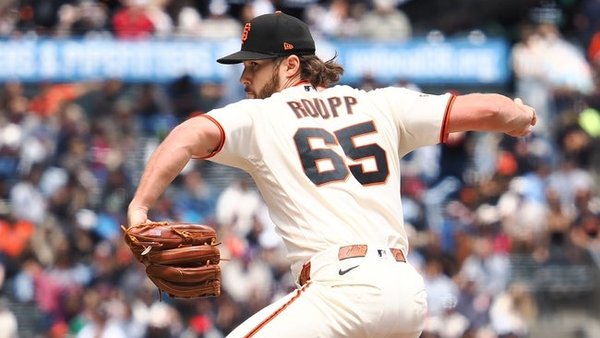
Landen Roupp enters this start with a 4.34 ERA, a 1.29 WHIP, and a 7-10 record over 118.1 innings — a profile that screams middle-of-the-rotation vulnerability. His arsenal leans heavily on a sinker (35.9% usage, 93.4 mph) that generates weak contact when it works, but bleeds hard contact when it doesn’t — an xwOBA of .384 against that pitch signals real exposure. His curveball is legitimately elite (34.6% whiff rate, .224 xwOBA), and his changeup (.252 xwOBA) gives him a secondary weapon. But Roupp lives and dies with that sinker, and Detroit’s lineup — particularly Dillon Dingler (.451 xwOBA, 5.8% barrel rate) and Riley Greene (.457 xwOBA, 6.8% barrel rate against right-handed pitching) — profiles as exactly the kind of hard-contact lineup that punishes elevated sinkers. Eduardo Valencia sitting fifth in the order brings an xwOBA of .494 with an 11.3% barrel rate, a genuine middle-of-the-order power threat.
Jackson Jobe is the honest complication in this analysis. His 2026 numbers are completely unknown — analytically, he’s a blank slate. In 2025 he posted a 4.22 ERA with a 1.49 WHIP and just 39 strikeouts over 49 innings, generating a modest 7.16 K/9. That’s not an ace profile. The Giants’ lineup — even with Bericoto and Schmitt on the IL — still features Rafael Devers (.411 xwOBA, 24 HR), who homered off Detroit’s starter Friday, and Bryce Eldridge (.433 xwOBA, 5.4% barrel rate). Jobe’s 2025 command concerns (27 walks in 49 IP) would be a meaningful vulnerability against a lineup with legitimate power threats. The pitching gap at the starter level is much narrower than the team ERA figures suggest — which is precisely why this is framed as a team-quality bet, not a starter bet.
The Pushback
The concern with this lean is significant enough to take seriously. Jobe is analytically unknown in 2026 — if he’s regressed, is on a strict pitch count, or simply has nothing working, Detroit could be in a hole early against a Giants lineup that showed real pop on Friday. The bullpen situation adds another layer of friction: three Detroit relievers are currently on the 60-day IL (Burch Smith, Brant Hurter, Will Vest), and it’s worth noting that the Tigers’ 3.55 team ERA may not fully reflect the current bullpen’s capability with those arms unavailable, which softens the structural edge this thesis relies on. Friday’s two-run output is a data point — one game doesn’t mean the offense has gone cold, but it’s a reminder that Oracle Park and a hot Giants pen can suppress even a dangerous lineup. And the home-crowd factor in a nine-game homestand opener is real; San Francisco will have energy working in their favor.
None of that moves me off the lean. It keeps it at one unit rather than pressing harder.
The Rejected Angle: Run Line
The +146 on Detroit -1.5 is attractive on the surface, and the numbers project a game that could go either way by a run. But this is not a spot to press the run line. Jobe’s 2026 form is a genuine unknown — if he’s short, or if the Giants chase him early, Detroit needs a bullpen bridge they may not have. The projected score of Giants 4.2, Tigers 4.1 is almost exactly a coin flip on margin, and that’s the scenario where -1.5 at +146 destroys value. The moneyline at -104 captures the team-quality edge without the added execution risk of needing a multi-run margin from a depleted roster on the road.
Run Environment & Game Shape
Oracle Park at 0.92 park factor means this is already a run-suppressing venue before you factor in the total sitting at 8. The projected 8.3 combined runs maps nearly perfectly to a tight, low-margin game — both starters are capable of giving up runs early, but neither is going to dominate for seven innings and put this game away. What that means structurally is that the back end of each bullpen gets exposed in a game where every run matters. Detroit’s organizational pitching depth — even with three arms on the 60-day IL — still grades out as the stronger unit at a 3.55 ERA versus San Francisco’s 4.36. In a tight, late-game situation where both bullpens are working in a run-suppressing park, the team with the better pitching infrastructure has a compounding edge. The Giants’ relievers allowed the lead to hold Friday, but that was against a Detroit lineup that went quiet. If this game is within one run in the seventh inning, I want the team with the better organizational ERA behind a low-juice moneyline. That’s Detroit.
The Play: Detroit Tigers moneyline -104 | 1 unit | Lean