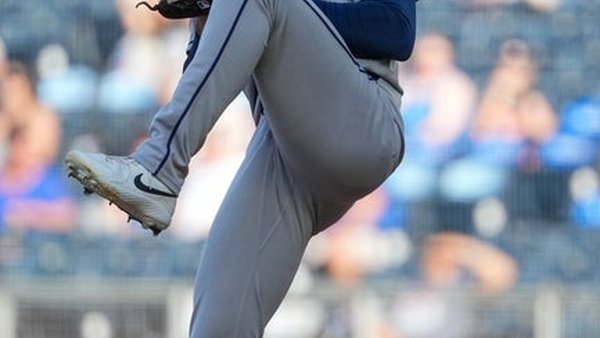
Joe Ryan’s elite secondary arsenal lines up against a negative-WAR starter who has surrendered 19 home runs in 85.1 innings — yet the moneyline prices Minnesota at -116, nearly a toss-up. The 2.30-run ERA differential between these two arms is real, and the number hasn’t moved to reflect it.
Joe Ryan vs. Mike Burrows: Minnesota Twins at Houston Astros Betting Preview
The Twins come into Tuesday night’s game at Daikin Park having beaten the Astros 5-4 on Monday, and the pitching matchup shifts dramatically in Minnesota’s favor. Joe Ryan (3.18 ERA) takes the ball for the Twins against Mike Burrows (3-8, 5.48 ERA, -0.47 WAR) — and that starter gap is the entire story. The market has priced Minnesota at -116, nearly a coin-flip, which seems to underweigh a 2.30-run ERA differential between two starters who are nowhere close to equal.
Yes, both teams are below .500. Yes, Houston is at home. Yes, Byron Buxton is day-to-day and Ryan Jeffers is on the IL. The market is balancing all of that. But when one team sends out a legitimate mid-rotation arm and the other sends out a pitcher with a negative WAR who has surrendered 19 home runs in 85.1 innings, that spread should be wider than a near-pick’em line suggests. The price here is the play.
Game Info & Betting Lines
- Date/Time: Tuesday, June 30, 2026 — 8:10 PM ET
- Venue: Daikin Park (Minute Maid Park) | Park Factor: 0.96 (slightly pitcher-friendly, dome)
- Probable Starters: Joe Ryan (MIN, 5-4, 3.18 ERA) vs. Mike Burrows (HOU, 3-8, 5.48 ERA)
- Moneyline: Minnesota Twins -116 / Houston Astros -102
- Run Line: Minnesota Twins -1.5 (+142) / Houston Astros +1.5 (-172)
- Total: 8.5 (Over -105 / Under -115)
Why This Number Is Off
The market is doing a reasonable job of incorporating the injury noise. Buxton’s hip (day-to-day) and Jeffers’ hand (10-day IL) remove two of Minnesota’s best bats — Buxton at .898 OPS with 25 home runs and Jeffers at .949 OPS are legitimate losses. Houston is at home and has won six of their last ten. The -102 on the Astros isn’t crazy; books are setting this as a virtual toss-up, and there’s a defensible logic to that framing.
But here’s where the market gets it slightly wrong: a near-even price implies relatively equal starting pitching tonight, and that’s simply not what the data shows. Burrows has a -0.47 WAR, meaning he has actively cost Houston wins relative to a replacement-level pitcher. His 1.50 WHIP and 19 home runs allowed in 85.1 innings reflect a starter who punishes opponents with mistakes, not one who generates weak contact. Ryan, by contrast, is a legitimate quality starter at 3.18 ERA. The home field edge in MLB is roughly 0.3 runs — far too small to bridge a gap this wide. Minnesota at -116 offers legitimate value for a clear pitching advantage that the price doesn’t fully reflect.
What Separates the Pitching
Joe Ryan’s arsenal is built around three pitches that suppress contact — but it’s important to be precise about which ones actually do the work. His 96.8 mph four-seamer leads his pitch mix at 49.3% usage, but it carries a .372 xwOBA against — that’s league-average at best, and it’s a legitimate vulnerability. Ryan does not win with his fastball. Where he wins is with everything else: his cutter sits at 89.7 mph with a 37.2% whiff rate and a .258 xwOBA against. His split-finger runs a 33.6% whiff rate and .248 xwOBA. His curveball generates a 38.5% whiff rate and .279 xwOBA. The cutter/splitter/curveball combination is genuinely elite at suppressing contact — the four-seamer is the pitch hitters can get to, but Ryan limits the damage by burying them in his secondary stuff. That’s actually what makes the Ryan-vs-Burrows contrast so stark: Ryan’s edge isn’t his fastball, it’s the three weapons behind it. Burrows doesn’t have that kind of secondary depth.
Now look at what Houston is sending out. Burrows leans heavily on his slider — 44.3% usage, 86.8 mph, .245 xwOBA against and 40.9% whiff rate. On paper, that’s a quality offering. The problem is his four-seamer, which accounts for 42.8% of his pitches and carries a .375 xwOBA against. When hitters sit on Burrows’ fastball, they do damage — and his sinker at .457 xwOBA against is even more alarming at 6.5% usage. The Twins’ lineup, even with Jeffers out, carries real power threats. Kody Clemens sits at a .400 xwOBA and 6.8% barrel rate. Josh Bell has a .381 xwOBA and went deep off Houston in Game 1 — anchor his threat there, because that home run is confirmed and the xwOBA backs up the pop. Christian Walker has a .777 OPS and Isaac Paredes carries a .315 xwOBA against Ryan’s profile — manageable, but there’s no dominant matchup advantage for Houston’s hitters. Yordan Alvarez is the one wild card at a .556 xwOBA against Ryan’s profile, which we’ll address — but the gap between these two starters across six-plus innings is significant and real.
One notable absence on the Houston side: Carlos Correa is on the 60-Day IL with an ankle injury and will not factor into tonight’s game. Any line that treats his stats as relevant lineup context for this matchup should be disregarded entirely.
The Pushback
The concern starts with Yordan Alvarez. He carries a 1.031 OPS, 25 home runs, and a .556 xwOBA in the Statcast splits against Ryan’s pitcher type. That number is not a typo. Alvarez is one of the two or three most dangerous hitters in baseball, and he’s batting second in Houston’s order tonight. One swing from Alvarez can erase two innings of Ryan’s work — and remember, Ryan’s four-seamer at .372 xwOBA is the pitch Alvarez will be hunting. That’s a legitimate threat the moneyline price doesn’t make disappear.
Beyond Alvarez, Jeremy Peña sat Monday with leg discomfort — but if he returns to the lineup, Houston gets their .799 OPS shortstop back, which bolsters a lineup that already went deep twice off Minnesota’s bullpen in Game 1. And while the Twins won that game, the 5-4 final was far from comfortable. Travis Adams surrendered a two-run shot in the ninth, and Yoendrys Gómez had to bail things out. The Twins’ bullpen depth is a real consideration, especially with Cole Sands (15-day IL, forearm) and Anthony Banda (15-day IL, lat) both unavailable.
These are real risks. But none of them change the fundamental asymmetry at the top of the starting pitcher matchup. Ryan’s secondary arsenal is genuinely elite. Burrows is a negative-WAR starter who has given up 19 home runs in 85 innings. The Twins win this game more often than -116 implies, and that’s enough to make it a play.
The Pick
I looked at the under at 8.5 (-115) as well. Ryan does suppress contact through his cutter, splitter, and curveball, and the 0.96 park factor leans pitcher-friendly. But Burrows’ volatility — a .375 four-seam xwOBA and a 1.50 WHIP that invites traffic — creates too much run-scoring upside for Minnesota’s side of the ledger. Add the -115 juice on the under and the risk-reward just isn’t there. The cleaner play is the team with the better starter at a price that undervalues the gap.
Bet: Minnesota Twins Moneyline -116, 2 units.