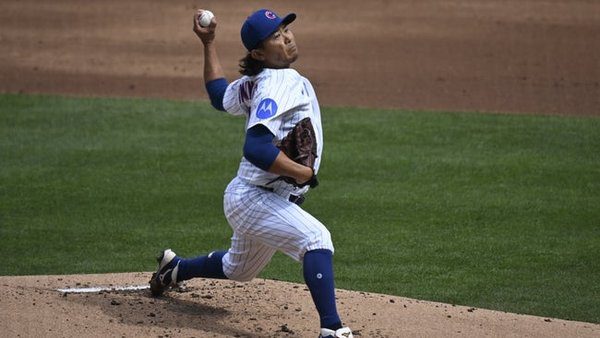
Shota Imanaga’s 1.12 WHIP and elite split-finger whiff rate position the Cubs as clear run-suppressors against a Twins lineup that grades out poorly against left-handed arsenals. The total sits at a flat 7.5 (-110 both ways) — a price that acknowledges balance but may not fully account for how deep Imanaga can go in a game where Minnesota’s middle of the order is overmatched.
Zebby Matthews vs Shota Imanaga: Minnesota Twins at Chicago Cubs Betting Preview
The Cubs took yesterday’s series rematch 6-2 behind Matthew Boyd’s sharp six innings, evening this series at one game apiece heading into Sunday’s finale. After backing Minnesota Twins ML yesterday and coming up short, today’s number presents an entirely different puzzle — one that isn’t about who wins, but about how many runs score doing it.
The market has this total posted at 7.5, and at first glance it feels reasonable. Wrigley Field carries a park factor of 1.02 — essentially neutral — and both starters have been serviceable without being dominant. What I keep coming back to, though, is the arm on the Cubs’ side. Shota Imanaga’s arsenal is genuinely elite in terms of run suppression, and when you factor in a Twins lineup that has been inconsistent in this series and a depleted Minnesota bullpen that could easily let a tight game stay tight, there’s a real case that 7.5 is a ceiling this game never approaches.
The numbers project Cubs 4.9, Twins 4.6 — but projections carry error bars, and when the market lands flat at -110 on both sides of a 7.5 total, it’s telling you there’s genuine balance here. The Under isn’t a lock. It’s an edge worth two units at moderate confidence.
Game Info & Betting Lines
- Date/Time: Sunday, July 19, 2026 | 2:20 PM ET
- Venue: Wrigley Field | Park Factor: 1.02 (neutral-to-slightly hitter-friendly)
- TV: MLB.TV, Twins.TV, Marquee Sports Net
- Probable Starters: Zebby Matthews (MIN, 4-6, 4.57 ERA) vs. Shota Imanaga (CHC, 5-8, 4.17 ERA)
- Moneyline: Minnesota Twins +136 / Chicago Cubs -162
- Run Line: Chicago Cubs -1.5 (+146) / Minnesota Twins +1.5 (-178)
- Total: 7.5 (Over -110 / Under -110)
Why This Number Holds
The market’s logic for a 7.5 total isn’t irrational — two starters with ERAs under 4.60 in a neutral park traditionally produces a low-to-mid-range total. But the case for the Under runs deeper than ERA. Imanaga’s 1.12 WHIP across 108 innings reflects a pitcher who limits traffic and generates elite swing-and-miss. His split-finger, thrown nearly a third of the time, posts a 40.6% whiff rate and a .251 xwOBA-against. His sweeper adds a 33.1% whiff layered on top. That’s a two-pitch combination that legitimately suppresses run expectancy inning over inning.
The market may also be anchoring on recent game scripts in this series — Friday’s 5-2 game, Saturday’s 6-2 result — and projecting a similar run environment. Both of those games featured starters who did their job for five-plus innings and kept the bullpen in manageable positions. Today, if Imanaga is operating anywhere near his arsenal’s ceiling, the Twins’ lineup — which has been inconsistent in this series — could spend a lot of time chasing splitters in the dirt. That’s a recipe for a final score in the 4-2 or 5-3 range, comfortably under the number.
What Separates the Pitching
Shota Imanaga is the superior arm here, and it’s not particularly close. His 4.17 ERA and 1.12 WHIP across 108 innings reflect a pitcher who limits walks (27 BB) and generates swings-and-misses at an elite rate. His split-finger, thrown 32.9% of the time, produces a 40.6% whiff rate and a .251 xwOBA-against — that’s a legitimate putaway pitch. His sweeper adds another layer at 33.1% whiff. The four-seam sits at 91.9 mph, modest velocity, but it plays up because hitters can’t barrel the split coming behind it.
The caveat with Imanaga is real: he’s allowed 22 home runs in 108 innings — a 1.83 HR/9 rate that creates a ceiling on how dominant any given start can be. That vulnerability is already baked into the price, though. The market isn’t naive. A flat -110 on the Under means oddsmakers have already priced in the possibility that Imanaga gives up a solo shot or two. What those home runs don’t automatically do is blow up the total — a 4-2 or 5-3 game with a pair of solo HRs is still an Under.
The most significant individual signal in this matchup is Alan Roden’s .927 xwOBA against left-handed pitching — a screaming platoon mismatch at the top of the Twins’ lineup. Roden can absolutely hurt Imanaga. But one dangerous hitter at the top of an otherwise inconsistent order doesn’t move the run-environment needle as much as the full lineup context does. Ryan Jeffers (.366 vsLHP xwOBA), Josh Bell (.338 vsLHP), and Brooks Lee (.302 vsLHP) all grade out as below-average matchups against a left-hander with Imanaga’s arsenal. The Twins can score, but the lineup architecture works more against them here than for them.
Zebby Matthews is a different story. His slider (32.0% whiff) and curveball (38.5% whiff, .171 xwOBA-against) show he can get outs when his secondary stuff is sharp. His four-seam at 95.0 mph generates just a 10.0% whiff and a .368 xwOBA-against, and his most-used secondary pitch — the cutter — sits at a .427 xwOBA-against. His 14 home runs allowed in just 67 innings (1.88 HR/9) is the real vulnerability against a Cubs lineup that has connected for 121 home runs this season. Pete Crow-Armstrong (.440 xwOBA) and Ian Happ (.409 xwOBA, .440 vs. RHP) are the two Cubs hitters most likely to punish him. But that HR exposure cuts both ways for our total analysis — it suggests the Cubs can score, not that both teams can light up the board.
The Pushback
The honest case against the Under here starts with Imanaga’s own HR rate. A 5-8 record and 4.17 ERA do not suggest a pitcher who dominates wire to wire. He allows contact, and against a Twins lineup that has Roden’s .927 vsLHP xwOBA at the top and Buxton-caliber pop lurking, one crooked inning is entirely plausible. Matthews’ vulnerability to the long ball also creates scenarios where Cubs runs come in clusters rather than dribbling in one at a time — which can push totals over faster than expected.
There’s also the bullpen dimension, and I want to be honest about how it cuts. Both of these clubs are decimated in the ‘pen — the Twins are missing Cole Sands, Anthony Banda, and Marco Raya; the Cubs are without Porter Hodge, Daniel Palencia, Hoby Milner, Ben Brown, and Riley Martin. The Over-leaning instinct is that shallow bullpens get lit up in the later innings. But here’s the counter: depleted bullpens also mean managers lean on their starters longer, and if Imanaga is dealing, he could eat seven innings and keep this game in the 3-1 or 4-2 range regardless of what Minnesota’s relief corps looks like. Tired starters going deep in low-scoring games is a real outcome, not just a theoretical one. The series itself has produced a 5-2 and 6-2 result — and neither of those crossed 8 total runs.
The -110 flat on both sides is the market telling you it’s genuinely uncertain. I don’t disagree with that read. The Under isn’t a slam dunk, and anyone pretending otherwise is selling you something. What I do believe is that Imanaga’s arsenal — particularly that 40.6% splitter whiff and 1.12 WHIP — gives this game a legitimate low-scoring pathway that isn’t fully reflected in the raw injury narrative. The pushback is real. The edge is moderate. Two units is the right size.
Run Environment & Game Shape
Wrigley’s 1.02 park factor is as close to neutral as you’ll find in baseball — it’s not a factor either direction, which means this total lives and dies on the pitching matchup and lineup construction, not the environment. The Cubs are 55-43 on the season with a +53 run differential; the Twins are 49-50 at -15. On paper, Chicago is the better team, but in a game where Imanaga is tasked with suppressing a Twins lineup he should be able to contain with his platoon advantages against most of the order, the game shape leans toward a grindy, low-event contest.
The series has averaged 6.5 runs over its first two games — already below the 7.5 posted today, and both of those games featured leads that never felt fully comfortable for either side. Sunday’s game shapes up similarly: a Cubs team that should win without needing to blow the doors off, facing a Twins lineup that will work counts but won’t barrel Imanaga’s splitter with any consistency. Factor in a bullpen that will be asked to cover multi-inning stretches with arms that are already stretched thin — and when the primary outcome of that equation is a pitcher’s duel through six followed by careful bridge work — the path to going Over 7.5 requires everything to go wrong at once. That’s not where I’m putting my money.
The Pick: Under 7.5 — 2 units, moderate confidence.