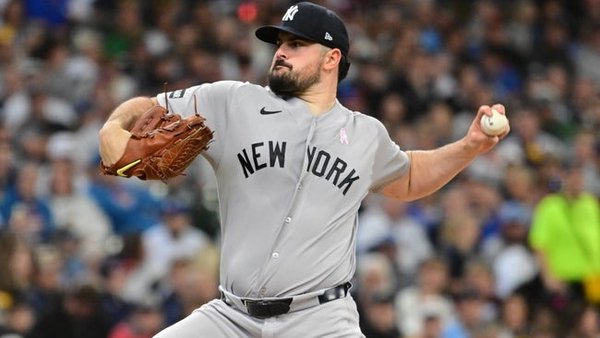
Carlos Rodon’s 1.19 WHIP and elite home run suppression (5 HR in 59 innings) paint a cleaner picture than Robbie Ray’s 1.30 WHIP and 20 home runs in 149 frames — yet the Yankees are priced at -106, barely a hair from even money. The matchup leans one direction; the market has not fully followed.
Carlos Rodon vs. Robbie Ray: New York Yankees at San Diego Padres Betting Preview
After Friday’s 3-2 extra-inning walk-off — Luis Campusano’s two-run shot off Paul Blackburn ending New York’s late bid — the series resets with fresh starters and a genuinely interesting pricing puzzle. The Yankees are listed at -106 on the road, making this essentially a coin-flip market. That number undersells what New York brings to the table tonight.
The core argument here is simple: the Yankees are a meaningfully better team — 80-61 against San Diego’s 74-67, a +114 run differential against the Padres’ +11, and a pitching staff with a 3.23 ERA and 1.17 WHIP that ranks among the better units in the league. When a team of this caliber is available at near-even money in a pitcher’s park, the process alone justifies the lean. This isn’t a strong conviction play; it’s a value play dressed as a pick-em.
The market is accounting for Petco Park’s suppressive environment, the Padres’ home-field edge, and Robbie Ray’s strong season numbers. Those are legitimate inputs. But the market also appears to be underweighting Carlos Rodon’s underlying quality and San Diego’s recent freefall — a team that’s gone 3-7 in their last 10 games, with a bullpen that just burned through extra innings last night.
Game Info & Betting Lines
- Date/Time: Saturday, September 5, 2026 | 7:15 PM ET
- Venue: Petco Park | Park Factor: 0.92 (pitcher-friendly)
- TV: MLB.TV, FOX
- Probable Starters: Carlos Rodon (NYY, 4-3, 3.20 ERA) vs. Robbie Ray (SD, 11-7, 3.14 ERA)
- Moneyline: Yankees -106 / Padres -113
- Run Line: Yankees -1.5 (+155) / Padres +1.5 (-189)
- Total: 8.0 (Over -102 / Under -118)
Why This Number Is Close — But Still Off
The market’s logic is defensible. Ray is 11-7 with a 3.14 ERA in 149 innings — a true workhorse with proven performance at scale. The Padres are at home in a park that actively suppresses run scoring. And after a walk-off win, there’s natural momentum on the San Diego side. Setting this near -110 for either team isn’t crazy.
But here’s the problem: the market seems to be treating raw ERA as the dominant signal when the underlying data points a different direction. Ray’s 1.30 WHIP is notably looser than Rodon’s 1.19 — that’s a consistent baserunner gap that compounds over nine innings. More importantly, Ray has allowed 20 home runs in 149 innings, a HR/9 rate around 1.21. Against a Yankees lineup that still features Ben Rice (.875 OPS, 36 HR) and Luis García Jr. (.862 OPS), that’s a real vulnerability.
The Yankees are also the better team by every macro measure, and the numbers project them to win 57.5% of the time — a meaningful gap from the implied probability of roughly 51.5% that -106 suggests. Getting 6 full points of implied probability for free, at juice this light, is where the value lives.
What Separates the Pitching
Both starters have ERAs clustered around 3.20, which is why the surface read says “even game.” The separation lives below that number.
Rodon’s arsenal leads with a four-seam fastball at 94.4 mph (44.9% usage, 21.4% whiff rate) paired with a slider that generates a 32.8% whiff rate and holds hitters to a .236 xwOBA — one of the more effective breaking balls in his division. His changeup sits at 37.5% whiff rate. The result is a pitcher who generates swings and misses in layers, and the 1.19 WHIP reflects clean, low-traffic innings. Most critically, 5 home runs allowed in 59 innings is an elite suppression rate — Rodon is not a fly-ball accident waiting to happen.
Ray brings the volume edge — 149 innings dwarfs Rodon’s 59 — and his slider (34.7% whiff rate, .334 xwOBA) and knuckle curve (34.9% whiff rate, .237 xwOBA) are legitimate swing-and-miss weapons. But his four-seam fastball and sinker generate concerning contact quality: .377 and .397 xwOBA respectively. Fernando Tatis Jr. carries a .428 xwOBA and a 36.6% hard-hit rate, but in 6 BvP plate appearances against Rodon he’s gone 0-for-6 with 3 strikeouts — a small sample that still suggests Rodon’s arsenal creates problems for San Diego’s best hitter. Manny Machado in 16 BvP plate appearances against Rodon is hitting .133 with 6 strikeouts. Meanwhile, Ray faces a Yankees lineup where Spencer Jones sits at a .487 xwOBA with a .523 xwOBA against left-handed pitching — the type of matchup that can flip an inning.
The gap isn’t massive, but it’s real: Rodon creates cleaner innings with fewer men on base, and his home run rate is dramatically better than Ray’s in a park that already plays small.
The Pushback
The concern I keep returning to is the Judge-Stanton absence. Aaron Judge and Giancarlo Stanton are both on the 60-Day IL — that’s the Yankees’ two most dangerous power threats, gone. The lineup Ben Rice leads is solid (.875 OPS, 36 HR from the DH spot is genuinely impressive), but it’s a different animal than New York’s full-strength construction. Luis García Jr. at .862 OPS helps, but the middle of this order doesn’t carry the same ceiling it did in April.
The bullpen situation also deserves honest treatment. Last night’s loss went to extra innings, and Paul Blackburn absorbed the losing decision in the tenth — but Blackburn is a spot starter type, not one of New York’s primary late-inning arms. David Bednar and the core relievers weren’t significantly taxed. The bullpen concern is real but shouldn’t be overstated based on one extra-inning game where the primary relievers got through their innings cleanly.
San Diego’s home-field advantage in a pitcher’s park is a legitimate factor too. Petco Park’s 0.92 run factor means this game is already playing in a context that slightly compresses margins. The Padres won here last night and know this environment.
These are all real inputs. I’m not dismissing them. They’re also already priced into -106, which is essentially what makes this interesting rather than obvious.
Angles I’m Avoiding
The run line at Yankees -1.5 (+155) is tempting juice for a team I think wins the game, but the projected score is essentially even — 4.2 to 4.1 — and backing a team to win by multiple runs when the margin is expected to be razor-thin is a losing process regardless of the payout. I’ll pass.
On the total, the Over at -102 is priced fairly for a projected 8.3-run game, but Petco’s suppressive environment and two pitchers with ERAs in the low 3.00s make me want more cushion than a half-run projected overage before I lay juice. The Under at -118 is too expensive for a spot where the starting pitching on both sides could easily falter. I’m leaving both total sides alone.
Run Environment & Game Shape
With a projected total of 8.3 against a posted line of 8.0, both sides of the total are essentially fairly priced. The park factor of 0.92 and two starting pitchers operating in the low-3.00 ERA range set up a game that figures to stay tight through six or seven innings before the bullpens take over. San Diego’s relievers absorbed some workload in extra innings last night, but the Yankees’ primary arms came through relatively fresh.
The Yankees hold a +114 run differential to San Diego’s +11 — a gap of 103 runs over the course of the season. That’s not a marginal edge; it’s the kind of sustained performance gap that reflects genuine roster-wide quality on both sides of the ball. In a low-scoring environment where one big inning can decide things, the team with deeper run-prevention infrastructure has a real edge. Rodon’s 5 home runs allowed in 59 innings becomes even more meaningful at Petco, where the park already suppresses fly balls. The game shape favors the Yankees: a tight, low-scoring contest where pitching quality and bullpen depth matter more than lineup ceiling — and New York wins that comparison even without Judge and Stanton.
Bet: Yankees ML -106 | 1 unit | Lean