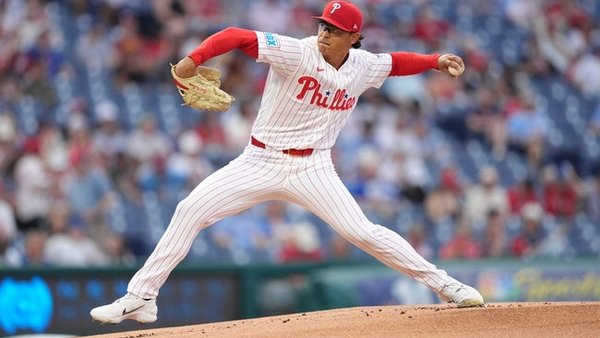
Cam Schlittler’s 2.20 ERA and 0.96 WHIP represent a clear tier above Jesus Luzardo’s 3.43 ERA — yet the Yankees are priced at plus money on the road. A 100-run differential gap between these clubs and three Phillies relievers on the IL point firmly in one direction; the moneyline hasn’t followed.
Cam Schlittler vs. Jesus Luzardo: New York Yankees at Philadelphia Phillies Betting Preview
The public sees this game and gravitates toward the home team. The Phillies are at Citizens Bank Park, they have Schwarber and Harper in the middle of the order, and they’re only a game behind New York in the standings. That narrative sells. But the moneyline at +104 on the Yankees is telling a different story — one where a team with a better record, a better run differential, and a significantly better starting pitcher is available at plus money because they’re the road club.
The real driver here is the pitching gap and what it costs to ignore it. Cam Schlittler at 2.20 ERA and 0.96 WHIP over 123 innings is not a fluke — that’s one of the better rate-stat profiles in baseball right now. Jesus Luzardo has been solid, but his 3.43 ERA and 1.21 WHIP over 115.1 innings is a tier below. The market has compressed that gap to roughly a run-and-a-quarter in implied value. I don’t think that compression is warranted.
Layer in the Phillies’ depleted bullpen — Trivino, Banks, and Keller all on IL — and the Yankees’ superior team pitching ERA (3.38 vs. 4.27), and a plus-money line on New York starts to look like genuine value rather than a market gift with strings attached.
Game Info & Betting Lines
- Date/Time: Friday, July 24, 2026 | 6:45 PM ET
- Venue: Citizens Bank Park — Park Factor 1.02 (slight hitter-friendly lean)
- TV: Apple TV
- Probable Starters: Cam Schlittler (NYY, 9-6, 2.20 ERA) vs. Jesus Luzardo (PHI, 9-4, 3.43 ERA)
- Moneyline: New York Yankees +104 / Philadelphia Phillies -122
- Run Line: New York Yankees -1.5 (+164) / Philadelphia Phillies +1.5 (-200)
- Total: 8 (Over +100 / Under -122)
Why This Number Is Off
The market is doing its job — it’s pricing in home field, the Judge absence, and the Phillies’ lineup depth. Those are legitimate inputs. A 56-47 home team with Schwarber and Harper in the middle of the order deserves to be favored at -122. That part of the math makes sense.
But here’s where the line slips: the Phillies are carrying a -15 run differential on the season. That’s a team that has been outscored overall, which is the kind of number that gets buried beneath a solid record and a loud home crowd. The Yankees sit at +88 in run differential — a gap of over 100 runs between these two clubs. That’s not a coin-flip roster gap. That’s a team that’s been consistently better at both ends of the game.
The market is balancing two real concerns — Judge on the IL and the road-team tax — against what should be a cleaner pitching edge than the -122/-104 spread suggests. The numbers project the Yankees to win this game 54.9% of the time. At +104, the implied probability is just 49%. That 5.9-point gap in win probability translates directly to positive expected value. The line isn’t dramatically wrong, but it doesn’t need to be — it just needs to be off by enough to make the play worth it at two units.
What Separates the Pitching
Schlittler and Luzardo are both strikeout-heavy starters, but their profiles create entirely different game textures. Schlittler’s four-seam fastball sits at 93.7 mph with a 21.8% whiff rate and a .296 xwOBA against — he’s not overpowering hitters with elite velocity, he’s generating weak contact and keeping the ball in the park (12 HR allowed in 123 innings). His sinker at 25.7% usage holds a 17.6% whiff rate and .351 xwOBA, working as a ground-ball complement. The curveball, while used sparingly at 4.5% of pitches, is a genuine put-away weapon at 36.1% whiff rate and .253 xwOBA. Against Schlittler, you’re dealing with a pitcher who creates innings without stress — soft contact, low walk rate (25 BB in 123 IP), and a 0.96 WHIP that reflects how rarely he puts himself in trouble.
Luzardo’s arsenal is built differently. His sweeper is elite — 36.6% usage, 47.8% whiff rate, and a .185 xwOBA against, which is a genuinely premium offering. His 97.0 mph four-seam sits at 24.3% usage but holds a softer 13.1% whiff rate, meaning hitters can make contact when he leaves it up. The concern with Luzardo is his 37 walks in 115.1 innings — that 1.21 WHIP reflects real traffic. Against a Yankees lineup that draws walks (382 BB on the season), his tendency to issue free passes creates scoring opportunities even without Schwarber-level power.
Ben Rice’s xwOBA of .465 against left-handed pitching (.428 vsLHP) makes him the key mismatch in this lineup — a 30-HR bat who the numbers love against Luzardo. Goldschmidt’s 12-PA BvP sample (.333, 2K) is too small to lean on, but his .445 xwOBA against lefties is a real number. The Phillies’ best threats against Schlittler are concentrated at the top: Schwarber carries a .533 xwOBA and a .544 mark against lefties specifically, which is a genuine mismatch the Yankees have to manage. Harper’s 10 BvP plate appearances against Schlittler went hitless with 4 strikeouts — a sample worth noting even if it’s small.
The Pushback
Aaron Judge on the 60-Day IL is not a footnote — it’s the central reason this line exists at +104 instead of -115. A lineup without its best hitter is a real liability, and I’m not going to wave that away. The Yankees are posting a .735 OPS as a team, which is respectable but not elite, and the top of the order without Judge means Rice and Goldschmidt are carrying more weight than usual in a ballpark with a 1.02 park factor.
The counterweight is Luzardo himself. His 11.2 K/9 and that 47.8% sweeper whiff rate are legitimate neutralizers for a lineup that already strikes out at a high clip (917 SO on the season). If Luzardo is on — commanding that sweeper, keeping his walk rate in check — the Yankees’ offense could go quiet in ways that make the moneyline sweat. That concern tips me back to New York only because the bullpen asymmetry is real: Trivino, Banks, and Keller all missing from Philadelphia’s relief corps is a structural problem that compounds in close games, and late-inning leverage is where the Yankees’ superior ERA (3.38 vs. 4.27) shows up most clearly.
On the bullpen side, Fernando Cruz’s blown save against Pittsburgh — allowing two hits and two walks while getting just one out in the 10th — is a reminder that the Yankees’ relief corps isn’t without its own risk. That’s a genuine concern. But the Phillies’ bullpen situation is structurally worse, and that asymmetry matters when you’re backing a team at plus money.
Angles I’m Passing On
Yankees -1.5 (+164): The projected final lands at 4.3-4.2, Yankees. That’s not a coin flip — but it’s also not a cover-by-two outcome. A one-run edge in projected score doesn’t justify buying into a run line that requires winning by at least two. Pass.
Under 8 (-122): The total of 8 looks tight given a projected 8.6 combined runs, but laying -122 on the under when both bullpens carry meaningful risk is the wrong side of the juice. The over at +100 has appeal if you want to play the total, but it’s not where I’m putting my units tonight.
The Pick
The Yankees at +104 represent a genuine 5.9-point win-probability edge over the implied market price. That’s not a dramatic mispricing, but it doesn’t need to be — it just needs to be consistent with a two-unit play in a spot where the pitching gap, the run differential contrast (+88 vs. -15), and the Phillies’ bullpen depth issues all point the same direction. That’s not a coin flip, that’s a price the public is getting wrong.
Bet: New York Yankees Moneyline +104 — 2 units