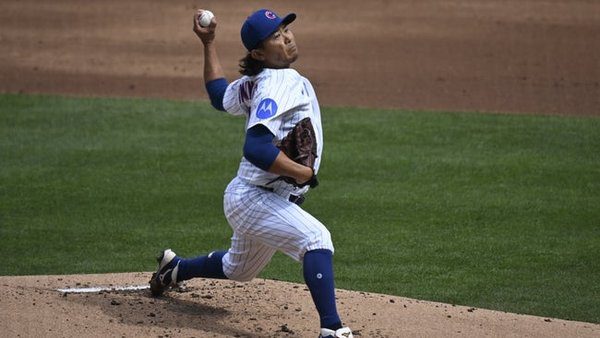
First glance at Saturday night’s matchup between Chicago and Cleveland, and it doesn’t feel right about forcing a play when both starting pitchers have been absolutely torched through their first starts of the season.
Shota Imanaga vs Slade Cecconi: Chicago Cubs at Cleveland Guardians Betting Preview
The market is asking us to pick a side when Shota Imanaga has posted a 7.20 ERA and Slade Cecconi owns a staggering 12.46 ERA through their opening starts. While the Cubs sit as moderate road favorites at -143, this line feels more like a dart throw than a handicap when you’re dealing with two arms who’ve combined to allow nearly 20 runs per nine innings.
Yes, sample sizes are microscopic in early April. But when you layer in key injuries to both lineups and bullpens, plus the inherent volatility that comes with trying to project outcomes from such chaotic starting pitching, this game screams variance rather than edge. The market is pricing in some level of normalization from both starters, but that’s a massive assumption when dealing with such extreme early-season struggles.
Game Info & Betting Lines
- Date/Time: Saturday, April 4, 2026 at 7:15 PM ET
- Venue: Progressive Field (Park Factor: 0.98 – slight pitcher advantage)
- Probable Starters: Shota Imanaga (0-1, 7.20 ERA) vs. Slade Cecconi (0-1, 12.46 ERA)
- Moneyline: Cubs -143 / Guardians +119
- Run Line: Guardians +1.5 (-149) / Cubs -1.5 (+123)
- Total: 8 (Over -108 / Under -112)
Why This Number Feels Like a Coin Flip
The market is trying to balance the Cubs’ slightly less horrific pitching performance (7.20 ERA vs 12.46) against Cleveland’s home field advantage and the general unpredictability that comes with such small samples. You can make a case that Imanaga simply had one bad outing and should revert closer to his established baseline, while Cecconi’s 12.46 ERA represents something closer to his actual skill level.
But here’s the problem with that logic: we’re dealing with 5 innings from Imanaga and just 4.1 innings from Cecconi. Neither sample tells us anything meaningful about what to expect Saturday night. The line is essentially the oddsmakers’ best guess about talent evaluation, not a reflection of demonstrated 2026 performance. When you’re handicapping based on projection rather than evidence, the edge gets thin quickly.
What Separates the Pitching
The comparative analysis here is more about degrees of concern than identifying clear advantages. Imanaga has allowed 4 earned runs over 5 innings with a 1.60 WHIP, while Cecconi has been tagged for 6 earned runs in just 4.1 frames with a 2.08 WHIP. Both pitchers are striking out batters at decent clips (12.6 K/9 for Imanaga, 10.4 K/9 for Cecconi), which suggests the stuff isn’t completely broken.
The key difference might be command. Cecconi has walked 3 batters in 4.1 innings compared to Imanaga’s 2 walks in 5 innings. In a pitcher-friendly environment like Progressive Field, that marginal control advantage could matter. But we’re talking about microscopic sample sizes where a single bad sequence can completely flip the narrative. When both pitchers have allowed home runs at concerning rates, you’re looking at arms that are currently creating chaotic innings rather than predictable outcomes.
The Pushback
The strongest case for making a play here is that early-season ERAs are notoriously unreliable, and both pitchers likely settle into more normal performance ranges. Imanaga showed enough in his limited 2025 sample to suggest real talent, while Cecconi’s strikeout numbers indicate he’s not completely overmatched. Progressive Field’s 0.98 park factor should help both starters, and the Cubs’ injury to Seiya Suzuki removes their most dangerous hitter from the equation.
The concern is that we’re essentially betting on regression to the mean without knowing what that mean actually is for either pitcher in 2026. Add in the Guardians’ bullpen injuries to Hunter Gaddis and Carlos Hernandez, plus the Cubs missing key reliever Porter Hodge, and you have compromised depth on both sides. That creates additional late-game uncertainty that makes projecting final scores even more difficult.
Run Environment & Game Shape
The market expects a moderate-scoring affair with the total set at 8 runs, which feels reasonable given Progressive Field’s slight pitcher-friendly reputation. However, when you have two starters who’ve combined for a 9.83 ERA, that environment becomes completely unpredictable. The park factor might save both teams from complete blowouts, but it’s not going to mask poor command or hittable stuff.
The likely scoring range feels enormous here – anywhere from 5 total runs if both pitchers suddenly find their form, to 12+ runs if the early-season struggles continue. That kind of variance makes it nearly impossible to identify a reliable edge on either the side or the total. You’re essentially betting on which version of these struggling starters shows up, and that’s more lottery ticket than sound handicapping.
Joe Jensen’s Pick
JENSEN’S PICK: PASS — 0 Units
I looked at the Cubs moneyline based on Imanaga’s marginally better performance, but a 7.20 ERA isn’t exactly a foundation for confidence. The run line seemed tempting with Cleveland getting 1.5 runs at home, but when you can’t project with any confidence whether this game goes 6 innings or 12, laying runs either direction becomes a guessing game. The total appears equally unpredictable – the under makes sense given the park, but not when both starters have been getting shelled.
This is one of those spots where the market uncertainty reflects actual handicapping uncertainty. When both starting pitchers have posted ERAs in the stratosphere and key players are missing due to injury, the smart play is to wait for a better spot. I’m not confident enough in either side to risk units on what amounts to early-season chaos.