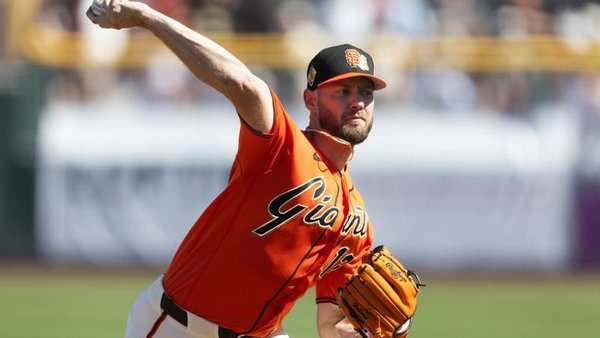
The Giants’ bullpen depth creates a late-game edge that the moneyline doesn’t reflect. Philadelphia’s recent road struggles against left-handed starters add another layer to this pricing inefficiency.
Andrew Painter vs Adrian Houser: Philadelphia Phillies at San Francisco Giants Betting Preview
The market has settled on Philadelphia as a modest road favorite at -120, and on paper, that looks about right. Both starters sport identical 1.69 ERAs through their first starts, both teams are navigating the early-season variance, and Oracle Park’s pitcher-friendly environment suggests a tight game. But when you peel back the numbers, Andrew Painter and Adrian Houser have reached the same destination through vastly different routes.
The Phillies just had their four-game win streak snapped in Colorado, but that offensive explosion against the Rockies — including a 10-1 blowout — showed this lineup can capitalize when facing inferior pitching. Meanwhile, the Giants have stumbled to a 3-7 start with a concerning -25 run differential, getting swept at home by the Mets in their most recent series.
The question isn’t whether both pitchers can continue their early success, but which approach is more sustainable when the small sample size regression arrives.
Game Info & Betting Lines
- Date/Time: Monday, April 6, 2026 | 9:45 PM ET
- Venue: Oracle Park (Park Factor: 0.92)
- Probable Starters: Andrew Painter (PHI) vs Adrian Houser (SF)
- Moneyline: Philadelphia -120 / San Francisco +100
- Run Line: San Francisco +1.5 (-171) / Philadelphia -1.5 (+141)
- Total: 8 (Over -105 / Under -115)
Why This Number Is Close
The market is balancing several legitimate factors that make this line reasonable. San Francisco gets the standard home field advantage, and Oracle Park’s 0.92 run factor creates an environment where marginal pitching differences get amplified. The Giants’ recent struggles mask the fact that they’re still playing at home with a veteran starter who’s posted solid numbers early on.
The case for San Francisco centers on Houser’s experience and the Giants’ desperation after getting swept by the Mets. Sometimes early-season home dogs provide value when the market overreacts to small sample sizes, and a veteran like Houser could easily outpitch the young Painter in a hostile environment.
But here’s where I think the market is missing something: those identical ERAs are masking a significant process gap. Painter’s 13.5 K/9 rate compared to Houser’s 6.75 K/9 suggests completely different approaches to getting outs. Painter is dominating hitters with pure stuff, while Houser is relying on contact management and defense. In a pitcher’s park like Oracle, the guy who can generate swings and misses has a clear edge over the one depending on his teammates to make plays behind him.
What Separates the Pitching
The tale of these two starters lies in their contrasting profiles, despite the matching ERAs. Painter’s 0.9375 WHIP versus Houser’s 1.5 WHIP tells the real story — Painter is preventing baserunners at an elite rate while Houser is allowing traffic but escaping damage. That’s a sustainable advantage for Painter, especially when you consider his dominant strikeout rate.
Houser’s approach relies heavily on inducing weak contact and getting help from his defense. His 6.75 K/9 rate means he’s putting the ball in play frequently, trusting his fielders to convert outs. That works until it doesn’t, and early-season defensive alignment issues can quickly turn routine plays into base hits. Meanwhile, Painter’s ability to generate strikeouts at nearly double Houser’s rate means he’s controlling outcomes independent of his defense.
The control aspect is equally telling. Both pitchers have walked just one batter, but Painter’s higher strikeout rate means he’s working deeper into favorable counts and putting hitters away with authority. Houser’s contact-heavy approach in Oracle Park could work, but it requires precision location and defensive execution. Against a Phillies lineup that just scored 10 runs in Colorado and has shown the ability to capitalize on mistakes, that margin for error becomes razor-thin.
What separates these innings is predictability — Painter creates strikeouts through stuff, while Houser creates outs through circumstance. In a tight game where one mistake can be decisive, I’ll take the pitcher who doesn’t need help.
The Pushback
The sample size concern is legitimate — we’re evaluating 5.1 innings each, which is statistically meaningless for establishing true talent. Painter could regress quickly as a young pitcher making his second start, especially in a hostile road environment where inexperience gets exposed. Early-season variance can humble dominant starters overnight.
There’s also San Francisco’s desperation factor. After getting swept at home and starting 3-7, the Giants need to salvage something from this homestand. Home teams facing must-win situations often find ways to grind out victories, and Houser’s veteran presence could provide stability that trumps pure stuff metrics. Oracle Park’s pitcher-friendly dimensions favor experienced arms who know how to work within their environment.
The Pick
Despite the valid concerns about sample size, I’m backing process over circumstances. Painter’s strikeout rate reflects genuine swing-and-miss stuff that translates across different environments and situations. When you’re getting nearly twice the strikeouts of your opponent, you’re creating sustainable advantages that don’t depend on defense, park factors, or game situation management.
The WHIP differential reinforces this edge — Painter’s superior command creates fewer scoring opportunities, while Houser’s contact-heavy approach leaves more room for big innings. Against a Phillies lineup that just demonstrated its ability to capitalize on mistakes in Colorado, that traffic Houser allows could prove costly.
Take Philadelphia Phillies -120. The market is pricing these pitchers as equals based on matching ERAs, but the underlying metrics suggest Painter holds decisive advantages in the areas that matter most for road favorites looking to control tight games.