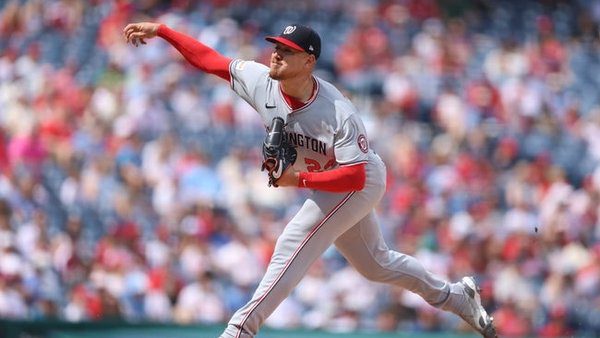
The pitching matchup screams one-sided advantage — yet the moneyline is still treating this like a coin flip. When obvious talent gaps don’t move betting lines, sharp money usually follows.
Matthew Liberatore vs Cade Cavalli: St. Louis Cardinals at Washington Nationals Betting Preview
The Cardinals roll into Nationals Park riding a solid pitching performance from Matthew Liberatore (1.64 ERA), but they’re facing a Washington offense that just exploded for six runs in the eighth inning Monday night. The Nationals are averaging 6.4 runs per game compared to St. Louis’s 4.6, yet the line treats this as essentially a pick ’em at -112.
Opening week numbers can be deceiving, but Washington’s offensive advantage runs deeper than small sample noise. They lead in every meaningful category — .277 average versus .222, .457 slugging versus .353, and 64 total runs versus 46. That’s not variance; that’s a fundamental difference in offensive capability that yesterday’s comeback only reinforced.
Game Info & Betting Lines
- Date/Time: Tuesday, April 7, 2026 at 6:45 PM ET
- Venue: Nationals Park (Park Factor: 0.98)
- Probable Starters: Matthew Liberatore (1.64 ERA) vs Cade Cavalli (2.79 ERA)
- Moneyline: Cardinals -108 / Nationals -112
- Run Line: Nationals +1.5 (-184) / Cardinals -1.5 (+151)
- Total: 7.5 (Over -108 / Under -112)
Why This Number Is Too Close
The market is balancing Liberatore’s pristine 1.64 ERA against Washington’s offensive surge, and I understand the hesitation. A sub-2.00 ERA pitcher getting plus money on the road feels like found money, especially when the home team’s pitching staff carries a bloated 6.24 ERA.
But the line is giving too much credit to Liberatore’s early results while undervaluing the stark offensive disparity. Washington has scored 64 runs in 10 games — that’s elite production through the early going. The Cardinals managed 46 runs in the same span, and their .657 team OPS suggests those struggles aren’t random.
The market sees two teams with similar records — St. Louis at 5-5 and Washington at 4-6 — and splits the difference. What it’s missing is that Washington’s offense has already proven it can explode against quality pitching, as evidenced by Monday’s six-run eighth inning rally.
What Separates the Pitching
The surface stats favor Liberatore significantly — his 1.64 ERA versus Cavalli’s 2.79 tells a clear story. But dig deeper and you find concerning peripherals for the Cardinals lefty. Liberatore’s 3.27 K/9 rate is alarmingly low, suggesting he’s not missing bats consistently. Against a Washington lineup that’s clicking at .808 OPS, that lack of strikeout stuff becomes problematic.
Cavalli counters with a much healthier 7.45 K/9, indicating better swing-and-miss ability. Yes, his 2.79 ERA is higher, but his ability to generate strikeouts gives him tools to work around trouble. His control remains a question mark with 5 walks in 9.2 innings, but against a Cardinals offense that’s managed just 46 runs while striking out 82 times, those occasional free passes become manageable.
The betting angle here isn’t just about ERA comparison — it’s about how these pitchers create outs. Liberatore is relying on weak contact and defense behind a Cardinals team that’s scored just 4.6 runs per game. Cavalli has the swing-and-miss ability to limit damage when Washington’s offense gives him run support.
The Pushback
Here’s what keeps me from going heavier: the Cardinals just proved Monday they can score when needed, putting up six runs in what became a slugfest. That offensive showing, combined with Liberatore’s genuinely impressive 1.64 ERA, suggests this game could stay closer than Washington’s season averages indicate.
There’s also legitimate concern about Cavalli’s control issues — five walks in 9.2 innings could spell trouble against a Cardinals lineup desperate to find baserunners. And with both bullpens struggling early, this game could turn into a different animal entirely once the starters exit.
But I keep coming back to the fundamental offensive gap. Washington has shown sustained scoring ability across 10 games, not just one explosive inning. Their lineup depth gives them multiple ways to break through against a pitcher who isn’t missing enough bats to consistently escape trouble.
Run Environment & Game Shape
Nationals Park’s 0.98 park factor keeps this from becoming a complete launching pad, but both offenses have shown they can score regardless of environment. The market expects a moderate-scoring game around 7.5 runs, which feels reasonable given the pitching matchups.
This projected run environment actually helps Washington’s case. In a game where both teams figure to score 3-5 runs, the team with the superior offensive depth and recent momentum holds the edge. Washington just demonstrated they can manufacture runs in bunches — exactly what you want in a tight, pitcher-friendly setting where one big inning often decides the outcome.
Joe Jensen’s Pick
JENSEN’S PICK: Washington Nationals Moneyline -112 — 2 Units
I looked at the run line here, but Cavalli’s control issues and the Cardinals’ ability to score (as shown Monday) make me hesitant to lay 1.5 runs. The moneyline captures the offensive edge without requiring a blowout that may not materialize.
This is about backing the significantly better offense at home after they just proved their ceiling. Washington’s 6.4 runs per game versus St. Louis’s 4.6 represents a meaningful gap that the -112 price doesn’t fully reflect. I’m projecting Washington 6, St. Louis 4, and while I’m not going maximum units due to the early-season context, this number feels off by 15-20 cents.