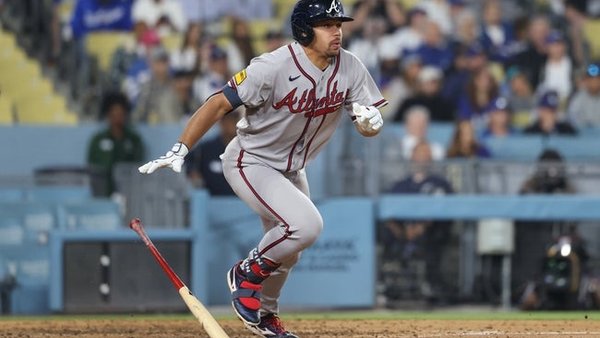
Atlanta’s superior team ERA and offensive depth point one way — the moneyline at +106/-124 treats this like a coin flip. The market appears focused on Chicago’s recent streaks rather than the underlying metrics that favor the home side.
Colin Rea vs Grant Holmes: Chicago Cubs at Atlanta Braves Betting Preview
The market has this essentially even — Chicago Cubs at +106, Atlanta Braves at -124 — despite the Braves holding clear statistical advantages across multiple categories. Atlanta leads in team OPS (.784 vs .764), runs scored (228 vs 215), and most notably team ERA (3.14 vs 3.81). The Cubs are coming off consecutive shutout losses that ended their second 10-game winning streak of the season, while the Braves took two of three from the Dodgers over the weekend.
What makes this number interesting is the market’s apparent focus on Chicago’s hot streaks rather than the underlying metrics that suggest Atlanta should be laying more chalk here. The Braves’ superior offensive production and significantly better pitching infrastructure create value on the home side at a price that feels too generous.
Game Info & Betting Lines
- Date/Time: Tuesday, May 12, 2026 | 7:15 PM ET
- Venue: Truist Park (Park Factor: 1.01)
- Probable Starters: Colin Rea (4-1, 4.03 ERA) vs Grant Holmes (2-1, 4.34 ERA)
- Moneyline: Chicago Cubs +106 / Atlanta Braves -124
- Run Line: Atlanta Braves -1.5 (+158) / Chicago Cubs +1.5 (-192)
- Total: 9 (O -105 / U -115)
Why This Number Is Too Close
The market is balancing Chicago’s recent hot streaks — they had two 10-game winning streaks in a 23-game span — against Atlanta’s superior baseline metrics. The Cubs’ resilience is real, and they’ve shown they can get hot quickly, which explains why this line isn’t wider despite the Braves’ advantages.
But the market appears to be overweighting Chicago’s recent success while undervaluing the regression that’s already begun. Those back-to-back shutouts in Texas represent exactly the kind of offensive drought that was bound to hit after unsustainable run creation. Meanwhile, Atlanta’s offensive depth led by Matt Olson (1.031 OPS) and Drake Baldwin (.892 OPS) creates more consistent run-scoring upside than Chicago’s balanced but lower-ceiling lineup.
The Braves’ team ERA advantage of nearly 0.70 runs is significant and sustainable — their pitching infrastructure from rotation through bullpen is demonstrably stronger than what Chicago brings.
What Separates the Pitching
Grant Holmes‘ dominant slider sits at the heart of his arsenal, used 36.7% of the time at 85.0 mph. The Statcast data shows this pitch limiting opposing hitters to just a 0.287 xwOBA — an excellent mark that demonstrates true swing-and-miss ability against Chicago’s contact-oriented approach. To put that in perspective, an xwOBA under 0.300 represents elite performance for any pitch, meaning Holmes’ slider consistently neutralizes opposing hitters. His 94.4 mph four-seam pairs effectively with that slider, sitting 34.7% of his arsenal. Holmes has the higher WAR (0.17 vs 0.04) despite a slightly higher ERA, suggesting better underlying performance.
Colin Rea relies heavily on his 39.3% four-seam at 93.8 mph, but it’s been hit hard (.367 xwOBA against) and generates only 13.5% whiffs. His split-finger (16.1% usage) provides swing-and-miss with 34.2% whiffs, but Atlanta’s lineup has shown ability to handle secondary offerings. Rea’s sinker has been particularly vulnerable (.466 xwOBA), and the Braves’ power threats like Olson and Baldwin can exploit mistakes in the zone.
The transition from Holmes’ elite slider performance to Rea’s struggles highlights the key pitching mismatch. Holmes’ ability to miss bats with that dominant slider creates specific problems for Chicago’s low-strikeout approach, while Rea’s fastball-heavy arsenal plays directly into Atlanta’s offensive strengths. When you combine Holmes’ superior underlying metrics with his proven swing-and-miss weapon, the pitching edge clearly favors the home side.
The Pushback
The concern is Chicago’s proven ability to bounce back from adversity — they’ve already shown twice this season they can rattle off 10-game winning streaks when things click. Road favorites have been profitable against Chicago, but that suggests the market has been undervaluing their opponents, not that the Cubs can’t compete.
Both starting pitchers have similar ERAs and the game could easily go either way given the close pitching matchup on paper. Holmes’ higher walk rate (17 vs 12) creates more traffic, and Chicago’s patient approach could work counts and get to the Atlanta bullpen earlier than expected. The Cubs also have the better recent momentum despite the shutouts — those Texas games might have been an aberration rather than a trend.
That said, I keep coming back to the fundamental gap in team quality. Atlanta’s run differential (+87 vs +47) reflects consistent dominance, while Chicago’s hot streaks appear more variance-driven than sustainable excellence.
Run Environment & Game Shape
The 9-run total at Truist Park (1.01 park factor) suggests the market expects a pitcher-friendly game with tight margins. Both teams have solid pitching metrics, but Atlanta’s offensive consistency should create more reliable scoring opportunities than Chicago’s recent struggles indicate.
This environment favors the team with better offensive depth and more reliable starter, which points to Atlanta. In close, low-scoring games, the Braves’ superior bullpen ERA and overall pitching infrastructure become magnified advantages. The game shape likely features multiple lead changes but Atlanta’s ability to score in bunches gives them the edge in late innings.
Joe Jensen’s Pick
JENSEN’S PICK: Atlanta Braves Moneyline -124 — 2 Units
I looked at Atlanta Braves -1.5 at +158, but the math is tight — too many recent games decided by exactly 1. The moneyline captures Atlanta’s edge without requiring a multi-run margin in what projects as a close game.
I considered the over given both teams’ offensive capabilities, but the recent Cubs cold streak creates too much uncertainty about their run production. The moneyline play captures the value in this essentially pick’em price while avoiding the variance of margin-dependent bets in what should be a tight, well-played game.