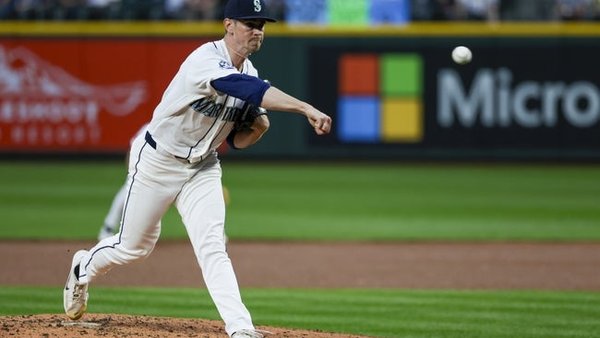
The pitching matchup heavily favors Seattle with Hancock’s 9.39 K/9 rate — the 7.5 total still treats this like both arms are equals.
Sean Burke vs Emerson Hancock: Chicago White Sox at Seattle Mariners Betting Preview
After yesterday’s 2-1 Seattle victory in the series opener, the pitching matchup shifts significantly toward the home team’s advantage. Emerson Hancock brings a 3.02 ERA and dominant 9.39 K/9 rate to the mound against Sean Burke, whose 4.10 ERA masks some decent underlying metrics but still represents a clear step down in quality. The market has this total at 7.5, acknowledging both teams’ offensive limitations, but T-Mobile Park’s 0.92 run factor and the starter gap create conditions for an even lower-scoring affair than the number suggests.
Both lineups continue to struggle with key injuries — Seattle missing Brendan Donovan and Cal Raleigh, Chicago without Everson Pereira and Austin Hays. The White Sox have played better baseball lately at 7-3 in their last 10, but their .235 team average and .734 OPS remain problematic against quality pitching. Seattle’s offense isn’t much better at .229/.696, setting up a pitcher-driven contest in one of baseball’s most pitcher-friendly environments.
Game Info & Betting Lines
- Date/Time: Wednesday, May 20, 2026 | 4:10 PM ET
- Venue: T-Mobile Park (0.92 run factor)
- Probable Starters: Sean Burke (2-3, 4.10 ERA) vs Emerson Hancock (3-2, 3.02 ERA)
- Moneyline: Chicago White Sox +130 / Seattle Mariners -154
- Run Line: Seattle Mariners -1.5 (+136) / Chicago White Sox +1.5 (-164)
- Total: 7.5 (O -110 / U -110)
Why This Number Is Close But Catchable
The 7.5 total reflects the market’s recognition of both teams’ offensive struggles and the pitching-friendly venue. Seattle ranks just 26th in runs per game at 4.16, while Chicago sits slightly better at 4.51 but has been ice-cold recently. The line-setters also factored in T-Mobile Park’s run suppression and the general early-season trend toward lower-scoring games.
But here’s the problem with the market’s calculation: it’s treating Burke and Hancock as roughly equivalent arms when the performance gap is substantial. Hancock’s 9.39 K/9 rate with just 10 walks in 53.2 innings represents elite control that Burke simply can’t match. The concern is Burke’s mediocre 4.10 ERA could actually play up better in this park against Seattle’s weak lineup, making the game closer than the starter gap suggests.
The market is pricing this as a 7-8 run environment, but the combination of Hancock’s dominance, T-Mobile’s suppression factor, and both teams’ offensive limitations points toward something in the 6-7 range.
What Separates the Pitching
The starting pitcher matchup heavily favors Seattle, but not in the way most expect. Hancock’s elite control stands out immediately — his 9.39 K/9 rate with just 10 walks in 53.2 innings creates a strikeout-to-walk ratio that Burke can’t approach. Hancock’s four-seam fastball sits at 95.0 mph with a 25.7% whiff rate, but his real weapon is a devastating sweeper that generates a 39.3% whiff rate and holds hitters to just .140 xwOBA.
Burke presents a more contact-oriented profile with his 7.63 K/9 rate, relying on a four-seam fastball (38.2% usage, 94.2 mph) and knuckle curve combination. His slider generates a solid 29.2% whiff rate, but the overall arsenal lacks the put-away quality that Hancock possesses. Burke’s 1.18 WHIP versus Hancock’s 1.01 tells the story of two pitchers operating at different levels of precision.
The matchup data reveals why this pitching gap matters for run scoring. Chicago’s top-of-order hitters show concerning whiff rates against Hancock’s arsenal — Derek Hill whiffs at 27.5% and strikes out 29.2% of the time, while Colson Montgomery’s 30.5% strikeout rate makes him vulnerable to Hancock’s sweeper. Conversely, Seattle’s better contact hitters like Josh Naylor (.714 average in 9 PA against Burke historically) and Julio Rodriguez (who homered off Burke previously) have shown they can solve Burke’s more predictable patterns.
The Pushback
The risk is Burke’s 4.10 ERA doesn’t tell the full story — his underlying metrics suggest some bad luck that could correct in a pitcher-friendly park. Seattle’s offense has been equally problematic, managing just 4.16 runs per game, and key injuries to Donovan and Raleigh have removed their most consistent contact threats. Burke’s knuckle curve could actually play up well against Seattle’s aggressive approach.
That said, what works against this theory is Chicago’s recent offensive surge during their 7-3 stretch. Miguel Vargas (.860 OPS) and Colson Montgomery (.848 OPS) have provided more consistent run production than their season numbers suggest. The flip side of that is Seattle’s pitching staff owns a 3.69 team ERA that ranks among the American League’s best, creating a significant mismatch when Hancock hands the ball to their bullpen.
The concern is early-season variance cutting into any edge — small sample sizes mean one bad inning from either starter could push this game over the number regardless of the underlying matchup quality.
Run Environment & Game Shape
T-Mobile Park’s 0.92 run factor creates a natural ceiling on offensive output, particularly when both lineups struggle with consistency. The market expects a tight, low-margin contest, likely in the 4-3 or 5-3 range based on the current pricing. Hancock’s dominance suggests he can keep Chicago to 2-3 runs through six innings, while Burke’s contact-heavy approach in a pitcher-friendly park should limit Seattle’s explosive potential.
The game shape favors patient at-bats and manufacturing runs rather than power-driven offense. Both teams rank in the bottom third in home runs, making this more about situational hitting and pitching execution than big innings. The park’s dimensions and marine layer effect should suppress any borderline fly balls that might escape in more hitter-friendly environments.
Joe Jensen’s Pick
JENSEN’S PICK: Under 7.5 (-110) — 2 Units
The pick is Under 7.5 (-110), meaning the combined score must stay under 7.5. I considered Seattle Mariners -1.5 at +136, but laying runs leaves no margin for a late bullpen wobble — I’d rather take the moneyline. The moneyline at -154 exceeds my juice threshold, making it unplayable despite the starter advantage.
This projects as a 4-3 type contest where Hancock’s elite control and T-Mobile’s run suppression create too many obstacles for consistent offensive output. Both teams have shown they can’t consistently string together rallies, and the pitching quality gap favors the type of efficiency that keeps runs off the board rather than creating separation on the scoreboard. I’m moderately confident at 2 units — not going heavier because Burke’s variance and early-season unpredictability create enough uncertainty to limit exposure, but the combination of park, pitching, and offensive limitations makes this number catchable.