Brady Singer has surrendered 14 home runs in 46 innings — a 2.74 HR/9 rate — and now faces a Cardinals lineup that battered this Reds staff for eight runs in Sunday’s first game, all inside a park playing 10% above league average for scoring. The market has Cincinnati at -120, a number that prices in home-field uncertainty around Brycen Mautz but doesn’t fully account for the structural damage Singer’s sinker-heavy arsenal invites in this environment.
Brycen Mautz vs. Brady Singer: St. Louis Cardinals at Cincinnati Reds Betting Preview
The market has Cincinnati as a modest favorite at -120, which makes sense on paper — home field, momentum from a gritty 11-inning win in Game 2 of yesterday’s twin bill, and facing a Cardinals starter in Brycen Mautz with almost no scouting data attached to his name. That’s the public case for the Reds, and it’s not nothing.
But the pitching gap here is substantial and in St. Louis’s favor in a way the line doesn’t fully price in. Singer’s 2026 season has been a slow-motion disaster — a 6.26 ERA, 14 home runs allowed in 46 innings, and a -0.3 WAR — and he’s getting the Cardinals at a park that plays 10% above league average for run scoring. That combination is dangerous for a pitcher who already leads the sport in home-run vulnerability. Getting St. Louis at +102 against arguably the most hittable starter they’ll face all season is where the value lives.
Yesterday’s loss on the over (9.5) in this series is a reminder that even obvious run environments don’t always deliver on cue. Today, I’m staying away from the total and focusing on which team wins the game outright.
Game Info & Betting Lines
- Date/Time: Sunday, May 24, 2026 | 1:40 PM ET
- Venue: Great American Ball Park (Park Factor: 1.10 — hitter-friendly)
- Probable Starters: Brycen Mautz (STL) vs. Brady Singer (CIN, 2-4, 6.26 ERA)
- Moneyline: Cardinals +102 / Reds -120
- Run Line: Cardinals +1.5 (-192) / Reds -1.5 (+155)
- Total: 9.5 (Over -122 / Under +100)
Why This Number Is Off
The market is doing legitimate work here. Cincinnati is at home, they just won a comeback 11-inning game to split the doubleheader, and Mautz is a virtual unknown at the major-league level. Books price that uncertainty into the away starter, and that’s fair. The Reds also have genuine lineup pop — Elly De La Cruz (.288/.884, 12 HR) and Sal Stewart (.256/.840, 12 HR) can punish any starter, and De La Cruz crushed a three-run homer in the nightcap. Home teams in hitter-friendly parks with an offense of this caliber deserve chalk status most days.
But the concern isn’t with Cincinnati’s lineup — it’s with their starter. Singer’s underlying Statcast data tells an even grimmer story than his ERA. His primary weapon is a 91.2 mph sinker thrown 47.4% of the time that produces an xwOBA of .373 against. His true secondary pitch is a slider thrown 33.4% of the time — it carries a 25.1% whiff rate and a .323 xwOBA, which is his best contact-suppression offering at meaningful volume. He also deploys a sweeper at just 10.8% usage; while it posts his highest individual whiff rate at 34.8%, it’s a tertiary offering rather than a primary weapon, and it bleeds hard contact when it doesn’t miss — xwOBA of .418 against. His cutter is a liability at .577 xwOBA. Singer gets grounders but he can’t miss bats consistently, he can’t escape barrels, and in a park that inflates runs, that formula has disaster written into it.
The numbers say St. Louis wins this game 63.1% of the time. At +102, that’s a 17-point implied probability gap — that’s where the bet lives.
What Separates the Pitching
The honest version of this analysis starts with the fact that Brycen Mautz is a wildcard. His Statcast arsenal shows a pitcher who works with a mid-90s four-seam and sinker combination, leans heavily on a slider with a 36.9% whiff rate and a .297 xwOBA against, and mixes a curveball that generates 37.8% whiffs and an outstanding .237 xwOBA — suggesting real swing-and-miss potential when located. His cutter has a .174 xwOBA against in limited usage. If the secondary stuff plays, he can suppress this Reds lineup. The Reds’ top-of-order hitters are predominantly right-handed, and Mautz’s curveball and slider could generate problems for a lineup that’s not used to seeing that profile.
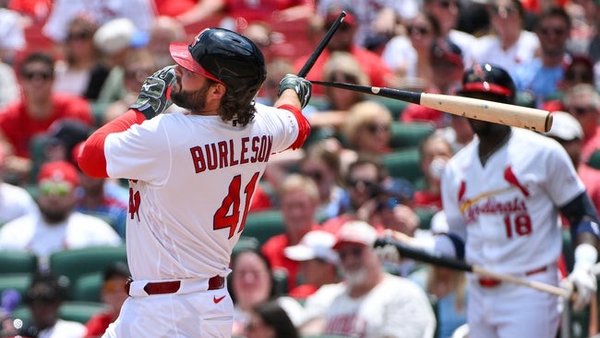
Against Singer, the Cardinals’ lineup presents a specific mismatch problem. Jordan Walker hit two home runs across yesterday’s doubleheader and carries elite underlying numbers — a .482 xwOBA and an 8.2% barrel rate, with a 32.3% hard-hit rate that profiles well against a sinker-heavy attack. That said, the BvP history is worth flagging directly: Walker is 0-for-7 with 4 strikeouts against Singer in this small sample. That’s not something you can dismiss, and it cuts against any narrative that he has a favorable track record against this specific pitcher. What Walker brings here is general profile — the ceiling of a bat that can punish soft sinker contact — not a demonstrated history of feasting on Singer. Alec Burleson (xwOBA .439, .453 vs. right-handers) has gone 3-for-7 with a home run against Singer in his BvP sample and represents the cleaner individual matchup edge in this lineup. Ivan Herrera sits at .373 xwOBA overall. The Cardinals hit right-handers well as a unit, and Singer’s arsenal gives them a profile they can attack at the team level even where individual BvP is mixed.
Singer’s 2.74 HR/9 rate in 2026 isn’t a fluke — it’s baked into the pitch design. A sinker with below-average velocity and an xwOBA of .373 against in a 1.10 park factor environment is a structural problem, not a hot streak. St. Louis has 60 team home runs and the lineup construction to exploit a pitch-to-contact, low-whiff starter who has no reliable chase offering. The starter gap here is real and meaningful.
The Pushback
The strongest case against this play starts with Mautz. There is essentially no meaningful major-league data available. A favorable arsenal profile means nothing if he can’t locate, and in a hitter-friendly environment against a lineup that includes De La Cruz (.486 xwOBA, 9.7% barrel rate) and Sal Stewart (.439 xwOBA, 7.9% barrel rate), any mechanical issues get punished fast. Cincinnati also comes in with genuine emotional momentum — they won a game in walk-off fashion in the 11th inning last night and are playing in front of a home crowd that watched them battle back from a 5-1 deficit. That’s not nothing, and it’s worth pricing into the confidence level here.
Singer’s walk rate is also a stabilizing factor worth noting. With 12 walks in 46 innings (2.35 BB/9), he’s not walking himself into trouble — his damage comes from contact, not from free passes loading bases for inevitable meltdowns. There’s a version of this game where his sinker-heavy approach produces soft grounders and the Cardinals strand runners instead of clearing the bases. That’s a legitimate downside path.
On the total: I considered the over given the park, Singer’s ERA, and the combined offensive profile, but Mautz’s variance cuts both ways. If he’s sharp, this game could stay well under 9.5. The over is not the play I want to be in with that kind of uncertainty on one half of the pitching equation. I’m passing on the total entirely.
Run Environment & Game Shape
Great American Ball Park playing at a 1.10 park factor means an average game here scores about 10% more runs than a neutral site. Stack that against a pitcher with a 6.26 ERA and 14 home runs allowed in 46 innings, and you get a run environment that structurally favors the team doing the attacking — which is St. Louis. The Cardinals are 29-22 on the season with 60 team home runs, and they come in having scored eight runs off this staff in Game 1 of yesterday’s twin bill.
Cincinnati’s bullpen is also worth flagging as a liability in a close game. The Reds’ relief corps is already depleted, with Emilio Pagan on the 15-Day IL with a hamstring injury. That’s a meaningful piece of their late-game infrastructure unavailable, which matters in exactly the kind of tight game where Singer hands a lead over to a shorthanded pen and things unravel.
The shape of this game favors St. Louis winning outright: a vulnerable starter at a hitter-friendly park, a short bullpen, and a Cardinals lineup coming off an eight-run output 24 hours ago. The price at +102 is the opportunity.
Bet: Cardinals Moneyline +102 — 2 units, moderate confidence.
Singer’s structural vulnerabilities at Great American Ball Park are real and persistent, Walker’s elite underlying numbers represent the ceiling of what this lineup can do even with mixed individual BvP, and Burleson’s 3-for-7 sample with a homer is the cleaner matchup edge. Mautz’s unknown status tempers the confidence level, but getting the better pitching matchup team at plus money in this environment is the right side of the line.