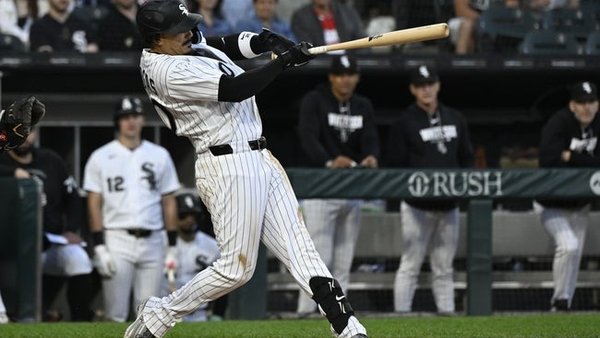
Detroit arrives as -120 favorites on the back of a starter with 5.2 career innings — a sample so thin that his 1.59 ERA is noise, not signal. The White Sox carry a meaningfully stronger offense (.727 OPS, 75 HR) and are priced as plus-money home underdogs at +102, a number that treats unknown rookie volatility as solved information.
Troy Melton vs. Erick Fedde: Detroit Tigers at Chicago White Sox Betting Preview
The market has set Detroit as a modest -120 favorite, and on paper that’s defensible — the Tigers have the better projected starter by ERA, and Fedde has been among the worst starters in baseball this season. But ERA comparisons only hold when one of the pitchers actually has a real ERA. Melton has thrown 5.2 career innings. His 1.59 ERA is a number in the same way a single coin flip can “prove” a coin is two-headed. It is meaningless as a predictive input.
The real frame here is: a bad pitcher versus an unknown one, with the better offensive team catching a road squad in freefall. Detroit is 4-18 since May 4, has lost seven consecutive series, and is limping into Chicago with a devastated roster. The White Sox, meanwhile, just took three of four from Minnesota, including a 15-2 blowout and a 6-2 win Thursday behind Davis Martin’s sixth straight winning decision.
Getting Chicago at +102 — actual plus money on the home team with the better record, the better offense, and the power to torch a rookie — is the core of this value argument. Yesterday’s loss on the Detroit moneyline is a reminder that form and roster depth matter, and Detroit keeps proving the point.
Game Info & Betting Lines
- Date/Time: Friday, May 29, 2026 — 7:40 PM ET
- Venue: Guaranteed Rate Field (Park Factor: 0.98 — neutral)
- Probable Starters: Troy Melton (DET) vs. Erick Fedde (CHW)
- Moneyline: Detroit Tigers -120 / Chicago White Sox +102
- Run Line: Chicago White Sox +1.5 (-166) / Detroit Tigers -1.5 (+138)
- Total: 8.5 (Over -105 / Under -115)
Why This Number Is Off
Detroit’s -120 price is built on the assumption that Melton’s roster spot means something, and that Fedde’s 5.47 ERA is the dominant signal. Both assumptions have problems. The market is essentially pricing this as a slight Tigers edge on pitching, which would be fair — if Melton had thrown more than one and two-thirds starts’ worth of innings against major league competition.
The legitimate case for Detroit: their pitching ERA of 4.03 is respectable despite the terrible record, and Riley Greene (.468 xwOBA, .835 OPS) and Dillon Dingler (.463 xwOBA) are legitimate threats against a leaky starter. The Tigers can score — they dropped six runs on the Angels earlier this week before falling apart in extras.
But here’s the problem: the market appears to be weighting Melton’s sparkling ERA as real information, when it’s really just noise from a microscopic sample. The White Sox’s offensive metrics — .727 OPS, 75 HR, 262 runs scored — dwarf Detroit’s .686 OPS, 49 HR, and 218 runs. Chicago’s lineup is meaningfully better. Getting plus money on the stronger team at home, against a pitcher with no track record, is where the line is wrong.
What Separates the Pitching
Fedde has been genuinely bad. There’s no softening that. His 5.47 ERA and 1.46 WHIP over 49.1 innings reflect a starter who cannot miss bats — his 5.66 K/9 is below league average — and who has surrendered 12 home runs in less than 50 innings. His arsenal leans heavily on a sweeper that generates a solid 24.4% whiff rate and holds hitters to a .261 xwOBA, but his sinker is getting punished (.414 xwOBA) and his cutter is no better (.420 xwOBA). When hitters sit on that sinker/cutter combination up in the zone, they do damage. Detroit’s Greene and Dingler are exactly the right profile to exploit that — Greene sits at .468 xwOBA and Dingler at .463 xwOBA, both making hard contact at rates that should concern Chicago.
Melton’s arsenal data tells a different story than his ERA. His four-seam fastball sits 96.3 mph and draws just a 22.7% whiff rate, with a concerning .421 xwOBA against it — meaning hitters are making solid contact when they put it in play. His slider has been his best weapon (.143 xwOBA against), but he’s only thrown 79 total pitches in his career. The White Sox lineup presents an immediate stress test: Munetaka Murakami carries a .525 xwOBA and a 10.6% barrel rate, with a 36.9% hard-hit rate. His .547 xwOBA against right-handed pitching — exactly what Melton is — makes him the single most dangerous matchup on the field tonight. Colson Montgomery (.424 xwOBA) and Miguel Vargas (.410 xwOBA) add depth behind him. The gap isn’t that Fedde is good and Melton is bad — it’s that Fedde has a known floor and Melton has no established ceiling or floor at all.
The Pushback
The honest concern here is Fedde blowing this game open before the fifth inning. His 12 home runs allowed in 49.1 IP isn’t a fluke — it’s a pattern of leaving pitches in hittable zones. Detroit’s lineup, even decimated by injuries, features Greene’s .451 xwOBA against left-handed pitching (Fedde is right-handed, so that’s less relevant) and Dingler’s .490 xwOBA against righties, which is directly relevant. The Tigers can absolutely put up a crooked number against this starter.
The numbers also give Detroit a 55.8% win probability — a genuine edge that I’m not going to paper over. That projection is grounded in Melton’s peripheral data looking less disastrous than his opponent’s, and it deserves respect. This isn’t a fade of Detroit because they’re bad. It’s a fade of Detroit because the 55.8% implied by their price requires Melton to perform like a pitcher with real major league track record, and he simply doesn’t have one. The coin flip ERA works both directions — he could be legitimately good, or he could give up five runs in the second inning. The uncertainty is the point.
Joe Jensen’s Pick
I’m on the Chicago White Sox moneyline at +102 for 2 units. The numbers have Detroit favored, and I understand why — Fedde’s ERA is real and ugly. But +102 on the home team with a superior offense, against a starter with 5.2 career innings in the books, is the kind of price inefficiency worth pressing. The White Sox lineup — Murakami’s .547 xwOBA against righties, Montgomery’s .424, Vargas sitting at .410 — is built to punish a pitcher who hasn’t yet proven he can navigate a major league order a second or third time through. Fedde’s volatility is priced in. Melton’s volatility is not.
I also considered the run line — Chicago White Sox +1.5 at -166 — but the juice on the cushion is steep and the logic doesn’t hold up. Paying -166 for a 1.5-run cushion only makes sense if I’m confident this game stays close or Detroit wins by exactly one. But Fedde’s volatility cuts both ways: if he gives up an early crooked number, that +1.5 is irrelevant, and I’ve already paid a heavy premium. More to the point, Melton’s complete unknowability means Detroit can absolutely score off him — a rookie making his second or third career start, in a road environment, against a lineup this hot, is not a lock to keep it tight. The cleaner expression of this edge is the plus-money moneyline, where I’m getting paid above even money on the home team without sacrificing value to a run-line price that demands near-perfection from a starter nobody has a real read on.
Bet: Chicago White Sox Moneyline +102 — 2 Units