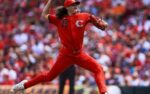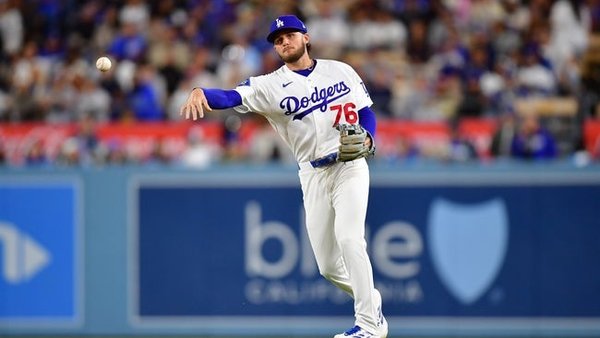
Yoshinobu Yamamoto’s 0.98 WHIP meets a Phillies offense posting a .675 OPS and a .293 OBP — a pairing that should suppress the run environment well below what the posted total of 9 implies. Painter’s 5.40 ERA keeps the Dodgers’ ceiling honest, but the combined pitching profile points to a game shape the market hasn’t fully accounted for.
Andrew Painter vs. Yoshinobu Yamamoto: Philadelphia Phillies at Los Angeles Dodgers Betting Preview
The conversation starts and ends with Yoshinobu Yamamoto on one side and Andrew Painter on the other. That is not a balanced matchup. The posted total of 9 suggests the market is pricing in more offensive contribution than either starter’s underlying numbers support, and that’s the entry point here.
The Dodgers are a -225 moneyline favorite in a game where the Phillies carry a -18 run differential for the season. LA’s offense checks in at a .785 OPS against Philadelphia’s .675 — a gap wide enough to matter in a neutral park. Dodger Stadium carries a park factor of 0.98, a subtle suppressive lean that compounds the pitching edge already baked into this game’s structure.
The market noise here is real: it’s a Sunday ESPN national game, these teams just split the first two, and Philadelphia punched the Dodgers in the mouth with a three-run eighth last night. That kind of momentum narrative can inflate totals. The number shouldn’t be at 9. The under is the play.
Game Info & Betting Lines
- Date/Time: Sunday, May 31, 2026 — 4:10 PM ET
- Venue: Dodger Stadium (Park Factor: 0.98 — slight run suppression)
- TV: ESPN Unlmtd, MLB.TV, Sportsnet LA, NBC Sports Philadelphia
- Probable Starters: Andrew Painter (PHI) vs. Yoshinobu Yamamoto (LAD)
- Moneyline: Philadelphia Phillies +188 / Los Angeles Dodgers -225
- Run Line: Los Angeles Dodgers -1.5 (-108) / Philadelphia Phillies +1.5 (-111)
- Total: 9 (Over -104 / Under -118)
Why This Number Is Off
The case for 9 isn’t irrational. Painter has been genuinely hittable — a 5.40 ERA and 1.46 WHIP in 50 innings is a legitimate concern for any total-setter. The Dodgers’ lineup posts a .785 OPS and has scored 305 runs on the season, so there’s a reasonable world in which LA hangs four or five runs on Painter before the fifth inning and the total never sweats. That’s the market’s logic, and it’s not wrong to respect it.
But here’s the problem: the market is weighing the Dodgers’ offensive ceiling against Painter’s floor and forgetting that Yamamoto essentially neuters the other half of the equation. The Phillies are posting a .225 team average and a .293 OBP — both rank near the bottom of the league in contact rate and on-base production. That profile plays directly into Yamamoto’s 8.3 K/9 and sub-1.00 WHIP. The combined total of 8.8 sits nearly a full run below the posted line, and the juice on the under at -118 tells you the market has already started drifting in this direction. We’re not fighting the line — we’re buying into a direction the market itself is already moving. The slight -118 price is not ideal, but it’s far from prohibitive on a two-unit play.
What Separates the Pitching
The gap between these two starters is substantial, and understanding how each creates innings is essential to framing the total.
Yamamoto enters this start at a 3.09 ERA, 0.9843 WHIP, and 59 strikeouts in 64 innings — numbers that reflect consistent, high-quality run prevention. His split-finger is his best weapon: thrown 28.1% of the time at 91.2 mph with a 36.9% whiff rate and a filthy .196 xwOBA against. When you’re generating contact that soft nearly a third of the time on your primary off-speed offering, you’re pitching to dominate, not just to survive. His sinker generates an elite 40.0% put-away rate with a .252 xwOBA — a legitimate swing-and-miss finishing pitch. His four-seam fastball sits at 95.7 mph with a 21.5% whiff rate, though it carries a .399 xwOBA against — roughly league average in isolation. That number matters: the four-seam isn’t dominant by itself. Yamamoto’s effectiveness comes from tunneling it with the splitter and sinker, making each pitch harder to identify out of the hand. It’s a system, not a single weapon. This is a pitcher who creates soft contact and early counts against a lineup that already struggles to make contact at all.
Painter is a different story. His four-seam fastball, thrown 37.9% of the time at 96.4 mph, is posting a .397 xwOBA against — hard to square with the velocity, but it explains the 5.40 ERA. His sinker is even worse at a .410 xwOBA. The slider (.263 xwOBA, 41.4% whiff) and split-finger (.205 xwOBA, 39.7% whiff) give him legitimate put-away options, but his ability to mix them effectively against a lineup as deep as Los Angeles is uncertain. Shohei Ohtani carries a .532 xwOBA against right-handed pitching this season. Andy Pages sits at .405 against righties. Freddie Freeman’s vsRHP xwOBA sits at .411, nearly identical to his .419 mark against lefties — he’s just a problem. The Dodgers are built to work counts and punish fastballs up, which is exactly what Painter throws most often.
The innings these pitchers create look nothing alike. Yamamoto creates three-pitch strikeouts and weak grounders. Painter creates labored counts, elevated pitch counts, and occasional multi-run frames.
The Pushback
The concern I keep coming back to is Painter’s blowup ceiling. A 5.40 ERA and 1.46 WHIP aren’t just surface-level noise — they reflect a starter who can crater in a single inning. If the Dodgers hang six or seven runs on him early, the under still likely cashes, because Yamamoto isn’t giving up six on his end. Even a Painter blowup scenario tends to produce a lopsided, low-total result rather than a genuine shootout. The Phillies don’t have the offensive depth to keep pace in a high-scoring game — their .675 OPS and .293 OBP are real constraints. A 7-2 game still goes under 9. A 5-3 game goes under 9. The only scenario that burns this ticket is a functional Painter — say, five innings, three runs — combined with the Dodgers bullpen leaking runs late. That’s a real risk, but it’s the minority outcome given the underlying numbers.
Run Environment & Game Shape
Dodger Stadium’s 0.98 park factor is a small but directionally consistent suppressor. Over a full season it doesn’t move needles dramatically, but in a game already projecting below the posted total, every fractional edge compounds. The Dodgers have scored 305 runs on the year, but their lineup is facing a pitcher — Painter — who has shown the ability to rack up strikeouts (40 Ks in 50 innings) even while getting hit hard. The Phillies, meanwhile, are sitting with a team OPS of .675 and a contact profile that ranks near the bottom of the league. Yamamoto doesn’t need run support to win this game, and the Phillies don’t have the depth to consistently manufacture multi-run innings against a pitcher operating with a sub-1.00 WHIP. The offense sitting in the lower third of the scoring spectrum amplifies Yamamoto’s edge further. Game shape here points to a pitching-dominant result — somewhere in the 4-3 or 5-2 range — well within the under threshold.
The Pick
Under 9 (-118) — 2 Units — Moderate Confidence
Yamamoto’s 0.9843 WHIP and 8.3 K/9 suppress the Phillies’ half of the equation — a lineup posting a .225 average and .293 OBP has no business putting up five or six runs against this pitcher. The Dodgers’ ceiling against Painter is real, but even a blowup scenario on that side likely produces a lopsided, low-total result rather than a genuine shootout. Dodger Stadium’s slight suppressive lean and the numbers pointing to a combined 8.8 total leave a full run of cushion. Back the under, two units.