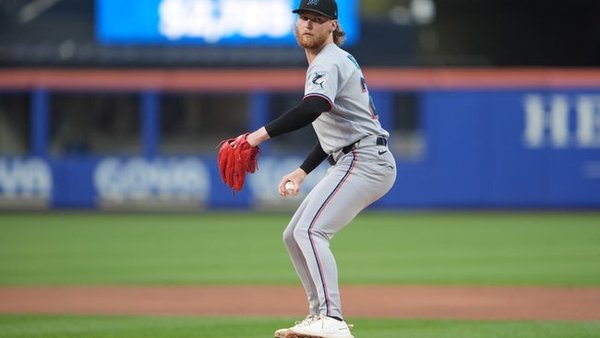
Max Meyer enters Wednesday’s contest at 5-0 with a 2.97 ERA and 66.2 innings of sustained excellence — then the market prices him at -108, identical to a Washington starter with just 15.2 MLB innings on the ledger. Nationals Park’s home-field edge and a dangerous Wood-Abrams tandem justify keeping the line close, but flat money on a genuine ace is a gap that doesn’t hold up under the numbers.
Max Meyer vs. Andrew Alvarez: Miami Marlins at Washington Nationals Betting Preview
Back-to-back 7-3 wins in this same series set the table for Wednesday’s matchup, and now the pricing inefficiency is even sharper. Miami comes in at -108, virtually even money, despite sending Max Meyer — a pitcher running a 2.97 ERA, 5-0 record, and 1.095 WHIP over 66.2 innings — against a Washington starter with just 15.2 innings of MLB experience this season. That is not a coin-flip pitching matchup. The market is treating it like one.
Washington has offensive weapons. James Wood (.952 OPS, 16 HR) and CJ Abrams (.926 OPS, 12 HR) are legitimate threats at the top of the order, and the Nationals’ team OPS of .743 outpaces Miami’s .696 by a meaningful margin. The home-field bump and lineup depth are real — this is why the line sits where it does. But when one team is running an ace and the other is rolling out a spot starter, flat money is a gift.
The core thesis is simple: the pitching gap is substantial, the price doesn’t reflect it, and the Marlins’ offense has been clicking against this exact Washington staff over the last two games. Miami at -108 is value.
Game Info & Betting Lines
- Date/Time: Wednesday, June 3, 2026 | 1:05 PM ET
- Venue: Nationals Park | Park Factor: 0.98 (slightly pitcher-friendly)
- Probable Starters: Max Meyer (MIA, 5-0, 2.97 ERA) vs. Andrew Alvarez (WSH, 1-0, 4.02 ERA)
- Moneyline: Miami Marlins -108 / Washington Nationals -108
- Run Line: Miami Marlins -1.5 (+155) / Washington Nationals +1.5 (-188)
- Total: 8.5 (Over +100 / Under -122)
Why This Number Is Off
The market has a legitimate argument for keeping this line flat. Washington is 31-31 with a 6-4 record over their last ten games and carries a home-field edge. Their lineup — Wood, Abrams, Curtis Mead (.855 OPS) — is genuinely dangerous. Andrew Alvarez has 17 strikeouts against just 5 walks in his 15.2 innings, and his curveball is generating a 30.6% whiff rate with an impressive .149 xwOBA against. The books aren’t setting -108 on a whim; there is a real case for Washington.
But here’s the problem: Alvarez’s slider — which he throws equally as often as the curve at 31.2% usage — is being absolutely crushed. That pitch carries a .533 xwOBA against and only a 19.0% put-away rate. That’s a pitch hitters are doing real damage on, and a Miami lineup that’s put up 14 runs in two games against this staff is not going to miss it. Meanwhile, Meyer’s 66.2 innings of sustained excellence is not a small sample. The market is pricing this like Alvarez’s curveball is enough to neutralize the gap. It isn’t.
At -108, you’re getting a legitimate ace at juice you’d expect on a replacement-level arm. The line is off because the market is balancing Alvarez’s upside against a live Marlins offense — but it’s underweighting the sheer distance between these two pitchers’ track records.
What Separates the Pitching
The gap between these two starters is the story of this game. Max Meyer is operating at an elite level this season. His slider — thrown 26.4% of the time at 90.2 mph — is generating a 40.9% whiff rate with a .316 xwOBA against. His sweeper, deployed just as frequently, holds hitters to a .257 xwOBA with a 34.5% whiff rate. His four-seam sits at 95.0 mph, and across 66.2 innings he’s allowed just 5 home runs — a contact suppression profile that matters enormously when facing a lineup built around power bats like Wood and Abrams.
Wood’s xwOBA against right-handed pitching is a frightening .619 with a 12.2% barrel rate — he is the single biggest threat to Meyer’s day. Abrams sits at a .414 xwOBA versus right-handers with a 24.6% whiff rate. Meyer’s swing-and-miss profile gives him the tools to navigate both, but Washington’s top of the order is not going to simply fold.
On the other side, Andrew Alvarez has thrown just 15.2 innings. His curveball is genuinely good — .149 xwOBA against is elite-tier contact suppression on that pitch. But his slider is a liability (.533 xwOBA), and his four-seamer at 92.5 mph is generating only a 4.5% whiff rate with a .374 xwOBA against. Miami’s lineup is built to punish exactly that — Heriberto Hernández carries a .436 season xwOBA and a .483 xwOBA against left-handed pitching, and Alvarez throws left. Kyle Stowers posts a .403 xwOBA overall with a .409 clip versus right-handers.
Meyer creates innings where weak contact piles up and strikeouts come in bunches. Alvarez creates innings where one bad pitch — particularly that slider — can define an at-bat. That’s the gap the -108 price doesn’t honor.
The Pushback
The honest concern here is that the numbers project Washington to win this game 4.4 to 4.3. That’s not a lean — that’s essentially a pick’em. When the same figures that are driving the bet recommendation also say the home team is slightly more likely to win, that friction deserves respect, not dismissal.
Washington’s offensive edge is real. Their team OPS of .743 versus Miami’s .696, combined with the home-field environment at Nationals Park, is what’s tilting the win probability toward the Nationals. The component breakdown shows a +0.467 home offensive advantage — that’s not noise. Wood and Abrams at the top of this lineup against a right-handed starter is a genuine threat, and Alvarez’s curveball could keep the Marlins off-balance long enough for the Washington lineup to do damage.
So why am I still on Miami? Because the starter component tells a different story: a -0.693 edge in favor of the away starter. That’s the biggest single factor in this game, and it’s pointing hard at Meyer. The win probability tilt toward Washington is real, but it’s being driven by lineup depth and home-field, not by the pitching matchup. When the price is -108 — essentially even money — I need the market to acknowledge the pitching gap, and it isn’t. That’s the inefficiency. The Nationals could win this game. But the price implies they should win it at roughly the same rate as the Marlins, and the pitching numbers say that’s wrong.
Rejected Angles
Run Line (Miami -1.5 at +155): Tempting, but I’m passing. The projected score of 4.4 to 4.3 Washington shows a razor-thin margin — there’s no cushion to confidently back Miami to win by two or more. Even if Meyer dominates, a one-run Marlins win covers the moneyline but loses the run line. At +155, the juice is attractive, but the projected separation doesn’t support it.
Total (Under 8.5 at -122): The combined projection of 8.8 runs sits above the posted total of 8.5, which actually leans Over on the numbers. Laying -122 on the Under in a game where the figures point slightly Over isn’t a spot I want. The Under juice is too steep for a number the data doesn’t clearly support, and the Marlins’ recent offensive output — 14 runs in two games — makes me uncomfortable hammering a low-scoring game script.
Run Environment & Game Shape
Nationals Park plays at a 0.98 park factor — effectively neutral, with a very slight lean toward pitchers. That’s not a meaningful thumb on the scale either direction, but it does suggest neither offense is getting a free gift from the dimensions. In a game projected at 8.8 combined runs, the environment fits: moderate scoring, nothing inflated.
The shape of this game hinges on how deep Meyer goes. If he gets through six or seven innings — entirely plausible given his 66.2-inning workload and 2.97 ERA — the Marlins’ bullpen advantage (run prevention component shows a -0.200 edge in Miami’s favor) becomes relevant in the late innings. Washington’s pen has carried a heavier load given their rotation’s injury situation, with Jake Irvin and Josiah Gray both on the IL alongside Ken Waldichuk.
Alvarez’s short track record is the X-factor for the Nationals. His 15.2 innings is a genuinely thin sample — his curveball might continue to miss bats, or Miami’s lineup might solve him the second time through the order. The longer he goes, the more his .533 xwOBA slider becomes a problem as hitters get additional looks. The more Meyer locks in early, the more his edge in whiff rate and contact suppression compounds against a Nationals lineup that — despite its offensive talent — strikes out at a nearly identical rate to Miami (504 SO versus 499). In a neutral park with a projected sub-nine-run total, the starter who limits damage in the first five innings shapes the game’s outcome, and the numbers say that starter is Meyer.
Pick: Miami Marlins Moneyline -108 | 2 Units