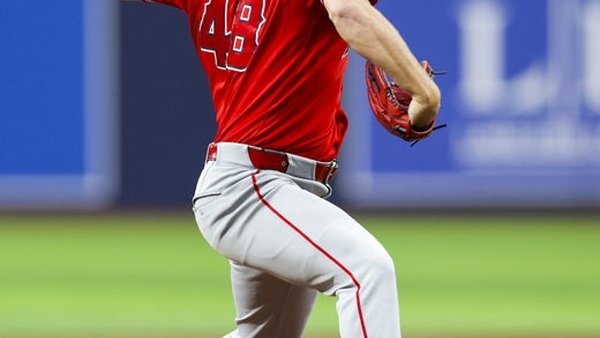
Angel Stadium’s 0.95 park factor already tilts against run production — then add Peter Lambert’s three home runs allowed all season and Reid Detmers’ 10.7 K/9, and two below-average, injury-depleted offenses face a double-barreled pitching context that the posted 8.5 total still may not fully account for.
Peter Lambert vs. Reid Detmers: Houston Astros at Los Angeles Angels Betting Preview
After Tuesday’s 10-1 Angels blowout, the instinct is to ride Los Angeles’s momentum and look for fireworks again. Resist that instinct. That game featured Walbert Ureña on the mound for the Angels and Kai-Wei Teng absorbing damage for Houston — a fundamentally different pitching context than what Wednesday brings. Tonight, Peter Lambert and Reid Detmers take the hill, and both are legitimate starters with quality profiles who have spent this season making opposing lineups uncomfortable.
The market has set the total at 8.5, pricing in the pitching matchup and the park. Angel Stadium carries a 0.95 park factor — a mild but consistent run suppressor. The numbers project just 8.6 combined runs (LAA 4.4, HOU 4.2), which is essentially a dead-heat confirmation of the posted number. The lean here is not about a dramatic market mispricing — it’s about finding the cleanest expression of a lean scoring environment when both offenses are below-average and both starters are capable of limiting damage deep into games.
The Under at -112 is the play. Not a hammer. A measured, moderate-conviction bet that reflects a genuine but marginal edge when the projection and the context both point the same direction.
Game Info & Betting Lines
- Date/Time: Wednesday, June 10, 2026 — 9:38 PM ET
- Venue: Angel Stadium (Park Factor: 0.95 — mild run suppressor)
- TV: MLB.TV, Space City Home Network, Angels.TV
- Probable Starters: Peter Lambert (HOU) vs. Reid Detmers (LAA)
- Moneyline: Houston Astros +104 / Los Angeles Angels -122
- Run Line: Los Angeles Angels -1.5 (+172) / Houston Astros +1.5 (-210)
- Total: 8.5 (Over -108 / Under -112)
Why This Number Is Close
The case for the Over is not hard to make. Both bullpens are mediocre — Houston carries a 4.90 team ERA and the Angels sit at 4.73. If either starter exits before the sixth inning, the relief corps for both clubs can surrender runs in clusters. Tuesday’s 10-1 blowout demonstrated that these Angels are capable of a ceiling game when everything clicks, and the Astros have shown they can scratch across multiple runs against the right opponent.
But here’s the problem with the Over: it requires the bullpens to actually blow up, which is a possibility but not a base case when both starters project to go five or six quality innings. The market has already priced in the pitching matchup — 8.5 is a modest number that acknowledges both rotations. The Under isn’t exploiting a naive market; it’s aligning with the projection when the juice (-112) is acceptable.
Where I think the market is very slightly soft is in the injury context. The Astros are missing catcher Yainer Diaz (oblique, IL), which disrupts lineup continuity and removes a reliable bat. The Angels are without Jorge Soler (oblique, IL) — a legitimate power threat gone from an already thin lineup. Neither team was punishing pitchers before these absences. Both teams carry negative run differentials on the season (HOU -37, LAA -43). The 8.5 total feels like the number the market had before fully accounting for how quietly depleted these offenses are right now.
What Separates the Pitching
Peter Lambert has been one of the more quietly effective starters in the AL this season — 3.55 ERA, 1.26 WHIP across 50.2 IP with only 3 home runs allowed all year. That HR suppression is meaningful at Angel Stadium, where the park factor already tilts away from power. Lambert’s 8.3 K/9 won’t overwhelm anyone, and his 25 walks in 50.2 innings represent genuine contact management risk — but his ability to limit extra-base damage projects well in this environment. The concern with Lambert is the limited sample: 50.2 IP is enough to form a thesis but not enough to declare variance fully smoothed out.
Reid Detmers has the more electric pure stuff — 10.7 K/9 with 88 strikeouts in 74 innings and a 1.14 WHIP that suggests he keeps baserunners in check. The gap between his 4.26 ERA and that WHIP points to a pitcher who generates weak contact but has allowed hard contact to score in clusters — 6 HR in 74 IP isn’t alarming, but it does reveal a vulnerability when he leaves pitches over the zone. Against an Astros lineup that features Yordan Alvarez (.311 AVG, 1.066 OPS, 22 HR) as its primary threat, that elevated contact can become expensive quickly.
The comparative gap here is real but nuanced. Detmers wins on strikeout rate — his ability to generate whiffs should limit Houston’s mid-lineup to fewer hard-contact sequences. Lambert wins on home run suppression — his profile at a non-hitter-friendly park means the Angels’ modest power production (77 HR on the season, OPS .702) gets further neutralized. Together, these are two arms that project to create low-leverage innings: lots of strikeouts, limited extra-base damage, and a combined game shape that trends toward the Under even before the park factor enters the equation.
Run Environment & Game Shape
An 8.5 total is one of the lower thresholds the market posts, and it still needs work to get there on Wednesday. Start with the park: Angel Stadium’s 0.95 run factor is not a dramatic suppressor, but it consistently shaves a fraction of run production relative to a neutral environment — and at the margins of an 8.5 number, fractions matter. Power hitters don’t get the same lift here that they would in a hitter-friendly environment, which is directly relevant given that Lambert has allowed only 3 HR all season and the Angels’ lineup is already missing Soler’s pop.
Layer the starter profiles on top of that. Lambert’s extreme HR suppression and Detmers’ elite strikeout rate create two distinct run-prevention mechanisms working in tandem. Lambert limits the ball in play from leaving the yard; Detmers limits the ball from being put in play at all. The result is a game shape that projects as low-scoring through at least five or six innings — and with both teams carrying thin, injury-depleted lineups and mediocre offenses to begin with (HOU OPS .728, LAA OPS .702), there’s no realistic source of sustained run production that justifies the Over in the early going.
The bullpen risk is real, but it’s symmetric — both relief corps are below average, which means neither side has a structural relief advantage that would tilt the game toward a blowout in one direction. Symmetric bullpen risk in a low-scoring game environment doesn’t push the total over; it just adds variance around an already-modest baseline. The Alvarez cluster risk for Detmers is the one scenario that could flip this game, but Detmers’ 10.7 K/9 gives him the tools to navigate that threat without catastrophic damage. The numbers point to a game that stays quiet, and the park and pitcher profiles both confirm it.
The Pick: Under 8.5 (-112), 2 units, moderate conviction. Two weak offenses, two legitimate starters, a mild run-suppressing park, and a pair of injury absences that quietly hollowed out each lineup’s best run-scoring insurance. The Under doesn’t need anything extraordinary to happen — it just needs this game to look like what the pitching matchup says it should.