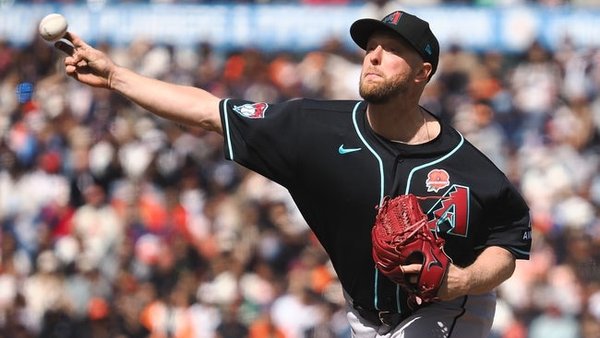
A 3.63-run ERA gap separates these two starters — the moneyline is treating it like a coin flip. Kelly’s four-seam fastball is generating a .493 xwOBA against, the Marlins have outscored Arizona 18-6 in this series, and the number still hasn’t moved to reflect it. The matchup leans hard one way; the price hasn’t followed.
Merrill Kelly vs. Tyler Phillips: Arizona Diamondbacks at Miami Marlins Betting Preview
The Marlins have outscored Arizona 18-6 across the first two games of this series. That isn’t noise — it’s the pitching gap expressing itself in real time. When the market prices a team at -112 despite that kind of series dominance and a historically lopsided starter matchup, the question isn’t whether there’s value. It’s whether the price is too good to be true.
The answer is that it isn’t. The line reflects genuine uncertainty about Merrill Kelly’s ability to implode early, Arizona’s power bats (Corbin Carroll’s .930 OPS, Ketel Marte’s 11 home runs), and the fact that the Marlins’ own run differential sits at -8 on the season despite the recent surge. The market is doing its job — pricing the chaos around a deteriorating starter honestly.
But the market still can’t fully price a 3.63-run ERA gap between two starters in the same game. That gap is the edge. Everything else is context.
Game Info & Betting Lines
- Date/Time: Thursday, June 11, 2026 | 1:10 PM ET
- Venue: loanDepot park (Dome) | Park Factor: 0.95 (slightly pitcher-friendly)
- Probable Starters: Merrill Kelly (ARI, 5-4, 5.71 ERA) vs. Tyler Phillips (MIA, 0-1, 2.08 ERA)
- Moneyline: Arizona Diamondbacks -104 / Miami Marlins -112
- Run Line: Miami Marlins +1.5 (-192) / Arizona Diamondbacks -1.5 (+158)
- Total: 8.5 (Over -114 / Under -106)
Why This Number Is Close
The market is pricing this essentially as a coin flip with a slight lean toward Miami, and there’s a legitimate case for that framing. Kelly has been punished this season, but Merrill Kelly is still a veteran who knows how to eat innings, and the Diamondbacks’ lineup — when healthy — carries real firepower. Carroll’s .930 OPS is elite. Marte’s 11 home runs remind you this isn’t a dead offense.
The case for Arizona is simple: Kelly doesn’t have to be good. He just has to be average for six innings and hand a lead to a bullpen that can stabilize. If he keeps the ball in the yard early, Arizona wins a low-leverage baseball game.
But here’s where the market is slightly wrong: Kelly’s home-run rate of 2.00 HR/9 in a dome isn’t a blip — it’s a systemic execution problem. His four-seam fastball is generating an xwOBA of .493 against, which means hitters are absolutely teeing off when it’s in the zone. At 91.8 mph with a 12.3% whiff rate on his primary pitch, Kelly is offering very little deception. The market sees the coin flip. The Statcast profile sees a starter who is genuinely below replacement level (-0.3 WAR) being handed to a lineup that has scored 10 and 8 runs in consecutive games against this same organization.
-112 isn’t a gift, but it’s a fair price on a significantly better pitching situation.
What Separates the Pitching
The gap between these two starters is not subtle. Tyler Phillips carries a 2.08 ERA and a 1.32 WAR across 43.1 innings. Merrill Kelly sits at a 5.71 ERA and -0.3 WAR across 58.1 innings. One starter is actively hurting his team’s chances of winning; the other is one of the more underrated arms in the National League right now.
The arsenal explains the gap. Phillips leans heavily on three pitches that generate elite miss rates: his sweeper (40.3% whiff, .251 xwOBA against), his split-finger (35.6% whiff, .256 xwOBA against), and his curveball, which is his most devastating offering at a staggering 49.3% whiff rate and .329 xwOBA. He backs those offspeed weapons with a 95.9 mph sinker that generates weak contact. His four-seam, used only 7.6% of the time, sits at 96.6 mph — he deploys it sparingly and as a surprise weapon. The result is a starter who generates soft contact and limits barrels in a park that already suppresses offense.
Kelly’s profile is nearly the inverse. His primary pitch — the four-seam fastball at 26.6% usage — generates a .493 xwOBA against. Even his best pitch, the slider (39.2% whiff, .256 xwOBA), is being used only 12.3% of the time. His changeup shows a 28.3% whiff but a .419 xwOBA, meaning even when hitters miss it, when they make contact it’s hard contact. Otto Lopez, who has gone 5-for-7 (7 PA) against Kelly and leads the majors in batting average at .341, is precisely the kind of high-contact, line-drive hitter who punishes Kelly’s flat fastball.
The innings these starters create are fundamentally different. Phillips creates quick outs, strand situations, and low-leverage late innings for the Miami bullpen. Kelly creates traffic, elevated pitch counts, and the kind of mid-game chaos that leads to six-run innings — exactly what happened in game one of this series.
The Pushback
The strongest counter to this play isn’t Arizona’s offense — it’s Kelly’s volatility working against the bet rather than for it. If Kelly is truly as erratic as the numbers suggest, there’s a real scenario where he exits in the third inning and the Arizona bullpen stabilizes the game, compressing the final score in a way that makes the Marlins’ underlying advantage irrelevant. A 3-2 or 4-3 game decided by one swing from Carroll or Marte is not outside the range of outcomes here.
Carroll’s .930 OPS is genuinely elite, and his .428 xwOBA and 33.0% hard-hit rate mean he can change the shape of any inning with one at-bat. Marte’s .415 xwOBA and 11 home runs mean Arizona’s 1-2 punch at the top of the order can manufacture runs even against a pitcher as efficient as Phillips. Neither of those guys folds quietly.
The other real pushback is Miami’s season-long run differential. A -8 mark isn’t alarming, but it’s a reminder that the Marlins’ recent 7-3 stretch is a hot streak, not a structural identity shift. Hot streaks end, and they sometimes end in the exact game where you’ve bet the most into them.
None of that changes the bet, but it does shape the sizing. The run line at -192 is juice I’m not willing to absorb — the implied probability on that number requires a margin of victory I’m not confident enough to pay that price for. The total at 8.5 is legitimately in play given Kelly’s HR rate, but I’d rather have the clean win equity than the over/under swing. The moneyline at -112 threads the needle: I’m getting positive expected value on a clearly superior pitching matchup without over-leveraging a specific run total outcome.
Run Environment & Game Shape
The 0.95 park factor at loanDepot park works directly in Phillips’s favor. He’s a contact-suppression pitcher — heavy sinker, elite sweeper, devastating curveball — and a slightly pitcher-friendly dome amplifies that profile. The total sitting at 8.5 with the over juiced to -114 suggests the market has already priced Kelly’s run-allowance risk into the number, which is exactly why the moneyline at -112 is the better vehicle. You’re capturing the win equity without paying the over premium.
The likely game shape here is a front-loaded, lopsided affair if Kelly falters early — which his pitch-count history and .493 four-seam xwOBA suggest is the percentage outcome. If the Marlins get to Kelly in the first three innings the way they did in Game 1 (six-run fourth, 8-0 final) and Game 2 (four-run eighth, 10-6 final), Phillips only needs to be efficient through five or six innings before Miami hands it to a bullpen that has been largely reliable during this hot stretch. The Arizona bullpen, meanwhile, has been absorbing heavy workloads after Kelly’s recent short outings, which could compound run-prevention issues in the middle frames if this game opens up early. Both teams carry injury-depleted rosters, but Miami’s pitching depth — even with multiple arms on the IL — has held up better over the last ten games. Game shape favors a Marlins lead through six, protected by Phillips’s ability to manufacture quick outs against a lineup that, while dangerous at the top, drops off sharply from the 5-hole down.
The Pick
The 3.63-run ERA gap between these starters is the entire argument. Phillips at 2.08 ERA and 1.32 WAR against Kelly at 5.71 ERA and -0.3 WAR, inside a dome that suppresses the very contact Kelly is already giving up at an alarming rate, on a team riding a 7-3 stretch with genuine momentum — that combination at -112 is a price I’m comfortable backing.
Bet: Miami Marlins Moneyline (-112) — 2 units — Moderate Confidence
The thesis is straightforward: a 3.63-run ERA gap between starters doesn’t resolve itself in Arizona’s favor at a coin-flip price, and Miami’s series momentum reinforces rather than inflates that edge. Two units on the Marlins ML at -112 keeps the exposure sensible while capitalizing on a matchup the market has priced more generously than it should have.