Truist Park’s 1.01 park factor strips away any venue-driven inflation, leaving the 9.5 total to stand entirely on two depleted rosters and a pair of starters with elevated WHIPs. Atlanta is missing Acuña and Farmer, San Francisco’s outfield is patchwork, and projections land closer to 9.2 combined — a gap that’s thin but consistent once the roster reductions are factored in.
Robbie Ray vs. JR Ritchie: San Francisco Giants at Atlanta Braves Betting Preview
The market has set this total at 9.5, essentially pricing in an average-to-above-average scoring game for a matchup featuring two starters with elevated WHIPs and modest strikeout profiles. That feels about half a run generous. The numbers project this at 9.2 combined — a small but real gap that becomes meaningful when the context tilts under.
The core argument here isn’t about Atlanta’s dominance or San Francisco’s futility. It’s about run environment. Truist Park plays almost perfectly neutral at a 1.01 park factor — no Coors-style inflation to push the number higher. The projected score of 4.8 to 4.4 lands at 9.2 combined. When the gap is thin, context matters, and the context tilts under: Atlanta is missing Ronald Acuña Jr. (hamstring, 10-Day IL) and Kyle Farmer (forearm, 10-Day IL), the Giants’ lineup is depleted, and neither starter is built to create high-run-output innings.
The Atlanta moneyline at -148 exceeds my hard juice ceiling. The edge is real, but it’s best expressed through the number rather than the outright winner.
Game Info & Betting Lines
- Date/Time: Wednesday, June 17, 2026 | 7:15 PM ET
- Venue: Truist Park | Park Factor: 1.01 (neutral)
- TV: MLB.TV, NBC Sports BA, BravesVision, Gray Media
- Probable Starters: Robbie Ray (SF) vs. JR Ritchie (ATL)
- Moneyline: San Francisco Giants +126 / Atlanta Braves -148
- Run Line: Atlanta Braves -1.5 (+138) / San Francisco Giants +1.5 (-166)
- Total: 9.5 (Over +102 / Under -124)
Why This Number Is Slightly Off
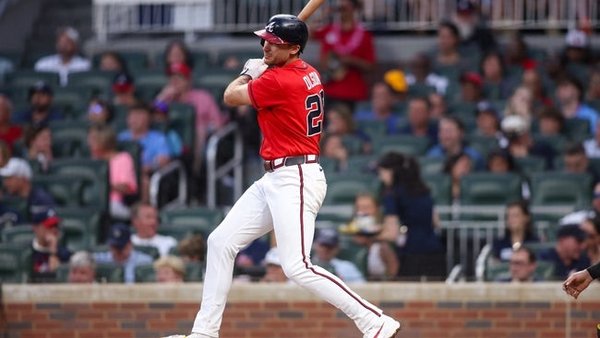
The market is balancing two legitimate forces pulling in opposite directions. On one side, Atlanta’s offense is genuinely dangerous — 95 home runs, 359 runs scored, and a lineup anchored by Matt Olson (.270/.894 OPS, 20 HR) and Drake Baldwin (.303/.931 OPS, 13 HR). Robbie Ray’s 4.42 ERA and 1.39 WHIP invites contact and doesn’t project as a shutdown presence against a Braves lineup that ranks among the NL’s most productive. The over at +102 is essentially a coin flip on the total — the market isn’t strongly leaning one way, which tells you sharp money hasn’t found a clear consensus.
On the other side, the Giants are one of the more offensively limited clubs in baseball — 29-43, -56 run differential, a .258/.309/.416 slash line — and they’re facing a Braves pitching staff that carries a 3.29 ERA and 1.184 WHIP, among the best in the National League. Atlanta’s run-prevention advantage is significant. The Giants have been held to one run or fewer in two of their last three games.
Where the market is slightly wrong: it’s treating this like a typical Atlanta home game without fully accounting for the lineup reductions on both sides. Acuña and Farmer being out shrinks Atlanta’s ceiling. The Giants’ depleted outfield — Heliot Ramos and Harrison Bader both on IL — reduces their ability to generate sustained offense. A 9.5 total prices in a run environment that requires both offenses to perform near their season-long peaks. The current roster construction doesn’t support that assumption.
What Separates the Pitching
Neither starter in this game is an ace, but the gap between them is real, and it runs in Atlanta’s favor. JR Ritchie is working with a slider-heavy approach — 39% usage, 41.8% whiff rate, .315 xwOBA against — that gives him a genuine swing-and-miss weapon. His curveball is his most suppressive pitch, generating a .169 xwOBA against with a 37% whiff rate and 27.8% put-away rate. Those are legitimate out-pitch numbers, not just volume stats. His four-seamer sits at 94.2 mph and generates a .375 xwOBA, which is exploitable — but the secondary stuff is good enough to navigate Giants hitters who are already among the league’s weaker contact producers. In 30.2 IP, Ritchie has allowed only 4 HR, suggesting he limits the big-inning damage that tends to blow totals open.
Robbie Ray presents a different profile. His primary offering is a sinker at 45.5% usage, 94.7 mph — but it generates only an 8% whiff rate and a .411 xwOBA against. That is a pitch getting hit hard. His changeup (30.7% whiff, .261 xwOBA) and four-seamer (25% whiff, .260 xwOBA) are quality secondaries, but the heavy sinker usage means he’s living on weak contact rather than swing-and-miss. Against Atlanta’s lineup, Drake Baldwin’s .478 xwOBA against left-handed pitching — Ray throws from the left side — is a meaningful mismatch, backed by a 9.4% overall barrel rate and 30.9% hard-hit rate. Olson’s .424 xwOBA vs. lefties adds another threat. Ray’s 36 walks in 73.1 IP (4.4 BB/9) is the most dangerous variable: free baserunners inflate pitch counts and extend innings in ways that can push totals over.
The Pushback Case
The case against the under is real and worth taking seriously. Ray’s walk rate cuts both ways — it can lead to crooked numbers in a hurry if his command deserts him in the early innings. The Braves bullpen, while generally solid, has been taxed: Tyler Kinley (elbow) and Joey Wentz (knee) are both on IL, thinning the back-end options if Ritchie doesn’t go deep. And Atlanta’s offense, even without Acuña and Farmer, retains enough firepower through Olson, Baldwin, and Austin Riley to post a four- or five-spot on a lefty who struggles with command.
The Giants aren’t completely toothless either. Bryce Eldridge (.474 xwOBA, 5.3% barrel rate) is the kind of young hitter who can ambush a pitcher in a short window, and Jung Hoo Lee (.331 AVG) makes consistent contact. If Ritchie’s four-seamer gets elevated and Ray’s sinker is locating poorly, this game can reach 10 or 11 before either bullpen gets involved.
That scenario exists. It’s just not the most likely one given the current roster context and starter profiles.
Run Environment & Game Shape
Truist Park at 1.01 offers no inflation — this is as close to a neutral venue as you’ll find in MLB, which means the total should be priced almost entirely on the two rosters and the pitching matchup, not on any park-driven run expectation. That’s an important filter: when the park isn’t pushing the number up, a 9.5 total requires genuine offensive output from both sides to cash the over. The roster construction here doesn’t support it. Atlanta is missing two lineup regulars. San Francisco’s outfield is patchwork. Neither starter profiles as a blow-up risk in the first three innings — Ray’s sinker gets weak contact more than hard contact in aggregate, and Ritchie’s slider/curveball combination can suppress a lineup that already ranks among the league’s lower contact-quality groups. The most likely game shape here is four to five innings of pitcher-controlled baseball, modest bullpen contributions on both sides, and a final score in the 4-3 to 5-4 range — exactly the run environment the 9.2 projection describes. The 9.5 line gives us a cushion of three-tenths of a run. In a neutral park, with depleted rosters and starters who suppress rather than surrender, that cushion is enough.
Bet: Under 9.5 (-124) | 1 unit | Lean