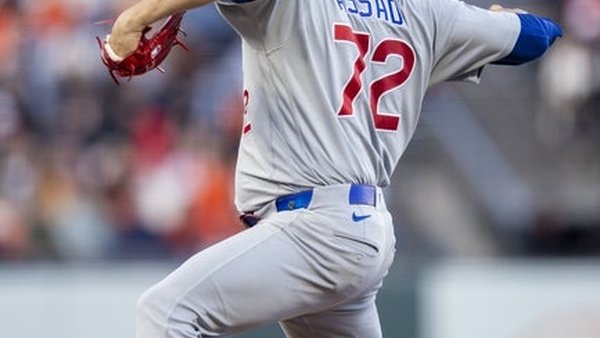
Javier Assad carries a 4-1 record into Wednesday night, but a 5.63 K/9 and a Cubs rotation depleted by four injured arms tells a different story than the -188 price tag. The component data projects Colorado to win this game outright — yet the market is treating the Rockies like a heavy underdog.
Sean Sullivan vs. Javier Assad: Colorado Rockies at Chicago Cubs Betting Preview
The Cubs are a .514 baseball team with a +7 run differential. That’s not a dominant club — that’s a team playing close to .500 baseball while the market treats them like a division favorite at -188. Meanwhile, Colorado walked into Wrigley on Tuesday and beat this Cubs staff 5-2, getting four relievers to hold Chicago scoreless over the final seven innings. The Rockies aren’t a good team — 28-46 with a -88 run differential makes that clear — but this game isn’t about the standings. It’s about price.
Chicago will send Javier Assad to the mound with a 5.63 K/9. That’s not a shutdown number. For a Colorado lineup that hits .253 as a team and features legitimate power threats throughout the order, Assad’s profile is one they can work. On the other side, Sean Sullivan is a complete unknown — 0-0, 0.00 ERA, almost certainly a debut or spot start — which introduces enormous variance into this number. The question is whether that variance is already priced into +158. When you work through the component data, it is — and then some.
Tuesday’s Cubs-Rockies game showed what Colorado’s bullpen can do when it gets a lead. Today’s matchup presents a different kind of edge: a price-driven moneyline on a team the numbers favor to win outright.
Game Info & Betting Lines
- Date/Time: Wednesday, June 17, 2026 — 8:05 PM ET
- Venue: Wrigley Field | Park Factor: 1.02 (neutral-to-slightly hitter-friendly)
- Probable Starters: Sean Sullivan (COL) vs. Javier Assad (CHC)
- Moneyline: Colorado Rockies +158 / Chicago Cubs -188
- Run Line: Chicago Cubs -1.5 (+105) / Colorado Rockies +1.5 (-126)
- Total: 10 (Over -114 / Under -106)
Why This Number Is Off
Chicago at -188 implies roughly a 65% win probability. For a team sitting at 38-36 with a +7 run differential, that price demands performance the Cubs haven’t consistently delivered. Their rotation has been ravaged: Taillon (15-Day IL), Boyd (15-Day IL), Horton (60-Day IL), and Cabrera (day-to-day with the hand cramp he left Tuesday’s game with) — this is a staff that is stretched thin and leaning heavily on a bullpen that worked into Tuesday’s eighth inning.
The market is building Assad’s 4-1 record and 3.99 ERA over 38.1 innings into a number that implies near-certainty. The concern is that Assad’s underlying profile doesn’t support that confidence — a 1.017 WHIP looks clean, but that 5.63 K/9 is well below the league average for a starting pitcher. He’s not missing bats. Against a Rockies lineup averaging .253 and capable of sustaining traffic, Assad projects as a beatable mid-rotation arm, not a stopper.
The legitimate case for Chicago: home field, a Rockies club with a season-long -88 run differential, and a starter in Sullivan who is functionally a mystery. That’s real. But when you stack the component data — a projected final of 4.7 to 3.9 in Colorado’s favor — the market isn’t remotely close to fair. Getting +158 on the team the numbers project to win is where the value lives, even accounting for the genuine uncertainty on both sides.
What Separates the Pitching
The gap here is defined almost entirely by what we know versus what we don’t. Assad is a known quantity — and the honest assessment of that known quantity is: a solid fourth starter, not a dominant arm. His 5.63 K/9 ranks among the lower tier of MLB starters who carry winning records, which means his ERA stability depends heavily on soft contact and weak sequencing rather than overwhelming stuff. Over 38.1 innings, he’s allowed four home runs and walked nine — controlled, but not a pitcher who blows lineups away. Against a Rockies order that includes Hunter Goodman (.865 OPS, 20 HR) and TJ Rumfield (.813 OPS, 9 HR), a starter who gives up hard contact will eventually pay. Rumfield hit a 385-foot shot off Cubs pitching on Tuesday — these bats have real pop even in a diminished lineup.
Sullivan is the wildcard in every sense. A 0-0 record with a 0.00 ERA almost certainly means debut or spot start — which means zero MLB track record to handicap against. That creates two scenarios: Sullivan is sharp and gives Colorado five useful innings, or he implodes and the bullpen faces an emergency early. Even with that uncertainty, the component breakdown — particularly a -4.937 starter advantage for the away side — leans Colorado. That’s a meaningful signal, and it’s driven by the gap between a known, limited Assad and an unknown Sullivan who the underlying numbers still credit above him in this context. It’s not a lock, but the edge is real.
The Cubs bullpen has also been taxed. Tuesday’s game went seven innings for Colorado relievers; Chicago’s pen was active Monday and Tuesday both. A Cubs staff already down multiple arms may be in a compromised state entering a Wednesday night start.
The Pushback
The case against this bet is real, and it starts with Pete Crow-Armstrong. He hit for the cycle Monday. He led off Tuesday’s game with a home run — his second leadoff shot in two days. He’s reached base in 20 straight games and is hitting safely in 19 of them. That’s an elite stretch of production from the Cubs’ best hitter, and it’s happening right now against this Colorado pitching staff. You can’t dismiss that.
Colorado is also running out there without Mickey Moniak (ankle, 10-Day IL) and Jordan Beck (hamstring, 10-Day IL). That’s real lineup attrition on a team that already ranks near the bottom of the NL in most offensive categories. The Rockies’ season-long -88 run differential isn’t noise — it reflects a team that gets beaten consistently, not just occasionally.
And Sullivan. He could get knocked around in the first or second inning and turn this into a bullpen game by the fourth. If Chicago scores three early, the rest of this analysis becomes academic. That’s a legitimate path to losing this bet, and anyone laying money on it should understand that going in.
None of that changes the price argument. At +158, you’re getting implied odds of roughly 38.7%. Even if you think the Cubs win this game 55% of the time — a reasonable position — you still aren’t betting them at -188. The Rockies don’t need to be the better team to be the better bet. They just need to be underpriced, and at +158 on a game where the pitching matchup genuinely favors neither side with certainty, they are.
Run Environment & Game Shape
The total is set at 10, which feels like the market leaning on Wrigley’s reputation more than this specific matchup. The park factor is only 1.02 — essentially neutral. Assad’s 5.63 K/9 suggests a contact-heavy game rather than a strikeout-and-empty-base affair, which means Colorado’s lineup will have opportunities to string together traffic. Sullivan’s unknown profile cuts both ways: if he struggles, runs come early for Chicago; if he holds, the game stays close into the middle innings where Colorado’s deeper-than-expected bullpen — which just held Chicago scoreless for seven innings on Tuesday — could be decisive.
The projected 4.7-3.9 final suggests a relatively low-scoring, tight game. A one-run final is plausible in either direction. That shape actually supports the moneyline play over the run line — Colorado +1.5 at -126 compresses the value significantly compared to taking the outright win at +158. The game doesn’t need to be a blowout for this bet to cash; it just needs to end with Colorado on top, which a close, bullpen-driven game absolutely allows for.
The Pick: Colorado Rockies Moneyline +158 — 1 unit, lean. The edge here is real but not guaranteed: Assad’s limited strikeout profile makes him hittable, the Cubs’ rotation depth is in rough shape, and +158 represents meaningful value on a team the component data projects to win outright. This isn’t a high-conviction spot, but at this price, you don’t need high conviction — you need the number to be off, and it is.