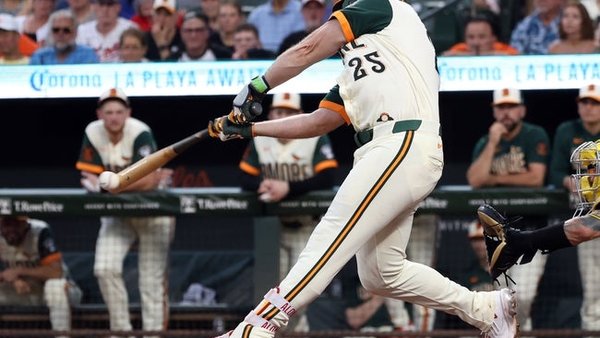
Yoshinobu Yamamoto’s 2.52 ERA and 0.84 WHIP headline a pitching matchup that is anything but symmetrical — Trevor Rogers’ 5.86 ERA and 1.45 WHIP represent the widest starter gap on the board this weekend. The total sits at 8.5, priced at -105 on the under, and the half-run margin between the projection and the posted line is where the real tension lives.
Trevor Rogers vs. Yoshinobu Yamamoto: Baltimore Orioles at Los Angeles Dodgers Betting Preview
Friday night’s 6-5 Dodgers walk-off was a chaotic finish that deserves the right telling. Mookie Betts hit a solo shot off closer Ryan Helsley in the ninth to pull LA to 5-4 — that was the spark, not the finish. The game actually ended on Dalton Rushing’s single that tied it, followed by Tyler O’Neill’s throwing error that plated the winning run. Helsley blew the save, the Dodgers won on a blunder, and now Saturday’s matchup shifts dramatically. Roki Sasaki couldn’t hold a 3-0 lead Friday. Tonight, the Dodgers send their ace, and Baltimore counters with one of the shakiest starters in baseball.
The core thesis here is simple: Yoshinobu Yamamoto is one of the five best starters in the sport right now, and at a park factor of 0.98, Dodger Stadium is not going to help the Orioles’ below-average offense find their footing. The numbers project 9.0 combined runs — right at the 8.5 total. That proximity is the bet. Any version of Yamamoto being even marginally better than his already-elite baseline pushes this game under.
The Dodgers’ moneyline at -270 is priced well beyond any reasonable value threshold, so the total is the cleanest vehicle here. You’re not laying juice on a lopsided win probability — you’re expressing a pitching-driven run suppression argument at -105, which is the most attractive number on the board.
Game Info & Betting Lines
- Date/Time: Saturday, June 20, 2026 | 10:10 PM ET
- Venue: Dodger Stadium | Park Factor: 0.98 (mild run suppressor)
- TV: MLB.TV, Sportsnet LA, MASN
- Probable Starters: Trevor Rogers (BAL) vs. Yoshinobu Yamamoto (LAD)
- Moneyline: Baltimore Orioles +220 / Los Angeles Dodgers -270
- Run Line: Los Angeles Dodgers -1.5 (-128) / Baltimore Orioles +1.5 (+106)
- Total: 8.5 (Over -115 / Under -105)
Why This Number Is Close
The market is doing legitimate work at 8.5. The books see what we see: Yamamoto suppresses offenses, and Baltimore’s .719 team OPS ranks well below league average. The projection of 9.0 total runs — only half a run over the line — tells you the books aren’t giving anything away. They’ve priced in Yamamoto’s dominance, which is exactly why the under is only -105 instead of -125.
The legitimate case for the over rests entirely on Trevor Rogers. At a 5.86 ERA and 1.45 WHIP across 66 innings, Rogers is a proven run-prevention liability. The Dodgers carry a .787 team OPS and 104 home runs on the season. If Rogers gets knocked around in the first three innings and the LAD bullpen — already missing Edwin Diaz (60-Day IL) and Ben Casparius (60-Day IL) — gives up runs in relief, the over hits before Yamamoto’s clean innings even matter.
But here’s where I think the market slightly underweights the elite arm: Yamamoto doesn’t just hold down lineups — he actively removes run-scoring probability from the equation for five to seven innings. Against Baltimore’s offense, the math becomes lopsided fast. The half-run margin between the projection and the line is thin enough that a Yamamoto outperformance — which is more likely than not against this lineup — flips it under cleanly.
What Separates the Pitching
There is no honest way to describe this as a competitive pitching matchup. Yamamoto enters with a 2.52 ERA and 0.84 WHIP through 85.2 innings, with a 2.12 WAR that ranks him among the elite starters in baseball this season. His arsenal backs it up: his slider generates a 39.1% whiff rate while holding hitters to just a .248 xwOBA, and his changeup — at 16% usage — produces a .267 xwOBA against. His four-seam fastball, thrown 43.4% of the time at 94.4 mph, draws a 24.4% whiff rate. Now, to be precise about where that pitch actually stands: the four-seamer carries a .400 xwOBA, meaning contact quality against it is not elite. Yamamoto’s true dominance lives in the slider and changeup — where hitters are posting .248 and .267 xwOBA respectively — and in the whiff and put-away ability across his whole mix. The fastball sets everything up and generates swings and misses, but it’s the secondary stuff that keeps the barrel rate down. Against a Baltimore lineup running a .719 team OPS, that full arsenal combination is more than enough.
Rogers is the structural problem on the other side. His 5.86 ERA is not a fluke of bad luck — his 1.45 WHIP confirms consistent baserunner traffic, and 9 home runs in only 66 innings (1.2 HR/9) is an alarming rate for any pitcher facing a power-oriented lineup. His four-seam fastball carries a .315 xwOBA against at only 94.1 mph, and his curveball — thrown 11.3% of the time at 74.7 mph — posts a .394 xwOBA. His best weapon is his slider, which generates a 41.9% whiff rate and a .262 xwOBA, but he only deploys it 15.3% of the time. The Dodgers’ top of the order has the plate discipline to wait him out: Freddie Freeman’s 15.3% strikeout rate and Mookie Betts’ 12.0% K rate are both well below league average — they make contact, they work counts, and they punish pitchers who fall behind. Andy Pages’ .399 xwOBA against left-handed pitchers is a specific red flag for Rogers, who is left-handed. The gap between these two starters is the widest variable on the board, but the direction of that gap cuts both ways for the total.
The Pushback
Let me be direct about what could unravel this under. Rogers is genuinely capable of surrendering a five-run inning without warning. His HR/9 rate of 1.2 against a lineup with Freddie Freeman (.850 OPS), Max Muncy (.887 OPS, 16 HR), and Dalton Rushing (.869 OPS) is the number that keeps me at moderate confidence rather than high. That trio alone represents legitimate power threats, and Rogers has shown he can’t consistently escape damage when his command wavers.
Yamamoto’s .400 xwOBA on his four-seamer is also a reminder that no pitcher is bulletproof on every pitch — Pete Alonso (.445 xwOBA against right-handers) and Samuel Basallo (.425 xwOBA, 8.1% barrel rate) are legitimate contact threats in Baltimore’s lineup who could punish a fastball that catches too much of the zone. The risk isn’t that Yamamoto gets shelled — it’s that Rogers gets touched for four or five runs and Yamamoto’s clean innings aren’t enough to keep the total in check.
The Under Thesis, Stated Plainly
Yamamoto’s slider-changeup combination is the most reliable run-suppression tool in this game — .248 and .267 xwOBA, respectively, against a lineup that posts a .719 team OPS. Baltimore simply doesn’t have the offensive firepower to consistently put crooked numbers on the board against an arm this good. Rogers is the volatility factor, and he’s real, but the under doesn’t need a Rogers gem — it needs Yamamoto to be Yamamoto for six innings and Rogers to give up three or four rather than six or seven. That is the most probable outcome given the pitcher profiles, the park, and the lineup matchups at play here.
The under at -105 is clean value in a market that’s done its homework. Yamamoto is the anchor, Rogers’ volatility is the primary risk, and the line sits just close enough to the projected total that the edge is real without being obvious. Two units, moderate confidence.
Bet: Under 8.5 (-105), 2 units — moderate confidence.