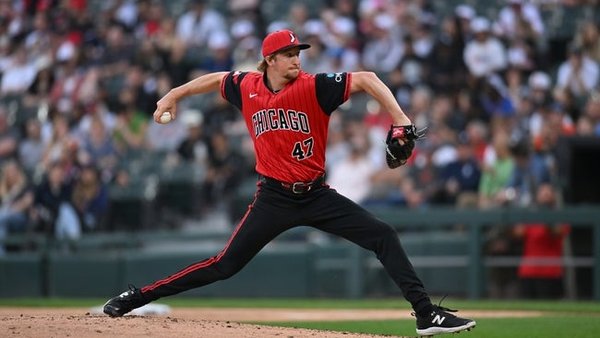
Ramirez, DeLauter, and Murakami — the three most productive bats in this game by OPS and home runs — are all on the injured list simultaneously, yet the total sits at 8.5 as though both lineups arrived intact. Bibee’s 4.03 ERA and 1.175 WHIP give Cleveland a real mound edge over Fedde’s 1.387 WHIP, but the number has not moved far enough to reflect the roster carnage stripping run production from both sides.
Tanner Bibee vs. Erick Fedde: Cleveland Guardians at Chicago White Sox Betting Preview
The Under at -112 is the number I’m playing today, and the case starts with what’s missing from both dugouts. The White Sox won Monday’s 6-5 thriller on a walk-off two-run single by Sam Antonacci in the ninth — but the lineup they’re running out Wednesday looks meaningfully different than the one that manufactured six runs in late-inning chaos. Jose Ramirez, Chase DeLauter, and Munetaka Murakami — by OPS and HR the three most productive bats in this game — are all sitting on the 10-Day IL simultaneously. That isn’t a footnote. That’s the entire Under thesis sitting right there in the transaction wire.
The market has posted 8.5 with the Under priced at -112, meaning the books already lean toward the lower side. But the question is whether 8.5 goes far enough given just how stripped down these lineups actually are. Bibee’s arm and Cleveland’s bullpen provide the pitching suppression layer. Two depleted offenses at a mild run-suppressing park provide the floor. The pieces fit.
Game Info & Betting Lines
- Date/Time: Wednesday, June 24, 2026 — 2:10 PM ET
- Venue: Guaranteed Rate Field | Park Factor: 0.98 (mild run-suppressor)
- TV: MLB.TV, CLEGuardians.TV, CHSN
- Probable Starters: Tanner Bibee (CLE) vs. Erick Fedde (CHW)
- Moneyline: Cleveland Guardians -112 / Chicago White Sox -104
- Run Line: Chicago White Sox +1.5 (-176) / Cleveland Guardians -1.5 (+146)
- Total: 8.5 (Over -108 / Under -112)
Why This Number Is Off
The 8.5 total is set where it is because the market sees two .500 clubs with modest offenses and two mid-rotation starters — a reasonable setup for a game that lands in the 8-to-10 run range. On paper, that’s defensible. Cleveland scores 3.95 runs per game this season and Chicago comes in at 4.63. Add those season averages and you get 8.58, which nearly pins the total exactly. The market is doing the math correctly on full rosters. The matchup-and-park-adjusted projection comes in at 9.0 — that number layers in additional inputs beyond simple run-per-game arithmetic, which is why the two figures don’t line up perfectly — but even that projection doesn’t fully account for the IL carnage below.
Here’s the problem: these aren’t full rosters. Ramirez (.757 OPS, 10 HR) and DeLauter (.745 OPS, 7 HR) were Cleveland’s second and fourth most productive hitters by OPS — both gone. Murakami (.938 OPS, 20 HR) was Chicago’s best hitter by a substantial margin — also gone. The projected lineup for Cleveland now slots Rhys Hoskins fourth, with Gabriel Arias at five — a significant downgrade from what the season averages assume. Chicago leans on Colson Montgomery (20 HR, .799 OPS) and Miguel Vargas (16 HR, .814 OPS), who are legitimate threats, but they’re doing it without the cleanup protection Murakami provided.
Real combined output trends closer to 8 or under, and you’re getting -112 to fade a number that hasn’t adjusted enough to the lineup carnage.
What Separates the Pitching
The gap between these two starters isn’t enormous, but it tilts the run environment meaningfully toward the Under. Tanner Bibee carries a 4.03 ERA, 1.175 WHIP, and 7.86 K/9 across 89.1 innings. Erick Fedde sits at a 4.46 ERA, 1.387 WHIP, and just 6.11 K/9 in 70.2 innings. Those differences compound over six or seven innings — Bibee strands runners, Fedde tends to let them score.
Dig into the Statcast arsenals and the contrast sharpens. Bibee’s cutter (26.8% usage, 86.0 mph) generates a 35.5% whiff rate — his most active swing-and-miss weapon — though it carries a .362 xwOBA, meaning hitters do real damage when they connect. It generates the chases; it doesn’t always win on contact. That nuance matters, but it’s his changeup (16.5%, 81.1 mph) that does the cleaner suppression work: a .282 xwOBA with a 31.5% whiff rate. That changeup is the genuine put-away pitch. His four-seamer sits 94.1 mph and his sinker at 93.7 — he’s not overpowering, but he mixes effectively. Against Chicago’s lineup, Colson Montgomery is 0-for-10 with 4 strikeouts in 10 career plate appearances against Bibee — a matchup the data clearly favors the pitcher.
Fedde leans heavily on his sweeper (37.8%, 81.8 mph) — it carries a 21.8% whiff and a .278 xwOBA, making it his most reliable pitch. The concern is his cutter (18.5%, 90.2 mph), which surrenders a .409 xwOBA and gets exposed against power hitters. Kyle Manzardo’s .419 xwOBA and Rhys Hoskins’ 23 plate appearances against Fedde (.333 AVG, 1 HR) suggest Cleveland’s depleted lineup can still work counts and find gaps. But Fedde’s 1.387 WHIP means runners accumulate — the question is whether a gutted Cleveland lineup can actually drive them in.
Cleveland’s team ERA of 3.80 adds another layer: even if Bibee exits early, the bullpen has been a genuine strength all season, capable of holding leads and suppressing late-inning scoring.
The Pushback
The strongest argument against the Under is Chicago’s remaining power. Even without Murakami, Colson Montgomery (20 HR, .799 OPS) and Miguel Vargas (16 HR, .814 OPS) combine for 36 homers and carry Statcast xwOBAs of .434 and .423 respectively — that’s genuine damage potential against a pitcher whose cutter and sinker both sit at a .362 xwOBA on contact. One crooked inning from Fedde’s walk rate and one Vargas or Montgomery barrel and this game can flip to the Over in a hurry.
Then there’s Randal Grichuk, who has been locked in lately — he hit a pinch-hit leadoff homer in the sixth inning Monday to give Chicago a 3-0 lead, his eighth of the season. That was not the walk-off (Antonacci handled that in the ninth), but Grichuk’s ability to change a game from the bench adds a real wild card. He carries an .857 OPS and a .487 xwOBA this season, and a pitcher who’s relying on a cutter that gives up contact damage is exactly the kind of matchup he can exploit.
The -112 price is also worth acknowledging. The books aren’t giving this away — they’ve already priced in the public lean toward the Under, which means the sharp money isn’t overwhelming. You’re not getting value by accident here; you’re making a deliberate bet that the roster attrition moves the real number below 8.5 more than the market has priced it.
I’ve looked hard at the run line given the 4.5–4.5 projection split, but the -176 price on Chicago +1.5 is too steep for a game this close to a coin flip on the moneyline. The Under is the cleaner play: you don’t need to pick a winner, you just need both depleted offenses to do what depleted offenses do.
The Pick
Both starters have enough to limit damage for five or six innings. Both bullpens are functional. Both lineups are missing their most dangerous hitter. The math on full rosters gets you to 8.58; the math on these actual rosters gets you to somewhere south of that. A 4-3 or 5-4 final easily cashes the Under, and that’s the most likely range given everything we’re working with here.
Bet: Under 8.5 at -112, 2 units, moderate confidence.