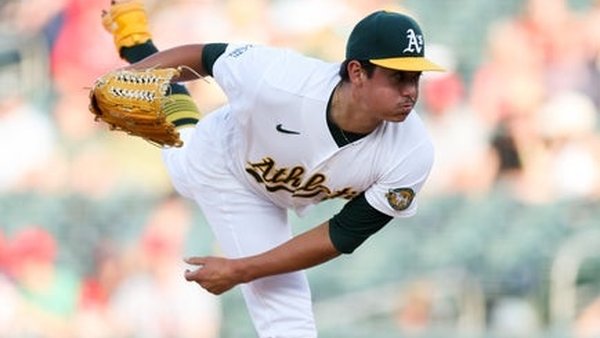
A 3.66-run ERA gap separates these two starters — Gage Jump sitting at 2.37 with zero home runs allowed, Tyler Mahle at 6.04 with a hamstring concern and 11 long balls surrendered in 56.2 innings. The Athletics are priced at -124, a number that reads like a coin flip but is carrying a pitching edge that wide without nearly enough cushion built in.
Gage Jump vs. Tyler Mahle: Athletics at San Francisco Giants Betting Preview
The Athletics enter Oracle Park tonight as -124 moneyline favorites, a price that reads like a coin-flip dressed up with a small premium. The market sees two flawed clubs — Oakland at 38-41, San Francisco at 32-46 — and prices the game accordingly. But that framing ignores the only thing that actually matters here: Gage Jump is one of the better stories in baseball right now, and Tyler Mahle has been one of the worst starters in the sport all season. That starter gap is not close to what -124 implies.
The Giants won 3-1 yesterday behind a dominant Robbie Ray performance, and there’s a natural instinct to ride momentum back toward San Francisco. The concern is that instinct is priced in — +106 on the Giants is genuinely live money for bettors leaning on recency. But Ray going eight innings Tuesday has nothing to do with Mahle and his 1-7 record showing up tonight. Two different pitchers. Two completely different games.
The thesis here is simple: Jump’s elite run-prevention profile against a homer-prone, IL-listed starter gives Oakland a real edge that -124 isn’t fully compensating for. That price is accessible, and the pitching mismatch is undeniable.
Game Info & Betting Lines
- Date/Time: Wednesday, June 24, 2026 | 9:45 PM ET
- Venue: Oracle Park | Park Factor: 0.92 (pitcher-friendly)
- TV: MLB.TV, NBC Sports BA, NBC Sports CA
- Probable Starters: Gage Jump (Athletics) vs. Tyler Mahle (Giants)
- Moneyline: Athletics -124 / Giants +106
- Run Line: Athletics -1.5 (+138) / Giants +1.5 (-166)
- Total: 8 (Over -110 / Under -110)
Why This Number Is Off
The market is doing its job here — pricing two bad teams against each other, assigning a modest edge to Oakland, and building in enough juice on neither side to punish action. The legitimate case for +106 on San Francisco: their contact-heavy lineup (Luis Arraez at .321, Jung Hoo Lee at .331) can string together runs without relying on home runs, which blunts Jump’s most impressive trick of allowing zero home runs across 30.1 innings. And Oracle Park’s pitcher-friendly environment actually helps the Giants’ contact profile more than it hurts them — they don’t need to hit it out to score.
But here’s where the market is slightly wrong: the -124 price doesn’t adequately compensate for a 3.66-run ERA differential between these two starters. Mahle is 1-7 with a 6.04 ERA, a 1.535 WHIP, and 11 home runs allowed in 56.2 innings — that’s a -0.55 WAR. He’s listed on the 15-Day IL with a hamstring, and even if he takes the ball tonight, workload limitations mean Oakland is attacking a compromised arm backed by a depleted Giants bullpen. Jump’s 2.37 ERA and 0.989 WHIP are not flukes — they’re backed by genuine contact-suppression metrics. The numbers project this at 4.3-4.2, Athletics. A coin-flip result priced with a 56.2% win probability deserves more than -124 if Jump is truly this much better than Mahle.
What Separates the Pitching
The head-to-head comparison between these two arms isn’t close, and the Statcast data makes it even clearer. Jump leans on a four-seam fastball at 44.2% usage (91.4 mph) that holds hitters to a .366 xwOBA — not an elite number on its own, but the pitch sets up his true weapon: a changeup at 22.4% usage that generates a 39.7% whiff rate and .265 xwOBA. That’s a legitimate swing-and-miss offering that keeps hitters guessing off the fastball. His slider adds another layer at 21.5% whiff and .320 xwOBA. The profile is a contact-management starter who rarely gives anyone a free base — nine walks in 30.1 innings — and has yet to surrender a home run all season.
Mahle’s arsenal tells a different story. His primary pitch is a sinker at 37.4% usage (93.4 mph) that generates only a 10.6% whiff rate and .350 xwOBA — a pitch hitters are squaring up. His best offering is actually his curveball (27.5% usage, 36.5% whiff, .216 xwOBA, 30.9% put-away rate), which is genuinely plus. But the curveball can’t carry a start when the sinker is getting punished. His cutter adds 26.3% whiff at .321 xwOBA, but those positive secondary numbers haven’t translated to run prevention — and 11 home runs in 56.2 innings tells you what happens when his sinker flattens out.
The matchup mismatch shows up immediately in the Oakland lineup. Nick Kurtz (xwOBA .514, 8.8% barrel rate) sits at .565 xwOBA against right-handed pitching — he’s exactly the kind of hitter who punishes a sinker that doesn’t sink. Shea Langeliers (xwOBA .427, 9.1% barrel, .469 xwOBA vs. lefties) adds another legitimate power threat. Compare that to the Giants’ numbers against Jump: Casey Schmitt (.464 xwOBA vs. left-handers) is the best matchup on paper, but even he comes in at just 3PA of BvP history, nothing predictive. The Giants’ power threats are real — but Jump’s changeup whiff rate suggests he can keep the barrel rates manageable.
Run Environment & Game Shape
Oracle Park’s 0.92 park factor is a run suppressor, and a total of 8 reflects that. The market is already pricing a game where neither offense does much damage, which on paper benefits the Giants — a lower-scoring game environment narrows margins. But park factors cut both ways, and a pitcher-friendly setting is exactly where Jump’s contact-suppression profile plays up. He’s given up zero home runs in 30.1 innings. At Oracle, where fly balls die, that trend has even more support behind it.
What the park factor actually does here is amplify Jump’s strengths while doing nothing to fix Mahle’s core problem. Mahle’s 11 home runs allowed in 56.2 innings aren’t entirely the result of hitter-friendly venues — they’re a product of a sinker that gets too much of the plate and a delivery that leaves the ball elevated when his stuff isn’t sharp. A 0.92 park factor trims some of that home run exposure, sure, but it doesn’t fix a 6.04 ERA or a 1.535 WHIP. The Giants’ contact-oriented lineup can scratch together runs in low-scoring environments, but they’re doing it against a guy with a 0.989 WHIP and no home runs allowed. That profile plays even better when the park is suppressing offense across the board.
The game shape here points to a competitive, lower-scoring contest — exactly the kind of game where the pitching edge matters most. Jump keeps the ball in the yard, limits walks, and generates swing-and-miss with his changeup. Mahle is working on a compromised hamstring with an ERA north of 6.00. In a tight game where margins are thin, I want the better arm on the mound. That’s Jump, and -124 is still a number I’m comfortable taking for 2 units.
Bet: Athletics Moneyline -124 — 2 Units