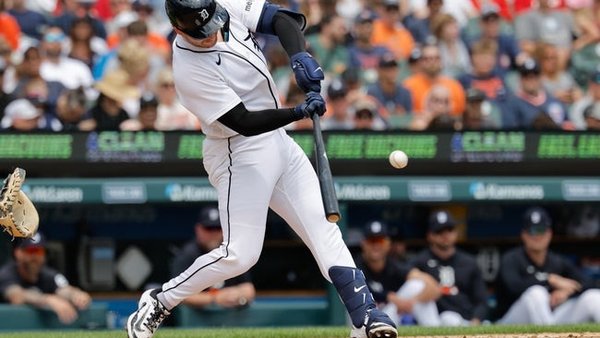
Hunter Brown’s 1.40 ERA and 13.03 K/9 sit on one side of this matchup — Jack Flaherty’s 92.7 mph four-seamer with a .348 xwOBA-against sits on the other. Houston is priced at -130, a number that accounts for Detroit’s stronger season-long construction but may be underweighting just how wide the starter gap is today at a neutral Comerica Park.
Hunter Brown vs. Jack Flaherty: Houston Astros at Detroit Tigers Betting Preview
The series finale between Houston and Detroit sets up a clear starter-driven edge — but the betting thesis lives or dies on one piece of information nobody has locked down yet: whether Jack Flaherty actually takes the mound. Flaherty is listed on the 15-Day IL with an ankle injury, and his availability for today’s start is legitimately in question. That uncertainty is baked into everything that follows.
Assuming Flaherty goes, the pitching gap is substantial. Hunter Brown has been one of the best starters in baseball through his first 19.1 innings — a small but statistically meaningful sample — while Flaherty ranks among the worst starters in the American League. The market has priced this correctly in direction but only partially in magnitude. Houston at -130 is right at the edge of what I’d call the playable ceiling for a moderate-confidence play.
Yesterday’s 8-6 Astros comeback — spoiling A.J. Hinch’s shot at his 1,000th career win — confirmed this lineup can score against Detroit’s bullpen. But after dropping the under on Friday’s 8-6 game (yesterday’s play on these teams went under 8.5), the reminder is fresh: this run environment can surprise in both directions. The thesis today is pitcher-driven, not narrative-driven.
Game Info & Betting Lines
- Date/Time: Sunday, June 28, 2026 — 1:40 PM ET
- Venue: Comerica Park | Park Factor: 0.99 (essentially neutral)
- Probable Starters: Hunter Brown (HOU) vs. Jack Flaherty (DET) — Flaherty listed on 15-Day IL (ankle); availability uncertain
- Moneyline: Houston Astros -130 / Detroit Tigers +110
- Run Line: Houston Astros -1.5 (+136) / Detroit Tigers +1.5 (-164)
- Total: 8 (Over -118 / Under -104)
Why This Number Is Close
The -130 moneyline is a reflection of competing market forces pulling in opposite directions. On one side, you have a historically sharp pitching edge — Brown’s ERA and strikeout rate are elite, Flaherty’s surface numbers are among the worst in baseball. That should price Houston somewhere in the -150 range against a struggling Detroit club.
But the market is holding back for legitimate reasons. Houston’s season-long run differential sits at -44, against Detroit’s nearly flat -1. That’s not noise — it tells you the Astros have been fortunate in some wins and badly exposed in others. Detroit’s pitching staff overall posts a 3.76 team ERA and a 1.24 WHIP, which is meaningfully better than Houston’s 4.76 ERA staff. The market is essentially saying: yes, Brown is better than Flaherty today, but Detroit is the better-constructed team over the full arc of this season.
Where I think the market is slightly off: it’s treating team-level construction as a mitigating factor against a starter advantage that is both extreme and directly on the field today. Brown vs. Flaherty isn’t a 10% edge — it’s closer to 20-25% in starting pitcher quality, and -130 doesn’t fully capture that in a neutral-park, low-juice environment. The price is fair, not cheap. But fair with a clear lean is still actionable.
What Separates the Pitching
Start with the Statcast arsenals, because they tell the story more clearly than ERA alone. Hunter Brown’s four-seam fastball sits at 96.3 mph with a 30.5% whiff rate and an xwOBA-against of just .149 — that’s an elite pitch generating weak contact and empty swings at an unusual rate. He pairs it with a knuckle curve (36.6% whiff rate) and a changeup that produces a 40.9% whiff rate, though that changeup’s xwOBA-against of .564 suggests some hard contact when hitters do make contact. Brown’s overall profile across 19.1 innings: 1.40 ERA, 1.19 WHIP, 13.03 K/9. One home run allowed.
Against that, Detroit’s top of the order has genuine upside. Dillon Dingler carries a .474 xwOBA and a 6.3% barrel rate this season. Riley Greene is at .442 xwOBA with a 6.0% barrel rate — though in 22 plate appearances against Brown, Greene has hit .250 with seven strikeouts, a signal that Brown can exploit his swing-and-miss tendencies. Spencer Torkelson (.413 xwOBA) has a .133 average against Brown in 18 PA with three strikeouts — that’s the kind of BvP data that reinforces the matchup edge, even with a small sample caveat.
Flaherty’s arsenal tells a different story. His four-seamer sits at 92.7 mph with a 15.3% whiff rate and an xwOBA-against of .348 — that’s a fastball hitters are squaring up. His slider generates better whiff rates (29.1%) but an xwOBA-against of .331, and his knuckle curve sits at .308. The consistent theme: Flaherty is generating contact, and it’s frequently hard contact. Eight home runs allowed in 65.2 innings punctuates that. Yordan Alvarez, batting with a 1.045 OPS this season, represents exactly the kind of power hitter who punishes an elevated, straight four-seamer sitting nearly four mph below league average. Christian Walker (.350 xwOBA, 5.1% barrel rate) has gone .300 with a home run in 14 PA against Flaherty — again, small sample, but it aligns with the profile mismatch. Note that Carlos Correa is on the 60-Day IL with an ankle injury and does not factor into today’s lineup. The active Houston lineup still has enough thunder at the top to exploit Flaherty’s contact-heavy profile.
Houston’s Active Lineup Without the Injured Names
The projected Houston lineup runs Jeremy Peña, Isaac Paredes, Raynel Delgado, Christian Walker, Joey Loperfido, Yainer Diaz, Jake Meyers, Taylor Trammell, and Christian Vázquez. Gleyber Torres is on the 10-Day IL (oblique) and does not appear in Detroit’s projected lineup either, which further thins the middle of Detroit’s order. The Houston group, while not overwhelming on paper, has the lineup-wide xwOBA profiles to do real damage against Flaherty’s contact-permissive approach. Peña’s .381 xwOBA and Walker’s .350 xwOBA anchor a lineup that doesn’t need to be elite — it just needs to be patient enough to let Flaherty’s walk rate (34 free passes in 65.2 innings) create traffic.
Rejected Angles
The Houston -1.5 run line at +136 is tempting — the implied win-by-two probability at +136 is theoretically fair given the pitching edge. But Flaherty’s volatility cuts both ways. He can get shelled in the third inning, or he can cruise through five innings on weak contact and get bailed out by a Tigers bullpen that just held the Astros to zero runs on Friday. The run line requires both a Houston win and a cover, and the variance around Flaherty’s starts is too high to pay the extra ticket price. Pass.
The over at -118 is priced too expensively for a game where Brown has the potential to suppress Houston’s half of the run environment almost entirely on his own. Pass.
The under at -104 is the more interesting side of the total, but Friday’s 8-6 beatdown is a recent reminder that this Detroit offense can erupt — and Houston’s bullpen has shown enough cracks that banking on the under requires trusting both teams’ relievers to hold. Not comfortable enough with Detroit’s pen to lay -104 on a game where Flaherty’s early exits are a real possibility.
Pushback
The legitimate counterargument here is that Detroit’s team-level construction is genuinely better than Houston’s when you strip away the starter matchup. The -1 run differential vs. -44 is a real number. And Flaherty, for all his struggles, has shown he can piece together four or five scoreable innings on any given day — his strikeout profile (78 K in 65.2 IP) isn’t nothing, even if the results have been ugly.
The invalidation scenario worth naming: if Brown exits early with two or more runs allowed — whether from a Dingler barrel or a Torkelson breakthrough — the entire thesis collapses. Houston’s bullpen doesn’t give you enough confidence to win a game where Brown implodes in the third or fourth inning, and Detroit’s home crowd feeding off a lead is a different game entirely. That’s the specific scenario where +110 on Detroit looks smart in retrospect.
But that’s a scenario, not a probability. Brown’s .149 xwOBA-against on his four-seamer and his 13.03 K/9 this season suggest the early-exit risk is lower than Flaherty’s comparable risk on the other side. The better-constructed team argument matters in a coin-flip game — this isn’t a coin-flip game when Brown is on the mound.
Run Environment & Game Shape
The total sitting at 8 (Over -118 / Under -104) is a number that accurately reflects the tension in this game. The numbers project a combined 8.4 runs, which is almost exactly on the line — and that slim 0.4-run over-edge doesn’t justify action in either direction given the specific game dynamics at play.
Here’s the problem with both sides of this total. Brown suppresses Houston’s half of the run environment effectively — his 1.40 ERA and elite contact-suppression profile (.149 xwOBA against on the fastball) mean Detroit is likely to put up fewer runs in a Brown start than in an average AL game. That makes the over harder to get to even if Flaherty gets shelled. On the flip side, the under at -104 isn’t cheap enough to absorb the real risk that Flaherty’s volatility creates. He’s allowed eight home runs in 65.2 innings against a power-capable Houston lineup, and if the Astros get to him early, this total clears 8 with ease. Flaherty’s early exits are a documented pattern — and Houston’s bullpen exposure on the back end means the under isn’t a clean ride even if Brown dominates his innings. The -118 juice on the over doesn’t justify the bet given Brown’s legitimate suppression upside on his half. Neither side of this total is playable at current prices.
The play is straightforward: Houston Astros moneyline -130, 2 units, moderate confidence. The pitching gap is real, the Statcast data backs Brown’s elite profile, and the active Houston lineup has the xwOBA depth to do damage against a contact-permissive Flaherty. Before you place this bet, confirm Flaherty’s IL status — that is the single most important pre-game check. If Flaherty is scratched and a replacement arm takes the mound, this entire thesis changes and the play is off. Assuming he goes, Houston at -130 is the number.
Bet: Houston Astros ML -130 — 2 units