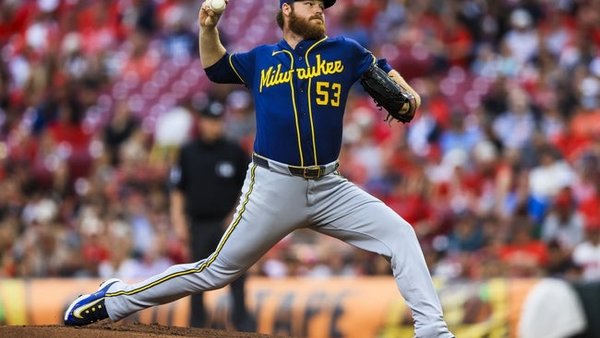
Brandon Woodruff’s 0.89 WHIP and Ryan Rolison’s 1.82 ERA represent two of the cleaner command profiles on the slate — yet the total is sitting at 8 with the over priced at -118, a number that leans toward offense in a dome with a perfectly neutral 1.00 park factor. The pitching matchup and the posted price are pointing in opposite directions.
Ryan Rolison vs Brandon Woodruff: Chicago Cubs at Milwaukee Brewers Betting Preview
After Friday’s blowout — the Cubs dropped a 6-2 decision to Milwaukee in a game that was never close — the pitching matchup shifts dramatically today. Jacob Misiorowski was untouchable on Friday, but Sunday belongs to two legitimately elite starters whose combined profiles should suppress scoring far below what the posted total implies.
The market opened this total at 8 and priced the over at -118, the under at -104. That juice asymmetry tells you the books built in some starter respect already — but not enough. The numbers project 8.8 combined runs, which technically registers as a moderate over lean — the projection clears the total by just 0.8 runs. I want to be straight with you about that tension: a projection of 8.8 on a total of 8 isn’t straightforward under support. But here’s why that thin margin still points to the under as the value play. First, projection models don’t fully price elite command profiles — Woodruff’s 0.89 WHIP and Rolison’s 1.82 ERA represent genuine starter quality discounts that raw run projections tend to underweight. Second, that 0.8-run cushion is razor-thin, not a comfortable over edge. And third, at -104, you’re getting the under at a price that barely penalizes you for taking the pitch-quality side. The structural case rests on those three pillars, not on the projection alone.
The under at -104 is where the value lives today. This isn’t a case of ignoring the Brewers’ dangerous lineup or the Cubs’ power. It’s a case of recognizing that two legitimate starters in a neutral dome environment — no wind, no temperature swings, a true 1.00 park factor — create the conditions where projected run totals actually hold.
Game Info & Betting Lines
- Date/Time: Sunday, June 28, 2026 | 2:10 PM ET
- Venue: American Family Field (Dome) | Park Factor: 1.00 — perfectly neutral, no environmental inflation
- Probable Starters: Ryan Rolison (CHC) vs Brandon Woodruff (MIL)
- Moneyline: Cubs +176 / Brewers -210
- Run Line: Brewers -1.5 (-102) / Cubs +1.5 (-118)
- Total: 8 (Over -118 / Under -104)
Why This Number Is Close But Leaning Wrong
The case for the over isn’t crazy. The Brewers average 5.19 runs per game on the season, and their lineup — Jackson Chourio (.873 OPS, .433 xwOBA vs LHP), Jake Bauers (.883 OPS, 14 HR), William Contreras (.810 OPS) — is one of the more dangerous top-to-bottom constructions in the National League. Worth noting: Garrett Mitchell carries a .461 xwOBA and 6.5% barrel rate and is listed in the projected lineup, though his designation as PH in the lineup data raises some uncertainty about his exact role today — if he’s starting, he adds another legitimate threat. The Cubs counter with Pete Crow-Armstrong (.882 OPS, 17 HR), who is a legitimate middle-of-the-order threat despite batting leadoff. Both offenses are capable of touching 5-plus runs on any given day, and the books know it — hence the -118 juice on the over.
But here’s the problem: the market is pricing the offenses in isolation rather than accounting for who is on the mound. At a 1.00 park factor, there is no atmospheric help for hitters. No Wrigley wind pushing fly balls over the wall, no altitude effect, no heat and humidity softening the ball. The dome neutralizes everything, leaving only pitcher-vs-hitter quality. And in that environment, Rolison and Woodruff are the story — not the lineups.
The under at -104 is the value side. You’re essentially getting a discount price to fade an over that’s been inflated by lineup reputation rather than honest starter-adjusted projection. The 8.8 combined run projection barely clears the total, and that’s before accounting for the above-average command profiles both starters bring today — profiles the model doesn’t fully credit.
What Separates the Pitching
Ryan Rolison enters with a 1.82 ERA and 1.11 WHIP over 29.2 innings — elite early-season numbers built on a diverse five-pitch arsenal that limits hard contact. His four-seam fastball sits 94.5 mph at 41.5% usage and holds hitters to a .287 xwOBA. The more important weapon is his sweeper — deployed 12.4% of the time, generating a 25.8% whiff rate and .229 xwOBA against. That pitch is essentially a free out against most right-handed hitters, and it pairs with a curveball (26.7% whiff rate) that gives him a legitimate two-breaking-ball combination. The concern with Rolison is the 13 walks over 29.2 innings — his BB rate is the one number that keeps this from being a perfect profile. But with only 3 HR allowed, he’s kept the ball in the yard, which matters most for total-suppression purposes.
Brandon Woodruff is operating at a different level of command. His 0.89 WHIP over 36 innings is the standout number — only 7 walks issued all season. That’s extraordinary control, and it translates directly to limiting the kind of baserunner accumulation that leads to crooked innings. His changeup is the pitch you need to know: 82.7 mph, 44.6% whiff rate, .231 xwOBA against. Against a Cubs lineup that profiles as aggressive — Pete Crow-Armstrong carries a .476 xwOBA vs. right-handed pitching (his season OPS is .882, a separate but complementary data point) and the raw numbers suggest he can damage Woodruff — the changeup becomes the equalizer that keeps big innings from developing. Woodruff’s four-seam fastball at 92.0 mph generates a 22.1% whiff rate and .258 xwOBA, giving him a reliable primary complement to that changeup.
The gap between these two arms and the rest of each team’s pitching staff is significant. Rolison’s 1.82 ERA diverges sharply from the Cubs’ team ERA of 4.27. Woodruff’s command profile puts him in the top tier of NL starters when measuring free baserunners allowed. Together, they project a starter-dominant early game where scoring opportunities are limited by design rather than luck.
Run Environment & Game Shape
American Family Field’s dome eliminates every variable that typically inflates outdoor totals. No wind, no temperature-driven dead air, no humidity shifts — the ball travels exactly as physics intends, and the park factor of 1.00 confirms it: perfectly neutral, neither hitter-friendly nor pitcher-friendly by design. That’s actually a feature for the under here, not a bug. Outdoor parks with hitter-friendly factors can bail out a projection that leans over; a 1.00 dome cannot. If Rolison and Woodruff execute their arsenals, the run environment offers no safety net for the over side.
The game shape sets up as a low-scoring affair through six innings, with bullpen exposure arriving only if one of these starters runs into command trouble. Rolison’s walk rate is the one wild card — 13 free passes in 29.2 innings isn’t ideal — but his home run suppression (3 HR allowed) suggests he’s managing contact even when he misses the zone. Woodruff’s seven-walk season essentially eliminates the baserunner-accumulation concern on his side entirely.
Factor in Milwaukee’s 3.42 team ERA and Chicago’s 4.27 mark, and the bullpen gap actually favors the under extending late if needed. This is a game that shapes up 2-1 or 3-2 more than it shapes up 5-4.
The Bet: Under 8 (-104), 2 units, moderate confidence. Two elite starters, a neutral dome park, and a juice line that prices the under as the cheap side — that’s the structural case in three sentences. The 8.8 run projection barely clears the total, the model doesn’t fully discount elite command profiles, and at -104 you’re not paying a premium to be right. Take the under.