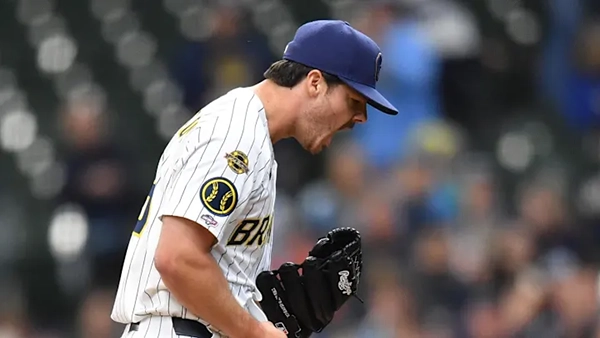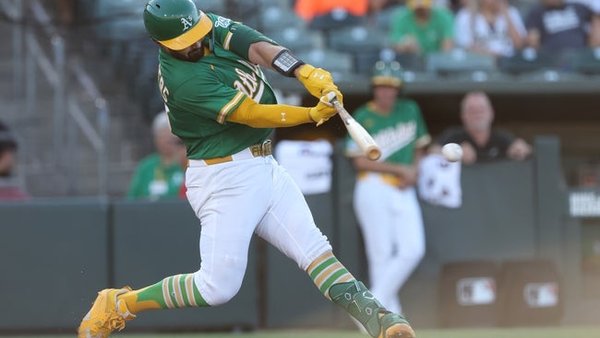
Aaron Civale (4.88 ERA) and Sam Aldegheri (5.47 ERA) represent two of the most hittable starters either team will deploy all season, yet the total sits at 9.5 in a park that trims run scoring by five percent. With Mike Trout shelved and a projected combined run total of 9.3, the gap between what the market is posting and what the numbers support is real — if narrow.
Aaron Civale vs Sam Aldegheri: Athletics at Los Angeles Angels Betting Preview
The Angels bounced back with a 5-2 win Saturday to split the first two games of this series, and now the finale features two of the more vulnerable starters either team will run out all season. Aaron Civale and Sam Aldegheri both carry ERAs north of 4.80, both are hittable, and both pitch in a park that mildly suppresses run scoring. That context — two legitimately bad starters in a 0.95-factor environment — is exactly where a total deserves scrutiny.
The moneyline is essentially a coin flip at Athletics -118 / Angels +100, with the numbers projecting a 52.7% home win probability and a nearly identical projected score of 4.7-4.6 in favor of Los Angeles. There’s no clean directional edge on the side. But the total at 9.5 tells a different story — the numbers land at 9.3, and with Angel Stadium trimming expected scoring and Mike Trout watching from the IL, the under is where the thin but real market gap lives.
Game Info & Betting Lines
- Date/Time: Sunday, June 28, 2026 | 3:15 PM ET
- Venue: Angel Stadium | Park Factor: 0.95 (run-suppressing)
- TV: Peacock
- Probable Starters: Aaron Civale (Athletics, 5-4, 4.88 ERA) vs. Sam Aldegheri (Angels, 2-3, 5.47 ERA)
- Moneyline: Athletics -118 / Los Angeles Angels +100
- Run Line: Los Angeles Angels +1.5 (-160) / Athletics -1.5 (+132)
- Total: 9.5 (Over -112 / Under -108)
Why This Number Is Close
The market isn’t wrong to set this at 9.5. Both starters generate baserunners, both lineups have genuine power threats, and the recent series context — a combined 9-3 A’s blowout on Friday — showed exactly how fast a game can spiral when a starter breaks down early. The books are pricing in the real possibility of a high-inning game shaped by bullpen arms rather than starter control, and that’s a legitimate concern with both teams carrying injury-depleted rotations.
But here’s where I think the number is slightly off: the Angels are not the same offensive club with Trout on the IL. His .866 OPS and 17 home runs represent the lineup’s highest-ceiling bat — the one hitter capable of turning a routine fly ball into a three-run swing. The replacement-level names filling that gap (Donovan Walton, Wade Meckler, Jose Siri) are serviceable contact hitters but not run-scoring drivers. Strip Trout out and this Angels offense — already running .240/.319/.398 as a unit, weaker than the A’s across every slash line — becomes genuinely low-ceiling.
The park factor is doing real work here too. Angel Stadium’s 0.95 run factor isn’t dramatic, but in a game projected within a half-run of the total, small nudges matter. A 9.3 projected combined run total, the park suppression, and the Trout absence together push the expected environment just under the posted number. That’s not a hammer — it’s a lean, and a disciplined one.
What Separates the Pitching
Neither starter inspires confidence, but the gap between them matters less than how each one shapes innings. Civale relies heavily on his cutter at 34.7% usage — it’s his most effective offering, holding hitters to a .276 xwOBA with a 21.4% whiff rate. His curveball generates whiffs at 23.8% but bleeds an xwOBA of .344. The problem is his sinker (18.7% usage, .437 xwOBA) and four-seamer (13.3% usage, .444 xwOBA) — when he misses up in the zone, hitters make loud contact. His 13 home runs allowed in 62.2 innings is the most damaging number on his ledger, and his 1.58 WHIP confirms the baserunner problem is real.
Aldegheri works with a very different profile. His four-seamer leads his arsenal at 43.5% usage, 92.1 mph, but it’s producing a .337 xwOBA with a troubling 9.0% whiff rate — hitters are putting it in play consistently. His changeup is his best swing-and-miss offering at 31.2% whiff with a .291 xwOBA, and his curveball misses bats at 28.6%. But his slider is an exposure: 5.0% usage, .641 xwOBA, 0.0% put-away rate — when he goes to it, damage follows. His 5.84 K/9 tells you he doesn’t miss bats regularly; he survives on weak contact with occasional slip-throughs.
The key matchup signal: Nick Kurtz sits at an xwOBA of .524 overall with a .440 against left-handed pitching — he’s the most dangerous bat Aldegheri will face. Zach Neto is hitting .414 xwOBA versus right-handers and is 3-for-10 with 4 strikeouts in limited BvP history against Civale — manageable, but not a total mismatch either. Neither pitcher creates the kind of dominant innings that lock down a total; both create the kind of innings where one bad sequence defines the line.
The Pushback
The strongest case against the under is sitting right in the recent game log: the A’s hung nine runs on the Angels on Friday. That game was a reminder that when a starter loses the zone early — as Ureña did in the fifth — these lineups can pile on in a hurry. Civale’s 1.58 WHIP means traffic is almost guaranteed, and a bases-loaded mistake in a short park can flip a 4-4 game into an 8-4 blowout before the sixth inning. The over is a live outcome, not a wild one.
I’m also aware that both bullpens are carrying extra load from this series. The A’s pen has already worked through a nine-run Friday and a tight Saturday loss; the Angels cobbled together late-inning arms to protect their 5-2 lead. Fatigued relievers who are asked to carry innings four through nine are a significant source of variance, and that variance tilts toward the over, not the under.
The Play
This is a lean, not a conviction bet. The 9.3 projected combined run total against a 9.5 posted line isn’t a screaming value — it’s a half-run of daylight in a -108 environment. What tips it for me is the combination of three independently reasonable factors all pointing the same direction: park suppression, Trout’s IL absence gutting the Angels’ ceiling, and two starters who generate weak contact more than strikeouts — which means innings stay efficient when the sequencing breaks right. One bad inning on either side erases this edge immediately.
At -108, you’re risking $108 to win $100. That’s a reasonable price for a lean with this much structural support. I’d cap exposure here at 1 unit.
Bet: Athletics @ Angels Under 9.5 — 1 unit (lean)