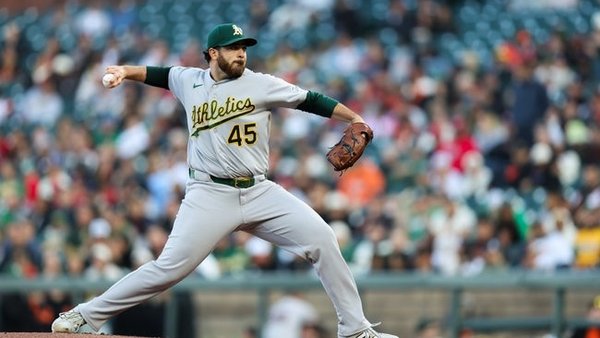
Alcantara’s 45.9% changeup whiff rate against a lineup missing Wilson, Soderstrom, Gelof, Rooker, and Langeliers is a matchup the -120 moneyline still hasn’t caught up with. Civale’s 1.86 HR/9 across 67.2 innings puts the mound gap in sharp relief — the number is treating this like a dead heat when it isn’t.
Sandy Alcantara vs. Aaron Civale: Miami Marlins at Athletics Betting Preview
Friday’s 12-5 demolition sent a message about which staff belongs in this park — and today’s number resets with Alcantara taking the ball against a struggling Aaron Civale. The market is treating this like a dead heat. I disagree, modestly but meaningfully.
Oakland is operating in survival mode. Five key position players are either on the IL or day-to-day: Jacob Wilson, Tyler Soderstrom, Zack Gelof, Brent Rooker, and Shea Langeliers — their three, four, and five hitters in terms of production are essentially gone. That’s not a minor inconvenience. That’s an order that Alcantara, even without elite strikeout numbers, should be able to navigate efficiently.
The pitching gap here is real. Alcantara’s 4.20 ERA and 1.28 WHIP stand in sharp contrast to Civale’s 5.05 ERA and 1.58 WHIP. Miami’s team pitching infrastructure (4.08 ERA, 1.251 WHIP) is meaningfully better than Oakland’s (5.05 ERA, 1.452 WHIP). The -120 moneyline doesn’t fully price in that separation when you stack the health disparity on top of it.
Game Info & Betting Lines
- Date/Time: Saturday, July 4, 2026 | 9:40 PM ET
- Venue: Sutter Health Park | Park Factor: 0.93 (slightly pitcher-friendly)
- TV: MLB.TV, Marlins.TV, NBC Sports CA
- Probable Starters: Sandy Alcantara (MIA, 9-4, 4.20 ERA) vs. Aaron Civale (OAK, 5-5, 5.05 ERA)
- Moneyline: Miami Marlins -120 | Athletics +102
- Run Line: Athletics +1.5 (-152) | Miami Marlins -1.5 (+126)
- Total: 11 (Over -110 / Under -110)
Why This Number Is Close — But Not As Close As It Looks
The market is doing something reasonable here: it sees a near-identical projected run environment (Miami 4.5, Oakland 4.4), a pitcher-friendly park, and a Marlins offense that just scorched Oakland for 12 runs on Friday. Regression is a real concept, and the books are pricing in some mean reversion from Miami’s blowout.
The legitimate case for Oakland at +102 exists. Nick Kurtz is a legitimate middle-of-the-order threat even in a decimated lineup — 19 home runs, a .938 OPS, and an xwOBA of .520 that signals he’s been as good as his numbers suggest, perhaps better. Alcantara’s K/9 of 6.54 doesn’t project as a swing-and-miss arm who can neutralize a power hitter like Kurtz with ease. The market knows Alcantara isn’t Max Scherzer in 2016; it’s pricing him accordingly.
But here’s where the line drifts off: the gap between Civale and Alcantara is wider than a 22-cent moneyline spread implies. Civale’s 1.86 HR/9 rate across 67.2 innings is genuinely alarming against a Miami lineup that has hit 84 home runs on the season. The Athletics’ lineup injuries remove the leverage points Oakland would need to make a close game competitive past the fifth inning. And the total set at 11 creates a pricing contradiction — if the market expects an 11-run game, it should be pricing Miami’s starter more favorably given who he’s facing. The number can’t be both a pitcher’s park and an 11-run environment at the same time. Something doesn’t add up, and I think it’s the total, not the moneyline.
What Separates the Pitching
This matchup isn’t close at the arsenal level, and the Statcast data makes that clear. Sandy Alcantara leads with a four-seam fastball sitting at 98.1 mph — 46.7% of his pitches — that holds hitters to a .328 xwOBA with a 21.5% whiff rate. That’s an above-average fastball by velocity, and it sets up his secondary arsenal effectively. His changeup, thrown at 89.7 mph and used 10.7% of the time, generates a 45.9% whiff rate — that’s an elite swing-and-miss offering. His curveball is his best soft-contact suppressor at a .199 xwOBA against, though he only throws it 6.7% of the time. His sweeper (.226 xwOBA against) complements it well, forcing weak contact and limiting barrels. The profile here is a starter who suppresses hard contact rather than piling up strikeouts, and against a depleted lineup, that’s exactly what you want.
Aaron Civale presents a sharply different picture. His four-seamer sits at 96.2 mph and leads his arsenal at 50.1% usage — but it produces only a 19.0% whiff rate and a .307 xwOBA against, which is passable. The concern is his slider, which he throws 25.4% of the time and surrenders a .352 xwOBA against. More critically, his overall command metrics — 1.58 WHIP, 14 home runs in 67.2 innings — tell the story of a pitcher who doesn’t miss enough bats to survive mistake pitches. His curveball (.199 xwOBA against) and changeup (.165 xwOBA against) are legitimate weapons when he throws them, but at 11.3% and 7.6% usage respectively, they’re not game-shapers.
The practical gap: Alcantara’s changeup and curveball create a run-suppression floor that Civale’s arsenal simply doesn’t match. Against a Miami lineup where Otto Lopez (.862 OPS, .371 xwOBA) and Joe Mack (.381 xwOBA vs. RHP) sit in the middle of the order, Civale’s HR vulnerability is the single biggest risk factor in the game.
The Pushback
The case against this play starts with how tight the projected run environment actually is — Miami 4.5, Oakland 4.4, a margin of 0.1 runs. That’s a coin flip dressed up as an edge. When I’m looking at the -1.5 run line at +126, that 0.1-run projected margin is the primary reason I’m passing. You can’t confidently lay a run-and-a-half when your projected scoring gap is one-tenth of a run, regardless of what the bullpen situation looks like on either side. The +126 is tempting but the math doesn’t support it.
Beyond the run-line rejection, there are real threats to the moneyline play too. Nick Kurtz represents a credible single-swing equalizer — his .520 xwOBA and 32.1% whiff rate against right-handers tell you Alcantara can’t take him lightly, even in a shortened order. The bullpen depth concerns on both sides are real; Miami is carrying its own IL casualties with Nardi, Bender, and Ekness all unavailable. A lead that Alcantara builds through five innings isn’t automatically safe.
And then there’s the total. The over/under is set at 11 in a park that plays to a 0.93 run factor. That’s a genuine contradiction — Sutter Health Park suppresses run scoring, and the total is priced as if the park doesn’t exist. If you believe the park factor matters (and you should), the total is the number most out of line here, not the moneyline. That tension doesn’t kill the Miami play, but it’s worth acknowledging that the market is sending mixed signals about what kind of game this is expected to be.
Run Line: Why I’m Passing
Miami -1.5 at +126 might look attractive on the surface — plus money on a team I expect to win. But as noted above, the projected scoring gap between these two teams is 0.1 runs. That’s the starting and ending point of this conversation. A one-tenth-of-a-run margin does not support laying a run-and-a-half, full stop. Civale’s HR tendency keeps the ceiling open for Oakland in any given inning, and with a bullpen that’s been taxed this series, Miami winning by a single run is a realistic outcome that -1.5 bettors lose on. The moneyline is the cleaner play.
The Play
Miami Marlins Moneyline (-120) — 2 Units — Moderate Confidence
The case is straightforward: Alcantara has a meaningful arsenal advantage over a Civale who is surrendering home runs at a 1.86 HR/9 clip against a Miami lineup that’s hit 84 on the year. Oakland’s injury attrition — Wilson, Soderstrom, Gelof, Rooker, and Langeliers all missing or day-to-day — strips the A’s of the lineup depth they’d need to manufacture a comeback against a quality starter. And -120 is within an acceptable juice range for a team with a legitimate pitching edge on the road. This isn’t a slam dunk; the projected margin is razor-thin and Kurtz is a real threat. But the combination of pitching gap, Oakland’s depleted roster, and a price that hasn’t fully accounted for those factors makes the Miami moneyline the play.
Bet: Miami Marlins Moneyline (-120) | 2 Units