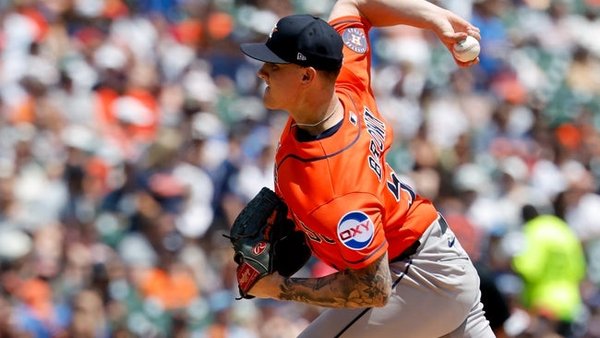
Christian Scott’s 11.18 K/9 and 39 walks in 89.1 innings profile sharper for this game shape than Hunter Brown’s 43 walks in just 74.1 innings — yet the market is anchored to the Mets’ 60-win record rather than starter efficiency. At +114, the Mets price sits looser than a projected near-even game warrants, and the walk-rate gap is the friction point the number hasn’t fully absorbed.
Hunter Brown vs. Christian Scott: Houston Astros at New York Mets Betting Preview
The Mets are a bad baseball team. Sixty wins, a negative run differential, and a lineup stripped down by injury attrition — that’s the honest description of what New York brings to the field on Friday night. The market knows it, which is why Houston opens as the moneyline favorite at -123 despite arriving on the road. But the favorite designation doesn’t tell the full story when you drill into the pitching matchup, and that’s exactly where this bet lives.
The numbers project this game 4.5 Mets, 4.2 Astros — a coin-flip dressed up as a Houston lean. The Mets are getting +114 in a game that looks like a slight home advantage when you run the starter and park factors through. That gap between market price and projected probability is where the value sits. The market is reacting to roster context — and reasonably so — but it’s slightly underweighting what Scott brings to the mound relative to Brown tonight.
The Astros arrive having taken two of three from the Yankees, with momentum and a lineup that is more dangerous top-to-bottom than anything the Mets can put out. None of that is irrelevant. But a pitching gap is a pitching gap, and this one deserves a closer look before the lineup disparity swamps the analysis entirely.
Game Info & Betting Lines
- Date/Time: Friday, August 28, 2026 — 7:10 PM ET
- Venue: Citi Field | Park Factor: 0.97 (slight pitcher’s lean)
- TV: MLB.TV, Space City Home Network, SNY
- Probable Starters: Hunter Brown (HOU) vs. Christian Scott (NYM)
- Moneyline: Houston Astros -123 / New York Mets +114
- Run Line: New York Mets +1.5 (-157) / Houston Astros -1.5 (+130)
- Total: 8.0 (Over -103 / Under -117)
Why This Number Is Off
The case for Houston at -123 is legitimate on its face. The Astros have a better overall record, a more dangerous lineup when healthy, and they come in off a confidence-building series win in New York. Meanwhile, the Mets just dropped two straight to Milwaukee by a combined 16-3 margin before sneaking out a 10-inning win Tuesday. The market is crediting the Astros for roster quality — and roster quality is real.
But here’s the problem: the moneyline price implies a meaningful win-probability gap that the projected scoring simply doesn’t support. A difference of 0.3 projected runs is the definition of a coin-flip. At -123, you’re paying roughly 55% implied probability for a game the numbers see as closer to 50-50 with a slight Mets edge due to home field and the starter gap. The price doesn’t reflect the actual pitching matchup — it reflects the Mets’ 60-74 record and depleted lineup, which the market has overcorrected on.
The flip side is that the market isn’t wrong about the Mets being a bad team — it’s just priced past the point where that weakness is already baked in. Getting +114 in a projected near-even game creates positive expected value even accounting for the Mets’ offensive limitations. That’s the angle.
What Separates the Pitching
The starting pitcher gap here is genuine and measurable, and it runs in Scott’s favor on the metrics that matter most for limiting damage in a tight, low-scoring game.
Christian Scott carries a 11.18 K/9 across 89.1 innings this season, backed by a four-seam fastball sitting 95.5 mph that he throws 47.2% of the time — and it’s producing a 25.9% whiff rate. His sweeper, thrown 22.9% of the time, is the secondary weapon: 81.4 mph with a 29.3% whiff rate and an excellent .236 xwOBA against. That’s a legitimate strikeout combination. Scott has also issued just 39 walks in 89.1 innings, giving him elite control relative to his counterpart.
Hunter Brown is no slouch — his 3.51 ERA is a real number and he’s been durable. His four-seam runs 96.3 mph and generates a 20.7% whiff rate. His knuckle curve at 83.4 mph is his best secondary, posting a 35.3% whiff rate. The concern is walk rate: Brown has issued 43 walks in just 74.1 innings. That’s roughly 1.2 fewer innings per walk than Scott. Against a lineup capable of stringing together baserunners — even a diminished one — that’s a meaningful free-pass problem.
The Astros’ lineup threats are real. Yordan Alvarez (.529 xwOBA, 36 HR) is the most dangerous hitter in this game by a wide margin — his .537 xwOBA against right-handed pitching means Scott cannot afford to miss in his zone. Jeremy Peña is listed day-to-day with the hand injury suffered when hit by a pitch Thursday, which introduces legitimate lineup uncertainty at Houston’s number-two spot. The Mets’ lineup counters with Francisco Lindor (.376 xwOBA) and Carson Benge (.403 xwOBA, .394 vs. RHP), who can cause problems for Brown if he’s spotty with his command. The per-inning efficiency edge belongs to Scott — and in a projected 8-9 run environment, that edge compounds.
The Pushback
The honest case against this bet starts and ends with Yordan Alvarez. His .537 xwOBA vs. right-handed pitching, 9.0% barrel rate, and 31.5% hard-hit rate make him a one-swing threat capable of erasing any pitching edge Scott builds. Scott has to face him multiple times in a game where run margins are thin — one mistake pitch and the entire value equation flips. That’s a real risk, not a theoretical one.
The bullpen situation compounds it. The Mets are without Devin Williams (shoulder, 15-day IL) and Cionel Perez (forearm, 15-day IL) — two of their better late-inning arms. If Scott exits early or runs into trouble in the fifth or sixth, the bridge to the back end gets dicey fast. The Astros don’t have those bullpen concerns at the same level, which means the leverage innings probably favor Houston once starters are removed from the equation.
And the Mets offense is genuinely bad. A .695 OPS as a team, 552 runs scored, and a lineup that currently has Juan Soto (calf), Mark Vientos (hand), and Jorge Polanco (ankle) on the IL. The top of the order can put together at-bats, but there’s very little margin for error if Scott doesn’t give them length. Brown’s walk-rate problem is real, but the Mets may not be disciplined enough to punish it consistently.
None of this makes the bet wrong — it makes it a lean, not a hammer. The Astros moneyline case is legitimate. The pushback here is genuine, and anyone fading this ticket isn’t making an unreasonable call.
Run Environment & Game Shape
The total is set at 8.0, and the projected combined output of 8.7 runs sits just above that number — a moderate over lean that I’m not chasing separately. What matters for the moneyline is game shape: at 8-9 projected runs in a 0.97 park factor environment, we’re looking at a relatively competitive, moderate-scoring game rather than a slugfest. That’s the kind of game where the starter efficiency gap between Scott and Brown has the most room to matter.
When games stay in the 4-5 run range per side, starters go deeper, walk rates become more consequential, and strikeout upside suppresses rallies. Scott’s 11.18 K/9 and tighter walk numbers are built for exactly that game shape. Brown’s profile — solid ERA, elevated walk rate, contact-heavy sinker at 29.3% usage — is more vulnerable when he’s forced to navigate traffic repeatedly against a lineup that will take its walks even if it doesn’t hit for power.
This isn’t a game I’m expecting the Mets to blow open. The roster gap is real and the bullpen limitations are real. But a coin-flip game at +114 doesn’t need the Mets to dominate — it just needs Scott to outpitch Brown for five or six innings and give the Mets a chance to win a close one. In a near-even run environment at a slight pitcher’s park, that’s a reasonable ask from a starter with his strikeout and walk profile.
The Pick
Scott’s K/walk edge is the clearest measurable gap in this game, and the market hasn’t priced it into the moneyline — +114 in a projected near-coin-flip is where the value lives. Yes, Alvarez’s .537 xwOBA vs. right-handers is a legitimate ceiling threat that keeps this firmly in lean territory rather than a strong play. But one unit on the Mets at plus money in a game the numbers call essentially even is exactly the kind of spot I’m looking for.
Bet: New York Mets moneyline +114 — 1 unit, lean.