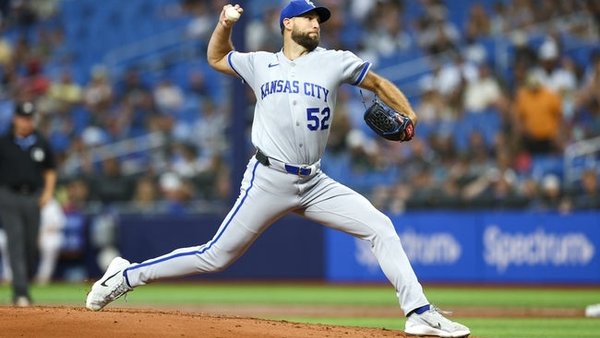
Two efficiency-first starters with sub-4.00 ERAs take the mound at Progressive Field — a slight run suppressor — while the 8.0 total still carries Kansas City’s recent offensive tear in its math. The market anchored on the Royals’ 9-1 stretch without fully adjusting for the dramatic pitching quality jump from Toronto’s staff to what Cleveland sends out tonight.
Michael Wacha vs. Tanner Bibee: Kansas City Royals at Cleveland Guardians Betting Preview
The market has priced this game around two legitimate mid-rotation arms in a run-suppressing environment, and the 8.0 total reflects that — at least on the surface. But there’s a gap between what the number acknowledges and what the pitching profiles actually project. Both Wacha and Bibee are efficiency-first starters who control the strike zone, limit walks, and generate weak contact rather than swing-and-miss volume. That’s not the profile that produces double-digit run totals.
Cleveland’s offense arriving at .686 OPS as a team — with just 124 home runs on the season — is not a lineup built to punish quality pitching. Kansas City’s .717 OPS is modest in its own right, and while the Royals have been scorching lately, the context of that hot streak matters. This game starts with Wacha and Bibee, not the patchwork staffs they’ve been feasting on. The pitching gap between Toronto’s rotation and what Cleveland puts on the mound tonight is significant, and that context is exactly what makes the Under the play here.
Yes, Kansas City just dropped 13 runs on Toronto. I’m not ignoring that. But Noah Cameron started that game — this is a completely different conversation.
Game Info & Betting Lines
- Date/Time: Friday, August 28, 2026 | 7:10 PM ET
- Venue: Progressive Field (Park Factor: 0.98 — slight run suppressor)
- TV: MLB.TV, CLEGuardians.TV, Royals.TV
- Probable Starters: Michael Wacha (KC) vs. Tanner Bibee (CLE)
- Moneyline: Kansas City Royals +121 / Cleveland Guardians -130
- Run Line: Cleveland Guardians -1.5 (+157) / Kansas City Royals +1.5 (-191)
- Total: 8.0 (Over -103 / Under -117)
Why This Number Is Close But Slightly Off
The 8.0 total is not an egregious number. The market is doing its job — it sees two starters with ERAs between 3.49 and 3.97, accounts for KC’s recent offensive surge, and sets a line that doesn’t screech for attention. That’s the legitimate case for the Over: Kansas City has gone 9-1 in their last 10, the offense is running hot, and the Royals have shown the ability to pile on when the situation opens up.
But here’s the problem: the market may be anchoring too heavily on Kansas City’s recent run production without adjusting for the dramatic pitching quality differential between their last series and tonight. Toronto’s staff is a significantly inferior product to what Wacha represents. And on the Cleveland side, the Guardians’ .686 team OPS suggests a contact-first lineup that grinds but doesn’t slug — they’ve hit just 124 homers all season, ranking them near the bottom of the league in power.
The numbers land at 8.8 combined runs projected — barely clearing the 8.0 posted number. That slim margin means both starters need to perform at their season-long averages, not their best, for the Under to cash. At -117, the price on the Under is still in playable range. This isn’t a screaming inflated number, which is exactly why this is a moderate lean — not a pound.
What Separates the Pitching
Michael Wacha and Tanner Bibee are remarkably similar arms on paper — and that similarity is precisely what makes this game a run-suppression candidate rather than a slugfest. Wacha carries a 3.49 ERA and 1.13 WHIP over 162.2 innings, with 42 walks issued all season. That’s elite-level control for a starter of his profile. His arsenal is built around deception: a changeup generating 26.5% whiff rate at just 80.6 mph, a slider at 29.4% whiff, and a cutter he leans on for 14.7% of pitches. His fastball sits 93.0 mph and doesn’t miss bats at a high rate (16.8% whiff), but his plus command keeps hitters off-balance. Against a Cleveland lineup featuring Steven Kwan (xwOBA .296, 6.3% whiff rate) and José Ramírez (xwOBA .354 — solid but not elite), Wacha’s contact-management style fits well. Ramírez carries a modest .261 average in 24 PA against Wacha with just 2 strikeouts — solid contact but no power production in that sample, which tells you Wacha is keeping him in the yard even when he makes contact. Salvador Perez is just .048 in 24 PA against Bibee with 7 strikeouts — that career futility matters in situational at-bats.
Wacha’s cutter sits 89.2 mph and generates a 13.0% whiff rate — not a swing-and-miss weapon, but a command and shape pitch that he deploys to work both sides of the plate and keep hitters from sitting on his changeup. It’s a sequencing tool more than a put-away offering, and that’s where Wacha’s real value lies: he makes you uncomfortable without needing to overwhelm you.
Bibee answers with a cutter that sits 85.8 mph and generates a 30.7% whiff rate — his best swing-and-miss offering — alongside a changeup at 32.3% whiff. His four-seamer sits 94.0 mph with a modest 13.5% whiff, which means he’s not blowing fastballs past anyone, but his secondary arsenal creates genuine chase situations. The concern with Bibee is his 26 home runs allowed in 156.1 innings — and Jac Caglianone’s .470 xwOBA with a 7.5% barrel rate represents exactly the type of hitter who can punish a mistake cutter over the plate. That said, Vinnie Pasquantino’s .588 average in 19 PA against Bibee with two homers is a real matchup flag. And Salvador Perez — who hits cleanup in this lineup effectively — is a career .048 in 24 PA against Bibee with 7 punchouts. Those splits don’t cancel each other out; they create a lineup that has isolated danger spots rather than sustained threat across the order.
The Friction: Where the Under Can Lose
The honest pushback here starts with Kansas City’s bullpen depth. The Royals are carrying an injury list that reads like a triage ward: Carlos Estevez (60-Day IL), Nick Mears (60-Day IL), Connor Seabold (60-Day IL), Beck Way (15-Day IL). That’s meaningful late-inning damage. If Wacha exits early or runs into trouble in the fifth or sixth, the bridge options behind him are significantly thinner than they would be at full strength. A short outing plus a shaky bullpen can unlock innings in a hurry.
Chase DeLauter is listed day-to-day with left hamstring tightness. He sparked the ninth-inning rally in Cleveland’s most recent win and is one of the Guardians’ most dangerous hitters at .289 AVG and .814 OPS. His absence from the lineup — or reduced capacity — matters for Cleveland’s run-scoring ceiling, but it also matters for how you structure your confidence in the Under. A Cleveland lineup without DeLauter at full health is a quieter lineup.
And then there’s the hot-streak momentum argument. Kansas City has gone 9-1 in their last 10 games. Momentum is real in baseball, and an offense that’s been scoring freely doesn’t just forget how to put up runs because the opponent changes. The Royals are scoring 578 runs on the season — that’s not a fluke pace. I hear the argument. I just don’t think it overrides a legitimate pitching edge when the matchup is this well-defined.
What I’m Not Betting
The run line at -1.5 (+157) is tempting on paper for Cleveland, but I’m not there. Bibee has allowed 26 home runs and Kansas City has genuine power threats at the top of the order — Caglianone at .470 xwOBA, Bobby Witt Jr. at .432 xwOBA. One swing changes a tight game. Laying 1.5 runs against a 9-1 team at a price that implies Cleveland wins by 2+ more than a third of the time is too much exposure on either side of that equation.
The Cleveland moneyline at -130 has a legitimate mathematical edge based on the win probability figures, but I don’t love backing a home favorite at that price when the road team is red-hot and the run line risk eats into your return on a narrow win. The total is cleaner, and the edge is more legible.
Run Environment & Game Shape
Progressive Field carries a 0.98 park factor — not a dramatic run suppressor, but a nudge in the right direction for the Under. It’s a tiebreaker, not a primary driver. What actually shapes this game’s run environment is the pitching on both sides: two starters with WHIPs under 1.15, two lineups with team OPS under .720, and a combined 8.8 projected run total that sits just above the posted 8.0 line.
In a game where the pitching matchup already profiles as a low-scoring, contact-management contest, that 0.8-run gap between the projection and the posted total is doing real work. When both starters execute at their season-long norms, the natural landing zone for this game is somewhere in the 4-4 to 5-4 range — which means the Under cashes without needing anything exceptional from either pitching staff. That’s the kind of game shape I want when I’m laying juice on a total.
Bet: Under 8.0 — 2 units, moderate confidence.