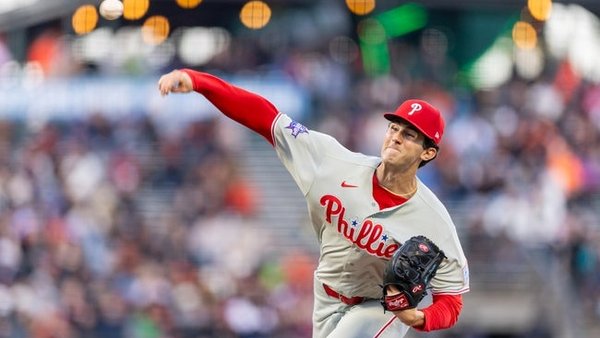
A 2.37-run ERA gap separates the two starters on the mound Tuesday night, yet the moneyline is built around Philadelphia’s season-long résumé rather than who is actually throwing the ball. Wesneski’s 1.06 WHIP and elite whiff rates meet a Painter who is surrendering home runs at a 1.45 HR/9 clip — the number at -145 does not reflect that specific mismatch.
Hayden Wesneski vs Andrew Painter: Houston Astros at Philadelphia Phillies Betting Preview
The market sees an 81-63 Philadelphia Phillies team playing at home against a Houston squad sitting at 73-71, and it prices accordingly — Phillies -145, Astros +120. That’s a reasonable reflex. Philadelphia has been the better team all season, they’re riding a 7-3 stretch in their last ten games, and Citizens Bank Park is their house. The public money flows toward that narrative, and the line reflects it.
But the market is pricing season-long résumés tonight, and tonight has a very specific pitching matchup that the résumés don’t capture. Hayden Wesneski against Andrew Painter is not a coin-flip arms race — it’s a significant gap that the +120 underdog price fails to account for. When the numbers project this game at Philadelphia 4.8, Houston 4.6, you’re being offered plus money on what amounts to a coin-flip outcome.
The Phillies are arriving from a dominant 1-0 shutout win over the Braves on Monday, while Houston just dropped two of three to Arizona. Context noted — and then set aside, because the pitching matchup on the mound Tuesday night is where the edge lives.
Game Info & Betting Lines
- Date/Time: Tuesday, September 8, 2026 | 6:40 PM ET
- Venue: Citizens Bank Park | Park Factor: 1.02 (marginally hitter-friendly)
- TV: MLB.TV, TBS, NBC Sports Philadelphia, Space City Home Network
- Probable Starters: Hayden Wesneski (HOU) vs Andrew Painter (PHI)
- Moneyline: Houston Astros +120 / Philadelphia Phillies -145
- Run Line: Philadelphia Phillies -1.5 (+139) / Houston Astros +1.5 (-168)
- Total: 8.5 (Over -115 / Under -105)
Why This Number Is Off
Philadelphia at -145 is not an irrational line. The Phillies are genuinely the better team — their +35 run differential compared to Houston’s -38 tells you that. Home field adds a small but real advantage, and the Phillies lineup featuring Kyle Schwarber (43 HR, xwOBA .508) and Bryce Harper (xwOBA .445) is legitimately dangerous.
But here’s the problem: the market is pricing the teams, not the starters. At -145, you need Philadelphia to win roughly 59% of the time to break even. The 56.2% win probability the numbers spit out for Philly falls short of that threshold. That’s a negative-value line — you’re paying for more certainty than actually exists.
The legitimate case for Philly is real: a proven home-field lineup, a bullpen that’s been solid when healthy, and a Houston offense that has gone cold recently. But the line already accounts for most of that edge. What it doesn’t fully account for is how badly Painter has pitched this season and how cleanly Wesneski has thrown the ball. When the projection says 4.8 to 4.6, paying -145 for the home team is an exercise in negative expected value. The +120 on Houston is where the overlay actually lives.
What Separates the Pitching
The gap between these two starters is the central story of this game. Hayden Wesneski carries a 3.18 ERA and 1.06 WHIP across 39.2 innings this season. Andrew Painter is at 5.55 ERA and 1.37 WHIP in 105.1 innings — a 2.37-run ERA gap over a sample that’s 2.5 times larger. Painter has surrendered 17 home runs in those 105 innings, a rate of 1.45 HR/9 that becomes a serious vulnerability against a Houston lineup with 187 team home runs.
Wesneski’s arsenal is built around deception and movement. His sweeper sits at 81.1 mph and generates a 41.7% whiff rate with an xwOBA-against of just .240 — that’s a genuine put-away pitch. His changeup adds another layer at 86.6 mph and a 36.8% whiff rate (.232 xwOBA). Even his sinker at 92.7 mph holds hitters to a .283 xwOBA. The cumulative effect is a pitcher who creates weak contact and soft innings.
Painter’s 96.5 mph four-seam fastball looks electric on paper — 34.1% usage, raw velocity that should generate swings and misses. But the four-seamer posts only an 11.2% whiff rate and surrenders a .394 xwOBA against, meaning hitters are squaring it up regularly. His best weapon is the split-finger at 87.5 mph — 38.3% whiff rate and a .234 xwOBA — but it’s deployed only 9.2% of the time. The slider and sweeper show promise, but his primary pitch keeps getting hit hard.
Now overlay the lineup matchups. Yordan Alvarez carries an xwOBA of .518 and a 30.9% hard-hit rate — and he hits right-handed pitching at a .535 xwOBA. Painter is right-handed. That is the single most dangerous individual matchup on this field. Alvarez’s 38 home runs and elite contact metrics against a pitcher surrendering 1.45 HR/9 is not a subtle edge — it’s the kind of mismatch that can decide a tight game with one swing.
The Pushback
The case against this bet deserves honest treatment. Wesneski has thrown only 39.2 innings this season. A 3.18 ERA over that sample is encouraging, but it’s a small enough window that regression is a legitimate concern — we simply haven’t seen him enough to know if this is the real version. On the Phillies side, Schwarber has a home run in six plate appearances against Wesneski in their brief BvP history, and Trea Turner has gone deep twice in six PA against him. A pitcher with a small sample and live BvP exposure to the top of a dangerous lineup is not a lock.
Houston’s bullpen situation also matters. Bryan King blew a save against Arizona on Saturday — a walk-off single that cost the Astros a win — and he now has 2 blown saves in 4 chances. Steven Okert is on the IL with a hamstring issue, which shortens the back end of the Houston ‘pen in a game that could come down to the seventh and eighth innings. The Phillies aren’t fully healthy either — Tanner Banks, Brad Keller, and Caleb Kilian are all on the IL — but Philadelphia’s bullpen depth has held up better through the stretch run than Houston’s has.
These are real risks. I’m not dismissing them. But they’re already baked into the +120 price to a significant degree. The question isn’t whether Houston is perfect — it’s whether +120 compensates you fairly for the risk. Given the starter gap and the 4.8-to-4.6 run projection, it does.
Rejected Angles
Two alternative bets will catch your eye on this line sheet, and both deserve a quick dismissal. The Phillies -1.5 at +139 is genuinely tempting — getting paid plus money to lay the run line on a home favorite looks like found money. But in a game projected 4.8 to 4.6, requiring a two-run Philadelphia margin means asking Painter to deliver a dominant performance. A 5.55 ERA pitcher facing Alvarez and a lineup with 187 home runs is not a reliable source of two-run cushion. The number is attractive precisely because the outcome is unlikely — pass. As for the over 8.5 at -115, the 9.4 projected total does clear the bar, but a 0.9-run edge priced at -115 juice doesn’t offer enough cushion to prioritize, especially with Wesneski capable of holding the Phillies in check through the order. The moneyline is the cleanest expression of the edge here.
Run Environment & Game Shape
Citizens Bank Park plays at a 1.02 park factor — marginally hitter-friendly, but not a number that meaningfully inflates run expectation. The total is set at 8.5, and the projected 9.4 total suggests a modest lean toward the over, but not enough edge at -115 juice to act on separately. This is a game that lives and dies with the starters through the first five or six innings.
The game shape here is pitcher-driven through five or six innings, after which the bullpens take over in what figures to be a tight, low-to-mid-single-digit game. Wesneski’s sweeper and changeup combination — 41.7% and 36.8% whiff rates respectively — gives him the tools to suppress the Philadelphia lineup through his allotted turns. Painter’s inability to miss bats consistently with his primary fastball (11.2% whiff rate, .394 xwOBA against) means Houston’s lineup, anchored by Alvarez’s .535 xwOBA vs. right-handers, has a real path to scoring early. A 4.8-to-4.6 final projection means neither team is running away with this game — which is exactly why +120 on the side with the superior starting pitcher is the right place to be.
The Astros don’t need to dominate. They just need to stay close long enough for the starter edge to matter, and at +120, that’s a bet worth making.
The Pick
The market has correctly identified Philadelphia as the better team and priced them accordingly at -145. What it hasn’t done is fully price in the gap between a 3.18 ERA pitcher with a legitimate put-away sweeper and a 5.55 ERA pitcher whose primary fastball gets squared up at an xwOBA of .394. When the numbers project a 4.8-to-4.6 game, you’re being asked to pay a 59% implied probability for a team the data says wins 56.2% of the time. That’s negative value. The +120 on Houston flips that equation in your favor.
Bet: Houston Astros Moneyline +120 — 2 units — Moderate Confidence