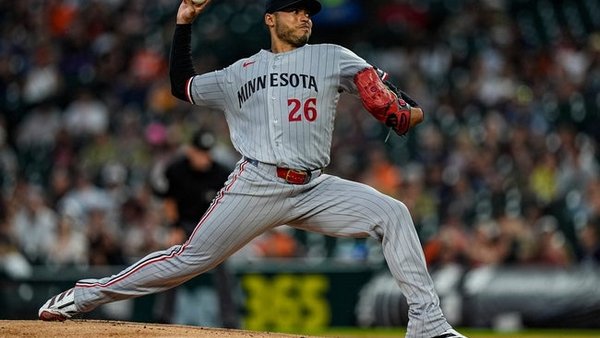
Parker Messick’s 2.53 ERA against Taj Bradley’s 3.95 ERA at near-even money represents a pitching gap the moneyline at -122/-102 hasn’t fully absorbed. Cleveland’s staff-wide ERA advantage of nearly a full run — 3.80 to Minnesota’s 4.67 — runs deeper than the price implies, and a neutral park at Target Field removes the one variable that could flatten it.
Parker Messick vs. Taj Bradley: Cleveland Guardians at Minnesota Twins Betting Preview
The market has Cleveland at -122 and Minnesota at +102 — a spread that implies roughly a 55/45 split. That’s fair if you think these two starters are comparable. They aren’t. Parker Messick (11-9, 2.53 ERA) and Taj Bradley (11-6, 3.95 ERA) represent a meaningful pitching gap, and the Guardians’ staff-wide advantage reinforces that edge at every level. The moneyline price doesn’t fully capture it.
What’s muddying the picture is Minnesota’s offensive profile — .245 batting average, 172 home runs, 675 runs scored — which looks more dangerous than Cleveland’s anemic .237/.686 OPS lineup on paper. Kody Clemens (26 HR) and Ryan Jeffers (.872 OPS) give the Twins real threats. Add in the fact that Bradley’s 11 wins suggest he’s been competitive in his starts, and suddenly the market hesitation around Cleveland makes a little more sense.
But this isn’t a lineup matchup win. It’s a pitching-driven lean. Cleveland’s team ERA of 3.80 against Minnesota’s 4.67, a neutral park, a missing Byron Buxton, and a starter edge that runs nearly 1.5 ERA points deep — that’s the argument. At -122, I’m buying it.
Game Info & Betting Lines
- Date/Time: Friday, September 11, 2026 — 8:10 PM ET
- Venue: Target Field | Park Factor: 1.00 (neutral)
- Probable Starters: Parker Messick (CLE, 11-9, 2.53 ERA) vs. Taj Bradley (MIN, 11-6, 3.95 ERA)
- Moneyline: Cleveland Guardians -122 / Minnesota Twins +102
- Run Line: Cleveland Guardians -1.5 (+138) / Minnesota Twins +1.5 (-168)
- Total: 7.5 (Over -115 / Under -105)
Why This Number Is Close But Off
The market is doing its job. Minnesota plays at home, has a more balanced offensive profile, and Bradley’s record suggests he’s been capable of winning ballgames — his 11-6 mark isn’t purely an ERA illusion. The Twins also score more often (4.62 runs per game vs. Cleveland’s 4.07) and have more thunder in the lineup. The bookmakers aren’t wrong to keep this tight.
But here’s the problem: team ERA is a blunt instrument until you notice that the gap here is nearly a full run — 3.80 vs. 4.67 — and that scales across nine innings in ways the moneyline doesn’t fully account for. Cleveland’s pitching staff has also racked up 1,384 strikeouts to Minnesota’s 1,224, a bullpen depth signal that matters when starters exit in the sixth or seventh.
The concern for Cleveland is real: their offense is bottom-tier (.686 OPS, 138 HR), and a projected 4.4-4.2 final score is not a comfortable margin. That said, what actually drives the outcome tonight is which staff controls the run environment — and Cleveland’s is measurably better from the rotation through the relievers. At -122, the juice clears the ceiling where this bet stops making sense, and that’s the baseline for pulling the trigger.
What Separates the Pitching
Parker Messick is the anchor of this play. His 2.53 ERA over 11 decisions isn’t a fluke propped up by lucky sequencing — it reflects a starter who limits damage and controls innings. Messick’s profile leans toward suppression: he keeps runs off the board consistently, and in a neutral environment like Target Field (park factor 1.00), that translates directly. There’s no wind-aided homer park to override his work.
The matchup against Minnesota’s lineup is manageable. Kody Clemens (.408 xwOBA, 6.4% barrel rate, 29.6% hard-hit rate) is the biggest concern facing a left-handed starter, and his .384 xwOBA against LHP confirms he’s not automatically neutralized by the handedness. Josh Bell (.383 xwOBA, 5.0% barrel rate) is another legitimate threat from the right side, posting a .404 xwOBA against RHP — but Messick’s ability to suppress contact across the board limits how much those hitters can exploit any single matchup.
Bradley, by contrast, shows the leakier profile. His 3.95 ERA puts him in a range where run prevention is inconsistent, and Minnesota’s team pitching WHIP of 1.380 suggests the whole staff bleeds baserunners. Cleveland’s lineup is cold — their recent stretch has been ugly — but Chase DeLauter (.363 xwOBA, 29.3% hard-hit rate) and Nathaniel Lowe (.413 xwOBA, 351 AB) are legitimate damage threats if Bradley doesn’t command the zone.
The gap isn’t just ERA. It’s the type of innings each pitcher creates. Messick tends to generate low-event frames that keep the bullpen fresh and the run total contained. Bradley’s profile invites traffic — and Minnesota’s bullpen behind him doesn’t inspire confidence given a 4.67 team ERA. That structural difference is where the edge lives.
The Pushback
I’m not going to paper over the legitimate friction here. Cleveland’s offense is genuinely anemic — .686 OPS, just 138 home runs, 598 runs scored on the season. That’s a lineup that makes every outing from Messick feel like a high-wire act, because if he gives up more than three runs, the Guardians may not have enough in the tank to bail him out. Recent form backs that concern up: Cleveland just dropped two of three in Baltimore, including an ugly 9-5 loss where they surrendered eight runs in a single inning.
Minnesota’s home-field advantage is also worth acknowledging. The Twins have scored 675 runs — they’re not toothless. Bradley at 3.95 isn’t elite, but he’s been good enough to win eleven games this season, and the Twins’ lineup, even without Buxton, can string together damage. Kody Clemens is hitting lefties at a .384 xwOBA clip, which is directly relevant against Messick.
The run line at +138 is tempting — Cleveland winning by two or more is plausible given the pitching edge — but the margin in a game projected this close doesn’t justify the added exposure. A one-run Guardians win still cashes the moneyline and loses the run line. I’d rather take the cleaner path.
The total is a pass too. At 7.5, the over is priced at -115, and while the combined offenses have the capacity to push past that number, Messick’s suppression profile argues against it. The numbers project 8.6 combined runs, but that figure is sensitive to early-inning variance — one crooked number and the total flips. Not enough edge to buy into the over at that price when the moneyline already captures the real thesis.
Joe Jensen’s Pick
Projected Score: Minnesota Twins 4.2 — Cleveland Guardians 4.4
Bet: Cleveland Guardians Moneyline -122 | 2 Units | Moderate Confidence
The pitching edge is real and the price is still reasonable — Messick’s 2.53 ERA against Bradley’s 3.95, backed by Cleveland’s staff-wide ERA advantage of nearly a full run, gives the Guardians a clear structural edge that -122 doesn’t fully price in.