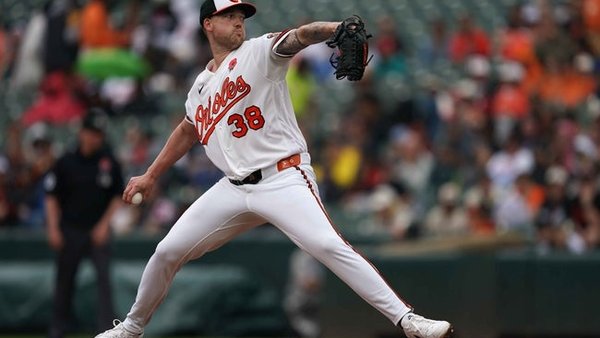
Spencer Miles carries a 2.77 ERA and a 0.51 HR/9 rate into a matchup where Baltimore’s outfield depth has been gutted by the IL — three starters gone. The total sits at 8.5, but the pitching halves do not pull evenly, and one side of this equation is being underweighted by a market still reacting to Friday’s seven-run Baltimore eruption off a very different arm.
Kyle Bradish vs Spencer Miles: Baltimore Orioles at Toronto Blue Jays Betting Preview
The series opened Friday with Baltimore’s bats coming alive — seven runs scored off Toronto starter Max Scherzer, a 7-4 final. Scherzer, Toronto’s Friday arm, took the loss (now 2-8), allowing six runs in five innings while Chris Bassitt earned the win for Baltimore. That result is going to drive casual money toward Baltimore today, and the near-even moneyline (-105 Orioles, -115 Blue Jays) suggests the market is taking it seriously. But Scherzer is not Miles, and that distinction is the entire argument here. Miles is a fundamentally different pitcher, and Baltimore is about to find out.
Spencer Miles brings a 2.77 ERA and 1.05 WHIP into Rogers Centre against a Baltimore lineup missing Tyler O’Neill, Christian Franklin, and Luis Robert Jr. — three outfielders on IL simultaneously. The Orioles have the raw power (Pete Alonso at 34 HR, 178 team home runs) but Miles has allowed just five home runs in 87.2 innings, a 0.51 HR/9 rate that neutralizes Baltimore’s primary offensive weapon.
Kyle Bradish, meanwhile, carries a 1.42 WHIP and 68 walks issued on the season — legitimate run-creation opportunities for Toronto. The problem is that the Blue Jays’ offense ranks among the weaker AL units at .692 OPS and 593 runs scored. The two pitching halves pull in different directions, and the net result barely clears this total. That’s where the play lives.
Game Info & Betting Lines
- Date/Time: Saturday, September 12, 2026 | 3:07 PM ET
- Venue: Rogers Centre (Park Factor: 1.00 — dead neutral dome, no inflation)
- Probable Starters: Kyle Bradish (BAL) vs Spencer Miles (TOR)
- Moneyline: Baltimore Orioles -105 / Toronto Blue Jays -115
- Run Line: Toronto Blue Jays +1.5 (-187) / Baltimore Orioles -1.5 (+154)
- Total: 8.5 (Over -107 / Under -113)
Why This Number Is Close
The market is doing real work here, and I want to acknowledge that before I explain the lean. The 8.5 total reflects two legitimately average offenses, a neutral dome park, and the reality that both clubs carry negative run differentials on the season (Baltimore at -24, Toronto at -42). The bookmakers aren’t being reckless. They’ve seen Friday’s 7-4 final and they know Baltimore can score in bunches when the conditions align.
The legitimate case for the over centers on Bradish’s walk rate. At 68 BB in 152.0 IP, he consistently puts runners on base, and Baltimore’s Pete Alonso (.484 xwOBA, 34 HR) represents exactly the kind of threat that can turn a two-runner into a three-run inning with one swing. Toronto’s lineup, despite its anemic .692 OPS, has Kazuma Okamoto at 31 home runs — power that doesn’t disappear overnight.
But here’s the problem with the over: the numbers land at 8.9 combined runs projected, which is barely four-tenths above the posted line. That’s not a number you hammer the over on. At -107 over versus -113 under, the juice structure nudges toward the under on an essentially coin-flip projection. When Miles is controlling one half of this equation with elite precision, I’ll take that nudge.
What Separates the Pitching
The gap between these two starters is real and it shows up in the Statcast data as clearly as anywhere. Miles’ sinker sits at 96.2 mph with a .290 xwOBA against — he’s throwing it 42.2% of the time and getting legitimate ground-ball contact that doesn’t travel. His four-seam fastball is the true weapon: 96.0 mph, 23.8% whiff rate, and an absurd .195 xwOBA against. That’s an elite zone-setting pitch that makes his curveball (.280 xwOBA, 24.1% whiff) play up significantly because hitters can’t sit on the breaking ball when the fastball is that live.
Bradish works a different profile. His sinker (36.1% usage, 94.7 mph) generates soft contact — a respectable .312 xwOBA — and his curveball is genuinely effective at a .263 xwOBA against with 35.2% whiff. The slider adds another put-away option. The problem isn’t his stuff; it’s his command. At 1.42 WHIP and 68 walks, Bradish creates traffic constantly. Against Toronto’s lineup, that traffic doesn’t necessarily convert to runs — the Blue Jays own a .309 OBP and struggle to string hits together. But the baserunner accumulation keeps innings alive longer than they should.
The critical matchup to watch is Miles versus Baltimore’s depleted middle of the order. Jackson Holliday went 0-for-3 with three strikeouts in his three prior plate appearances against Miles. Coby Mayo — who crushes left-handers (.575 xwOBA vs LHP) — has just one plate appearance against Miles with no read established. But Miles throws right-handed, and Mayo’s .351 xwOBA against right-handers is far more manageable. The outfield injuries strip Baltimore of depth behind Alonso and Henderson, leaving Miles with fewer dangerous at-bats per inning than the season-average lineup would generate.
The Pushback
Friday’s 7-4 Baltimore win is the main reason to pump the brakes here, and I’m not going to wave it away. The Orioles sent six consecutive hitters on base in the second inning off Scherzer. Dylan Beavers had three RBI. Christian Encarnacion-Strand had three hits. Baltimore’s lineup, even depleted, can erupt against the right arm. Scherzer gave them that opportunity Friday. Miles is a different conversation entirely.
The other friction point is Bradish’s ERA. At 3.91, he’s not a disaster — and if Toronto cobbles together a 3-0 lead early, the Blue Jays’ bullpen becomes a variable that could push the under toward the line in uncomfortable ways. Toronto’s relievers have been inconsistent, and a comfortable lead can evaporate quickly in this ballpark even if it is a neutral dome.
I also won’t pretend the moneyline and run line aren’t tempting. Toronto at -115 for a home game with the superior starter is reasonable value. But the run line at -187 for Toronto +1.5 is asking too much for a team with a -42 run differential, and the moneyline juice doesn’t offer enough edge on its own to move off the total angle. The total is where the clearest inefficiency lives.
The Play
Miles’ arsenal, the depleted Baltimore outfield, a park that neither inflates nor deflates scoring, and 8.9 combined runs projected — all of it points the same direction. The over juice at -107 versus -113 under is a mild structural tell. When the better pitcher is on the home side and the offensive context is this constrained, I lean toward the number that requires Miles to have a bad day to beat me.
The Play: Under 8.5 (-113), 2 units.