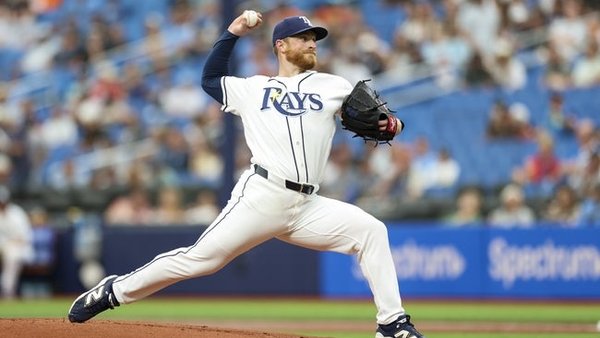
Drew Rasmussen’s 2.88 ERA and sub-1.6 walks per nine set up a run-suppression argument at Tropicana Field — yet the total sits at 7.5 with under juice of -102, pricing this like a neutral pitching environment rather than a pitcher-friendly dome. The park factor and the starter profiles are pointing in the same direction; the number has not fully followed.
Miguel Ullola vs Drew Rasmussen: Houston Astros at Tampa Bay Rays Betting Preview
Tropicana Field on a Friday night, Drew Rasmussen on the mound, and a total sitting at 7.5 with under juice of -102. The market is pricing this like a generic September matchup. It isn’t one.
Rasmussen has been one of the most reliable arms in the American League all season — 14-5, 2.88 ERA, 0.91 WHIP across 153.1 innings. That is not a hot stretch. That is a full-season body of work. He goes against a Houston offense carrying a team OPS of just .725 and a season-long run differential of -40, which tells you that when the Astros score runs, they are sometimes doing it in clusters that skew their season average. Their consistent output, especially against quality arms, is softer than that 4.5 runs-per-game baseline suggests.
The market noise here is real — Houston just took a series from Philadelphia and arrives with momentum, while Tampa comes off a loss to Atlanta that snapped a dominant two-game run against the Braves. Neither of those facts matters much once Rasmussen toes the rubber in a park factor of 0.95.
Game Info & Betting Lines
- Date/Time: Friday, September 11, 2026 | 7:10 PM ET
- Venue: Tropicana Field (Park Factor: 0.95 — pitcher-friendly dome, no weather variance)
- Probable Starters: Miguel Ullola (HOU) vs Drew Rasmussen (TB)
- Moneyline: Houston Astros +144 / Tampa Bay Rays -175
- Run Line: Tampa Bay Rays -1.5 (+124) / Houston Astros +1.5 (-149)
- Total: 7.5 (Over -118 / Under -102)
Why This Number Is Close — But Still Off
The market’s logic for setting this at 7.5 is defensible. Houston has a legitimate offensive ceiling — Yordan Alvarez’s .515 xwOBA and 38 home runs represent the kind of singular threat that keeps totals from collapsing. The Rays have dealt with bullpen attrition all season, with injuries to McClanahan, Pepiot, Cleavinger, Rodriguez, and Heasley thinning out Tampa’s late-inning depth. A setter who respects those risks lands on 7.5 as reasonable.
But here’s where I think the market is slightly wrong: it is not adequately pricing Rasmussen’s ability to shrink the innings that matter most. His 27 walks in 153.1 innings — fewer than 1.6 per nine — means runners are almost never on base without earning it. Combined with a dome that has historically played 5% below league-average run scoring, and a raw projected total of 8.2 combined runs that drops comfortably once that park adjustment is applied, you arrive at an adjusted expectation closer to 7.2. The under at -102 is essentially breakeven juice on a number that the math says should be 7 or lower. That is where the value is — not in the gap being enormous, but in the price being close to flat on a lean that the evidence supports.
What Separates the Pitching
The gap between these two starters is significant, and it matters directly for this bet.
Rasmussen operates with a four-pitch mix that creates early-count weak contact and suppresses baserunners at an elite level. His cutter (29.0% usage, 90.0 mph, 23.0% whiff rate, .288 xwOBA against) and four-seam fastball (28.8%, 95.8 mph, 21.7% whiff, .278 xwOBA against) give him two above-average primary pitches. His changeup is the separator — 35.1% whiff rate and just .193 xwOBA against. Against an Astros lineup that carries an above-average strikeout rate on the season, Rasmussen’s low walk rate and ability to generate weak contact is a perfect stylistic counter. Daulton Varsho, in 18 plate appearances against Rasmussen, is hitting .235 with 4 strikeouts — exactly the passive, strikeout-prone profile you expect Rasmussen to feast on.
Ullola is a different story — not because he’s bad, but because we simply don’t know yet. His 12.86 K/9 and 0.86 WHIP across just 7.0 innings are genuinely electric surface numbers. His four-seam fastball is his primary weapon, thrown at a 65.3% rate, sitting 94.6 mph with a 20.4% whiff rate and a stingy .237 xwOBA against — that is a legitimate offering. His changeup has generated a 66.7% whiff rate in a tiny sample, which is either a preview of something real or a number that will regress sharply the moment a lineup sees it twice. What flashes caution, though, is his slider: used 19.3% of the time, it’s carrying a .508 xwOBA — a genuine red flag against disciplined hitters. Against Junior Caminero (.409 xwOBA, 7.8% barrel rate, 35.1% hard-hit rate) and Yandy Díaz (.381 xwOBA, .378 vsRHP), both patient enough to lay off the fastball and attack secondary pitches, that slider is a liability Ullola hasn’t been tested on yet at this level. The 2 HR allowed in just 7.0 innings reinforces that point — when hitters recognize the fastball and sit on something offspeed, Ullola can be squared up. Rather than weakening the under thesis, this strengthens it: we’re not counting on Ullola to be bad, we’re acknowledging that his floor is genuinely unknown and his slider’s exposure to disciplined hitters is a real variable.
The innings Rasmussen creates are quiet. The innings Ullola creates are uncertain. In a low-total game, that uncertainty leans under — not because Ullola is bad, but because his floor is unknown.
The Pushback
The honest concern here is that the under is thinner than it looks at first pass.
Start with Alvarez. His .515 xwOBA and 30.7% hard-hit rate make him one of the few hitters in baseball capable of single-handedly reversing a pitching edge in one swing. In 12 plate appearances against Rasmussen, he’s hitting .333 with a home run — the BvP history here is not favorable for the under side. One at-bat can move a total by a run and a half, and Alvarez is the most dangerous single-swing threat in the American League right now.
Beyond Alvarez, Ullola’s 7.0-inning sample almost certainly means this becomes a bullpen game by the fifth or sixth inning. Tampa Bay’s bullpen depth has been eroded by injuries all season. If Ullola exits early, the Rays are leaning on a short-staffed relief corps in a game where the offense is capable of manufacturing runs even when the starters are dominant. That’s a legitimate path to the over.
And the raw projected total of 8.2 runs sits above the line, not below it. The park-adjusted number is what brings this into under territory — and a 0.95 park factor is meaningful but not dramatic. We’re talking about a number that is near the threshold, not a Petco Park-style suppressor. If Ullola gets through five clean innings, the over becomes very live in the back half.
One more thing worth addressing explicitly: I’m not playing the Rays -1.5 run line at +124, and I’m not touching the Rays moneyline at -175. The numbers project Tampa Bay to outscore Houston by just 0.2 runs (4.2 vs. 4.0) — that is nowhere near sufficient to justify laying 1.5. And -175 on the moneyline is too much juice for what amounts to a moderate-confidence situational play. The cleanest expression of the pitching thesis here is the total, not a directional team bet that introduces win-probability risk on top of everything else.
Run Environment & Game Shape
Tropicana Field’s 0.95 park factor doesn’t transform this into a pitcher’s paradise, but it is a decisive edge when the total is already sitting at the margin. The dome eliminates wind and weather variance entirely — what you see in the pregame numbers is what you get in the actual run environment. There are no late-inning humidity swings, no jet stream carrying fly balls an extra 10 feet. The ball simply plays as expected, and in a park that runs 5% below league average, that expectation tilts toward fewer runs than an outdoor venue would produce.
The shape of this game almost certainly involves both bullpens by the sixth inning. Rasmussen is the one anchor who can suppress a full lineup for six or seven innings; Ullola at 7.0 career innings is going to be on a pitch count that pushes the Rays to their relievers by the middle frames. But even with Tampa’s bullpen depth thinned by injury, they’re working with a lead — and a team managing a lead runs the game differently than a team chasing one. Fewer rally opportunities, more sequencing designed to strand runners. The Rays’ pitching staff, depleted as it is, still carries a team ERA of 3.81 and a WHIP of 1.15. This is not a relief corps that is falling apart; it is one that is stretched.
In a game where the scoring environment suppresses run totals by design, where the best arm on the field profiles as a genuine game-shrinker, and where the opposing starter’s biggest risk factor — a .508 xwOBA slider — is most dangerous when hitters have a book on him (which they will by the second time through), the under at near-flat juice is the number I want. The adjusted projected total of 7.2 sits comfortably below the line. Rasmussen’s floor is known. Ullola’s is not — and that uncertainty cuts both ways, but the park, the price, and the pitching math all point in the same direction.
Bet: Under 7.5 (-102) — 2 units — Moderate confidence.