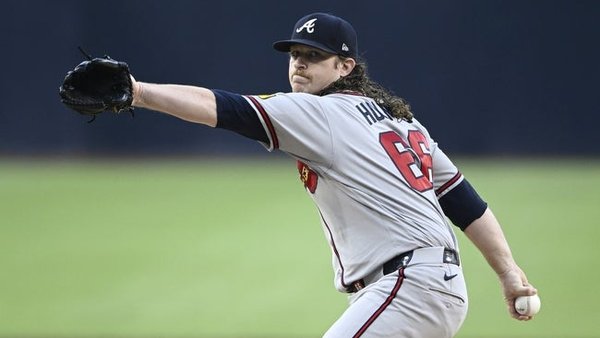
The total opened at 9.0 off the back of a 9-5 blowout — but that damage came against a struggling AJ Smith-Shawver, not a suddenly elite Nationals offense. Grant Holmes’ slider-first profile and Jackson Kent’s underlying 3.75 ERA paint a quieter run environment than last night’s box score implies, and the market hasn’t fully adjusted for the pitching reset.
Grant Holmes vs. Jackson Kent: Atlanta Braves at Washington Nationals Betting Preview
Washington just dropped a 9-5 result on Atlanta last night, and the temptation is to ride that offensive momentum into Wednesday’s matinee. But last night’s damage came against AJ Smith-Shawver, who allowed five runs in four innings — not exactly a competence benchmark. The pitching environment flips completely today, and the market’s posted total of 9.0 deserves scrutiny rather than acceptance.
Holmes and Kent present a meaningfully different pitching profile than what Washington touched up last night. Factor in a park playing at a neutral 0.98 run factor and a Washington lineup missing James Wood (10-Day IL, oblique), and the honest read is that this game shapes up tighter than last night suggested — not a blowout environment, but a controlled one.
The cleanest expression of that thesis isn’t the moneyline — Atlanta’s -163 price immediately disqualifies it — and it isn’t the run line, where Washington’s offensive upside makes covering -1.5 genuinely uncertain. The Under at -108 is where the value lives: fair juice, a neutral park, and two starters whose combined profile points toward a controlled scoring environment.
Game Info & Betting Lines
- Date/Time: Wednesday, September 2, 2026 | 1:05 PM ET
- Venue: Nationals Park | Park Factor: 0.98 (neutral)
- TV: MLB.TV, BravesVision, Nationals.TV
- Probable Starters: Grant Holmes (ATL) vs. Jackson Kent (WSH)
- Moneyline: Atlanta Braves -163 / Washington Nationals +135
- Run Line: Atlanta Braves -1.5 (-102) / Washington Nationals +1.5 (-119)
- Total: 9.0 (Over -112 / Under -108)
Why This Number Is Close
The market has set 9.0 with a reason. Washington (.757 OPS, 193 HR) is a legitimate run-scoring club — CJ Abrams is sitting at 29 home runs and an .852 OPS, and Daylen Lile has hit 20 long balls with genuine pull power. Atlanta carries real offensive threats of their own in Matt Olson (37 HR, .854 OPS) and Michael Harris II (.829 OPS). Posting 9.0 on this game isn’t the market being sloppy — it’s priced to reflect two lineups that can move the needle.
Where I think the market is slightly wrong is in the carry-over assumption from last night. A 9-5 game tends to pull the total up, and oddsmakers know bettors chase yesterday’s action. But last night’s run environment was inflated by a struggling Smith-Shawver, not by the Nationals lineup entering some elevated offensive state. The real question is whether Holmes and Kent suppress scoring enough to land under 9.0 — and the honest answer is they probably do, just barely.
The -108 juice is what makes this worthwhile. You’re not paying a heavy premium to fade a total that’s already elevated. The numbers put this game right on the edge of the posted line — close enough that the under is live without needing a dominant pitching performance from either starter.
What Separates the Pitching
Grant Holmes brings stability that his 3.71 ERA, 1.34 WHIP, and 128.2 innings pitched this season confirm. He’s a slider-first arm — that pitch sits at 39.2% whiff rate with an xwOBA-against of just .296, making it legitimately one of the better put-away offerings in this matchup. His curveball (.241 xwOBA-against, 35.2% whiff) gives him a second swing-and-miss option, and his changeup (.239 xwOBA-against) is his softest-contact suppressor. The concern with Holmes is that his four-seam (.380 xwOBA-against) and sinker (.411) can get punished when hitters sit fastball — Lile, for instance, is 3-for-4 with two home runs in limited BvP looks, and his .410 xwOBA against right-handed pitching is a real mismatch signal. Abrams, on the other hand, is 0-for-9 lifetime against Holmes with four strikeouts — the slider will eat him alive.
Jackson Kent is where the analysis gets interesting. His ESPN-listed ERA of 5.59 creates noise, but his season sheet tells a different story: 3.75 ERA, 1.19 WHIP over 69.2 innings. His four-seam sits at 94.6 mph with a 22.5% whiff rate and a .307 xwOBA-against — quality stuff, not a batting-practice arm. His sinker (.250 xwOBA-against) is his most contact-suppressing pitch, keeping the ball in the park. Worth noting: his 28 BB in 69.2 IP works out to roughly a 3.6 BB/9, which is league-average to slightly above — not a marquee control profile, but not a disqualifier either given the underlying contact suppression. The gap between these two starters exists — Holmes has the longer track record and better overall profile — but Kent is not the walk-year disaster his ESPN line suggests. Olson’s BvP is a telling signal: just .091 in 11 plate appearances. The Braves’ biggest power threat has struggled against Kent’s approach.
One hitter in the Washington lineup deserves specific attention on the under side: Yohandy Morales, batting fifth in his second career major league game after homering in his debut Tuesday night. His Statcast line shows an .963 xwOBA across 18 PA — an eye-popping number that is pure small-sample noise from an MLB debut, not a signal of true talent. The 38.9% strikeout rate and 39.4% whiff rate in that same sample are the more grounding numbers. Morales is a legitimate prospect who hit 25 homers at Triple-A, and a pitcher can’t dismiss him entirely — but the under thesis doesn’t need to ignore him, it just needs to contextualize him accurately. One hot debut doesn’t make him a lineup-wrecking threat in Game 2.
The Pushback
Here’s where I have to be honest: Washington just scored nine runs. Bats don’t go cold overnight, and Lile (two home runs Monday, a two-run double Tuesday) is in a genuine hot stretch. The Nationals’ 193 home runs as a team aren’t an accident — they can hit, and they can hit for power. Removing Wood from the lineup hurts, but this isn’t a toothless offense without him.
The concern that genuinely tests this thesis is Kent’s split identity risk. His 3.75 ERA and 1.19 WHIP are real, but Atlanta’s lineup is stacked with right-handed bats who can exploit the same fastball-sinker profile that Kent leans on. Baldwin (.448 xwOBA vs. RHP), Acuña (.427 xwOBA vs. RHP), and Harris (.446 xwOBA vs. RHP) all grade out as genuine threats against right-handed starters. If Kent’s command wavers early and the Braves get into his fastball, the scoring environment changes quickly.
Atlanta’s bullpen is also a factor worth flagging honestly. With Robert Suarez (60-Day IL, elbow) and Reynaldo Lopez (15-Day IL, knee) both unavailable, the backend depth isn’t what it was. If Holmes runs into trouble mid-game and the Braves need to patch innings, the relief options are thinner than the roster depth suggests on paper. That’s a real over-side risk factor.
Lile’s hot bat against Holmes is the sharpest edge case. Three hits and two home runs in four BvP plate appearances isn’t random — his .410 xwOBA against right-handed pitching confirms he has a genuine matchup edge in this spot, not just a lucky sample. Holmes’s four-seam and sinker are the pitches Lile can reach, and if Holmes leans on those early against a lineup that’s already seen him, the under has a specific vulnerability in that matchup.
Why the Under Still Wins This Argument
None of the pushback above is fatal to the thesis. Lile is a problem, but Holmes has enough secondary weapons — particularly that .296-xwOBA slider and .241-xwOBA curveball — to keep the lineup honest even when hitters are sitting fastball. The Braves’ lineup depth concerns are real, but Holmes going six-plus innings on standard rest limits the bullpen exposure window significantly.
The under at 9.0 doesn’t need everything to go right. It needs two reasonably competent starting performances, a neutral park doing what a 0.98 run factor suggests, and a Washington lineup that can’t fully carry over last night’s damage against a legitimate major league starter. All three of those conditions are grounded in the current pitching profiles and lineup context — not in hoping for a blowout or a collapse.
This is a two-unit play, not a hammer. The gap between where the total is set and where it’s likely to land is real but not wide. The juice is manageable. That’s the bet.
Bet: Under 9.0 (-108) — 2 units, moderate confidence