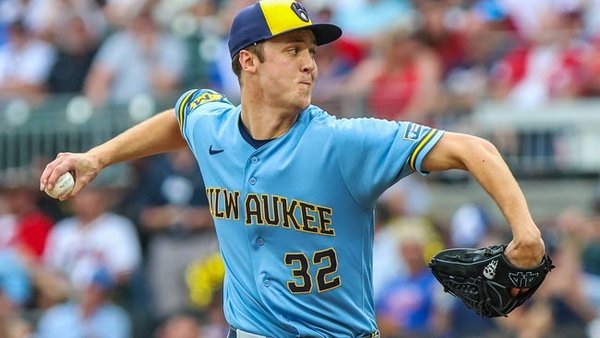
Jacob Misiorowski’s 1.89 ERA and 0.81 WHIP represent one of the largest pitching gaps of the late-season calendar — and the run line at -115 is barely pricing that in. Brandon Young’s 1.37 WHIP and soft fastball profile point toward hard contact against a Milwaukee lineup built to punish exactly that kind of starter, yet the market is still treating -1.5 like a genuine coin flip.
Jacob Misiorowski vs Brandon Young: Milwaukee Brewers at Baltimore Orioles Betting Preview
After yesterday’s 1-0 Milwaukee win — Robert Gasser’s gem, a fly ball lost in the sun, one run on a groundout — the pitching matchup shifts dramatically. Today, the Brewers send their ace, Jacob Misiorowski, to the mound against Baltimore’s Brandon Young, and the gap between these two arms is not subtle. Milwaukee closed out Games 1 and 2 of this series in completely different fashions, winning 6-5 in extra innings on Friday and 1-0 in a shutout Saturday. That range — grinding out a squeaker, then blanking an opponent — is exactly what a 97-win team looks like.
The core tension here is market pricing. Milwaukee’s moneyline sits at -205, which is simply unplayable. That kind of juice demands near-certainty, and baseball never provides that. But the run line at -115 — laying 1.5 runs with the dominant team in baseball — is a completely different conversation. You’re getting Misiorowski’s historic-caliber season as the engine, a depleted Baltimore roster as the matchup, and a price that barely clears even money. The market is doing the Brewers a quiet favor.
Baltimore is fighting for playoff survival at 75-80 with a -28 run differential, but they’re doing it without Jackson Holliday, Luis Robert Jr., Tyler O’Neill, and Ryan Mountcastle — four starters on the injured list simultaneously. The lineup they’re running out today is not the lineup that made them competitive earlier this season, and they’re asking Young to compensate for that.
Game Info & Betting Lines
- Date/Time: Sunday, September 20, 2026 | 7:20 PM ET
- Venue: Oriole Park at Camden Yards | Park Factor: 1.01 (essentially neutral)
- TV: Peacock
- Probable Starters: Jacob Misiorowski (MIL, 15-5, 1.89 ERA) vs Brandon Young (BAL, 9-4, 3.65 ERA)
- Moneyline: Milwaukee Brewers -205 / Baltimore Orioles +168
- Run Line: Milwaukee Brewers -1.5 (-115) / Baltimore Orioles +1.5 (-105)
- Total: 7.5 (Over -115 / Under -105)
Why This Number Is Off
The market set this total at 7.5, and on the surface, that’s defensible. You have Misiorowski, who has spent the entire season suppressing run environments, against a Baltimore offense averaging 4.47 runs per game that’s now missing three to four regulars. A low-scoring game is the expected shape.
Where the market is slightly wrong is on the run line price. At -115, the Brewers are laying 1.5 runs at essentially coin-flip juice. A team with a 76.1% win probability — against a pitcher with a 1.37 WHIP and 21 home runs allowed in 145.2 innings — is not a -115 proposition for a two-run margin. The market is pricing in the 7.5 total as a governor, essentially saying this game is tight enough that the run line is a genuine coin flip. But the pitching gap doesn’t support that. Misiorowski doesn’t just win games — he wins them cleanly, with low traffic, which structurally favors Milwaukee protecting multi-run leads.
The legitimate case for the other side: Young has a 9-4 record suggesting he keeps Baltimore competitive, and one Pete Alonso swing can close a gap instantly. Those are real concerns. But the 9-4 record comes with a 1.37 WHIP — Young has been getting results despite process indicators that suggest regression is overdue. At -115 for a Milwaukee -1.5, the market hasn’t fully accounted for the quality gap between these two starters.
What Separates the Pitching
The gap between these starters is one of the largest you’ll find in a regular-season game this late in the year. Misiorowski carries a 1.89 ERA, 0.81 WHIP, and 13.15 K/9 across 166.1 innings — a workload large enough that these numbers are real, not a small-sample mirage. His four-seam fastball sits at 100.4 mph, generates a 36.0% whiff rate, and holds hitters to a .229 xwOBA. He uses it 62.2% of the time. When he wants a swing-and-miss, he goes to his curveball — 42.4% whiff rate, .159 xwOBA. This is a pitcher who doesn’t just limit damage; he creates innings with one pitch, then buries hitters with another.
Against Baltimore’s lineup today, that matters enormously. Jeremiah Jackson leads off with a .325 xwOBA vs right-handed pitching. Gunnar Henderson hits .387 xwOBA vs righties, but that number comes with a 20.7% whiff rate — Misiorowski’s fastball-curveball combination is exactly the profile that creates those swings and misses. Even Coby Mayo, who has a .448 overall xwOBA, drops to .376 against right-handed pitching. The Orioles lineup is weaker against righties across the board, and they’re getting the best righty available.
Young, meanwhile, is a different story. His four-seam fastball sits at 94.4 mph with an 18.1% whiff rate and .340 xwOBA against. His sinker — used 13.7% of the time — generates a .372 xwOBA against with a 6.5% whiff rate. Those are contact-inducing, hard-contact-allowing pitch profiles. He does own one legitimate weapon: his slider carries a 39.0% whiff rate and .260 xwOBA at 15.1% usage — genuinely plus numbers. But one above-average secondary pitch doesn’t compensate for a leaky fastball and a sinker that hitters are teeing off on. Young lives in the zone and pays for it with his two primary offerings, and Milwaukee’s lineup is built to make him pay. Garrett Mitchell’s .502 xwOBA against right-handed pitching and Jake Bauers’ .459 xwOBA season-long represent real threats against a pitcher leaking hard contact at the top of his arsenal.
The Pushback
The honest version of the case against this bet starts with Pete Alonso. His .488 xwOBA this season, 38 home runs, and 33.2% hard-hit rate make him one of the most dangerous individual hitters in baseball. Misiorowski has held up against elite competition all year, but Alonso is the kind of hitter who can turn a 2-0 game into a 2-2 game with one swing. That’s not a hypothetical — it’s his entire profile.
The second concern is bullpen depth. Baltimore has Ryan Helsley and Keegan Akin both on the IL, which limits their options in tight games. But Milwaukee has also dealt with injuries in the bullpen — Brian Fitzpatrick, Angel Zerpa, and Bryse Wilson are all unavailable. If Misiorowski exits before the seventh, the Brewers’ margin for error narrows. Chad Patrick picked up the save Saturday, and the relief corps has been functional, but “functional” carries more risk when you’re laying 1.5 runs.
These are real objections. I’m not dismissing either of them. But the structure of this game still points toward a Milwaukee covering outcome more often than the -115 price suggests.
The Run Line Logic
Here’s why I keep coming back to the run line over the moneyline: at -205, you’re paying an enormous premium for a result that, if it happens, only pays you back at a fraction. At -115 on -1.5, you’re getting a meaningful discount relative to Milwaukee’s actual win probability, with the added requirement that they win by two. The 7.5 total is the complicating factor — a low total creates more coin-flip run line outcomes — but Misiorowski’s profile is specifically built to win games cleanly, not just win them.
His 0.81 WHIP means baserunners are scarce. His 243 strikeouts in 166.1 innings mean traffic that does exist gets cleared quickly. Against a lineup missing four regulars and facing a righty whose best pitch (the slider) sits behind a four-seamer and sinker that Milwaukee hitters will attack, the Brewers don’t need to manufacture a big inning. They need two runs, a clean Misiorowski start, and a functional bullpen bridge. That’s a reasonable ask at a reasonable price.
The Play
The moneyline is unplayable at -205. The run line at -115 is the cleaner expression of the edge here — you’re buying the pitching gap at a discount, accepting the 1.5-run requirement as the price of not paying through the nose on the straight side.
Bet: Milwaukee Brewers -1.5 (-115) — 2 units