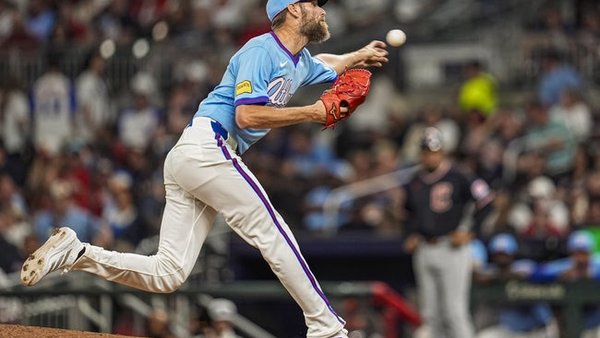
Two aces with sub-2.50 ERAs suggest a pitcher’s duel — but Coors Field’s 1.38 park factor tells a different story. Yesterday’s 14-run explosion between these same teams shows what happens when elite arms meet altitude reality.
Chris Sale vs Chase Dollander: Atlanta Braves at Colorado Rockies Betting Preview
The betting market sees two quality starters with sub-2.50 ERAs and sets a total at 9.5, but that number feels light for Coors Field. Chris Sale brings a 2.31 ERA and elite 9.77 K/9 rate into the most hitter-friendly park in baseball, while Chase Dollander counters with his own impressive 2.25 ERA and 10.97 K/9. On paper, this looks like a pitchers’ duel.
The problem is that paper doesn’t account for Denver’s thin air. Yesterday’s 8-6 Atlanta win produced 14 total runs between these same offenses, and both starting pitchers have shown vulnerability to the long ball this season. The market is pricing this like a neutral-site matchup between two aces, but Coors Field changes everything — even for pitchers this good.
Game Info & Betting Lines
- Date/Time: Saturday, May 2, 2026 | 8:10 PM ET
- Venue: Coors Field (Park Factor: 1.38 — significantly hitter-friendly)
- Probable Starters: Chris Sale (5-1, 2.31 ERA) vs Chase Dollander (3-2, 2.25 ERA)
- Moneyline: Atlanta Braves -230 / Colorado Rockies +190
- Run Line: Colorado Rockies +1.5 (+116) / Atlanta Braves -1.5 (-140)
- Total: 9.5 (Over -115 / Under -105)
Why This Number Is Too Low
The market is respecting the pitching matchup — and rightfully so. Both starters have been excellent, combining for a 2.28 ERA across 67 innings this season. Sale’s 43.5% whiff rate on his slider gives him a dominant out pitch, while Dollander’s five-pitch mix keeps hitters off balance with his knuckle curve generating 30.8% whiffs.
But the total at 9.5 suggests the market is treating this like a game at Petco Park, not Coors Field. That 1.38 park factor isn’t just a number — it’s a 38% increase in run expectancy. Even quality pitchers get punished here. Sale has allowed 5 home runs in just 35 innings, and Dollander has given up 3 in 32 frames. At sea level, those are manageable. In Denver, they become crooked numbers.
Atlanta’s offense has the firepower to exploit any mistakes, led by Matt Olson’s 1.011 OPS and 10 home runs. Colorado showed yesterday they can score at home, putting up 6 runs against Atlanta’s quality pitching. The Rockies’ Mickey Moniak is slashing .319/.1.033 with 9 home runs, and Hunter Goodman has matched that power output despite a lower average.
What Separates the Pitching
Sale’s arsenal is built around that devastating slider — 33% usage at 82.9 mph with a ridiculous 43.5% whiff rate. His four-seam fastball sits 94.9 mph on 46.8% of his pitches, but the slider is the true weapon. The concern is that even elite breaking balls can hang in Denver’s thin air, and Sale has already allowed 5 home runs this season despite his low ERA.
Dollander offers more diversity with five legitimate pitches, led by his knuckle curve (23.7% usage, 30.8% whiff rate) and a sweeper that generates 30% put-away rates. His four-seam fastball allows a concerning .388 xwOBA, but he’s compensated with location and pitch sequencing. The gap between these starters is narrower than their ERAs suggest — both rely on precision that gets tested at Coors Field.
The key difference is durability. Sale has thrown 35 innings across 6 starts, suggesting he’s being managed carefully coming off injury concerns. Dollander has been more consistent with his workload at 32 innings in 5 starts. If either pitcher gets knocked around early, these bullpens will be exposed to Atlanta’s .789 team OPS and Colorado’s home park advantage.
The Pushback
The strikeout rates demand respect. Sale’s 9.77 K/9 and Dollander’s 10.97 K/9 suggest both can miss bats regardless of park factors. Strikeouts don’t travel, and high-strikeout pitchers traditionally perform better at Coors Field than contact specialists. Both starters also limit walks — Sale at 2.31 BB/9 and Dollander at 2.53 BB/9 — which keeps crooked innings off the board.
The under also went 4-6 in Atlanta’s last 10 games, suggesting some recent lower-scoring trends despite their offensive talent. And while yesterday produced 14 runs, that game featured two different starters who may not match Sale and Dollander’s quality. The market might be correctly pricing in elite pitching overcoming park factors.
But I keep coming back to the ballpark. Yesterday’s result between these same teams proves both offenses can score at Coors Field, and the 1.38 park factor doesn’t disappear because the pitchers have good ERAs. Even Sale’s slider becomes more hittable when it doesn’t break as sharply.
Run Environment & Game Shape
The market expects a moderate-scoring game around 9-10 runs, but Coors Field historically inflates totals beyond what raw statistics suggest. The 1.38 park factor means every offensive metric gets amplified — exit velocities carry further, breaking balls flatten out, and even well-struck outs become doubles off the wall.
Atlanta’s 5.61 runs per game average jumps significantly in this environment, while Colorado’s 4.33 scoring rate gets boosted by home park advantage. Both offenses showed yesterday they can produce against quality pitching, and the thin air affects every pitch, not just mistakes. This projects as an 11-12 run environment, not the 9.5 the market suggests.
Joe Jensen’s Pick
JENSEN’S PICK: TOTAL OVER 9.5 — 2 Units
I looked at the under here based on the pitching quality, but that doesn’t hold up because Coors Field neutralizes even elite arms to some degree. The park factor is the overwhelming variable, and yesterday’s 14-run game between these same teams provides recent evidence these offenses can produce. I considered the Atlanta run line given their superiority, but yesterday’s close 8-6 result shows Colorado can keep pace at home.
The over at -115 offers solid value when the true total should be closer to 11. Both starters are excellent, but excellence gets tested differently at 5,200 feet above sea level. I’m backing the park and the recent offensive evidence over the ERA peripheral stats.