Martin Perez’s 1.06 WHIP and 0.95 HR/9 rate sit across from Anthony Kay’s 1.45 WHIP and 10 home runs allowed in 61.1 innings — yet the Braves, owners of a 45-23 record and +114 run differential, are priced at -116, barely a tick past pick’em. Chicago’s seven-game home win streak has compressed this number in a way the starter profiles simply do not support.
Martin Perez vs. Anthony Kay: Atlanta Braves at Chicago White Sox Betting Preview
The market is doing something unusual tonight at Guaranteed Rate Field. The Atlanta Braves, owners of the best record in baseball at 45-23 with a +114 run differential, are priced at -116 against a Chicago White Sox team starting Anthony Kay and his 4.40 ERA. That’s not a line built on pitching symmetry — it’s a line built almost entirely on home-field momentum and recency bias, and the math underneath it doesn’t hold up.
Chicago has been legitimately hot at home, and two straight wins over Atlanta in this series have given the market a reason to close the gap. But closing the gap to near pick’em territory against the best team in the sport, with a measurable starter disadvantage on the mound, crosses from respectable line-setting into market overreach. Martin Perez isn’t a superstar, but he’s posting a 3.02 ERA against Kay’s 4.40, and that gap has real run-scoring implications at a neutral park factor of 0.98.
After the numbers correctly identified value on the under in Wednesday’s game — which finished 2-1 — today’s matchup presents a different puzzle. The pitching edge is real, the price is right, and the question is whether Chicago’s home streak can override a genuine quality gap between these two starters.
Game Info & Betting Lines
- Date/Time: Thursday, June 11, 2026 | 7:40 PM ET
- Venue: Guaranteed Rate Field (Park Factor: 0.98 — essentially neutral)
- TV: MLB.TV, BravesVision, CHSN
- Probable Starters: Martin Perez (ATL) vs. Anthony Kay (CHW)
- Moneyline: Atlanta Braves -116 / Chicago White Sox -102
- Run Line: Atlanta Braves -1.5 (+140) / Chicago White Sox +1.5 (-170)
- Total: 8.5 (Over -112 / Under -108)
Why This Number Is Off
The case for the line being this close is real, and it deserves to be taken seriously before being dismissed. Chicago has won seven straight at home and went 17-3 over their last 20 home games. They’ve already beaten Atlanta twice in this series — a walk-off 6-5 in Game 1 and a 2-1 victory Wednesday — and Anthony Kay is 5-1 on the season despite the ugly ERA. The market is pricing a hot home team in a familiar run environment against a banged-up opponent, and that logic is fair.
But here’s the problem: Kay’s 5-1 record is almost certainly outrunning his underlying numbers. A 1.45 WHIP and 10 home runs allowed in 61.1 innings — a rate of roughly 1.47 HR/9 — point to a pitcher who has been bailed out by sequencing and run support more than he’s been dominant. Wins are not a pitcher quality metric. Meanwhile, Perez’s 1.06 WHIP and 6 HR in 56.2 innings (~0.95 HR/9) reflect genuine suppression quality. The market is leaning on Kay’s record rather than his process, and that’s where the edge lives at -116.
Atlanta’s team ERA of 3.22 versus Chicago’s 4.35 extends the staff-level advantage well beyond the starter matchup. This isn’t a single-night anomaly — it’s a systemic gap the price isn’t fully accounting for.
What Separates the Pitching
The Statcast arsenal tells the more complete story here. Perez operates with a changeup-heavy approach — 32.2% usage at 82.6 mph, generating a 29.6% whiff rate and holding hitters to a .271 xwOBA. His cutter at 21.2% usage produces a 31.4% put-away rate, and his four-seamer, while used sparingly at 6.8%, holds hitters to just a .176 xwOBA — an elite contact-suppression number on that pitch. To be fair about the full picture: his sinker (30.5% usage) carries a higher .403 xwOBA, making it his most-contacted pitch — but it generates weak ground ball contact rather than hard-hit fly balls, which limits the damage. This is a pitcher who generates soft contact through shape and sequencing rather than raw velocity, and his 3.02 ERA over 56.2 innings reflects real execution, not luck.
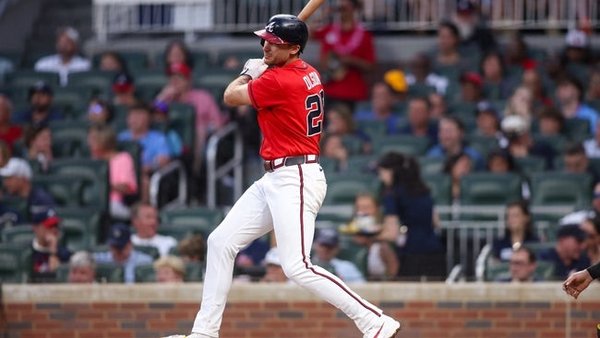
Kay’s profile is the structural opposite. His 1.45 WHIP means he consistently puts runners on base, and his HR/9 rate means those traffic jams get punished. The Atlanta lineup, even shorthanded, is built to exploit exactly that profile. Harris leading off and Olson batting third — Harris (.460 xwOBA, 8.3% barrel rate, 37.2% hard-hit rate) and Olson (19 HR, .461 xwOBA, 7.5% barrel rate) — represent legitimate power threats against a pitcher who has surrendered home runs at a troubling clip. Harris in particular owns a .507 xwOBA versus right-handed pitching — a pronounced platoon edge against the right-handed Kay.
The innings each pitcher creates look different in practice. Perez generates weak contact and quick outs. Kay generates traffic: baserunners, elevated counts, and opportunities for Atlanta’s middle-of-the-order bats to do damage. That’s a structural advantage for the Braves that transcends any single at-bat or sequence.
The Pushback
The strongest case against this lean isn’t a single data point — it’s a pattern. Chicago has beaten Atlanta twice already in this series, including a 6-5 walk-off on Tuesday in Braden Montgomery’s debut and a 2-1 victory Wednesday behind Davis Martin’s six scoreless innings. Montgomery himself is a genuine concern — his debut xwOBA of .623, 12.5% barrel rate, and 41.7% hard-hit rate are not small-sample flukes to dismiss; they’re warning signs that a hot, dangerous hitter is due up against Perez. The White Sox are also a sweep-or-be-swept situation: win tonight and they complete a series upset against the best team in baseball; lose and Atlanta salvages the finale. That asymmetric pressure tends to produce maximum effort from home teams.
The injury picture cuts both ways, and it’s worth being honest about that. Atlanta is genuinely shorthanded — Ronald Acuña Jr. (hamstring, 10-Day IL), Drake Baldwin (oblique, 10-Day IL), and Sean Murphy (finger, 60-Day IL) represent meaningful lineup and depth losses. But Chicago is also playing without their best power hitter: Munetaka Murakami (hamstring, 10-Day IL) is out tonight, and his .938 OPS and 20 home runs make that a significant absence. The injury disadvantage narrative isn’t as one-sided as it might appear — both rosters are depleted, and that partially offsets Atlanta’s relative inconvenience at catcher and in the outfield.
I’m also not ignoring that Chicago’s bullpen has been sharp in this series. Bryan Hudson closed out Wednesday’s 2-1 win, and their relievers have limited Atlanta’s offense in back-to-back games. If Perez runs into early trouble, the White Sox pen could hold the lead. This is a real path to a Chicago win, and it’s not low-probability.
Run Environment & Game Shape
Rate Field’s 0.98 park factor makes this essentially a neutral run environment — slight suppression, nothing dramatic. Both starting pitchers profile as contact managers rather than strikeout artists, which typically means a game that stays relatively low-scoring until the middle innings when bullpens take over. The total is set at 8.5, which feels a touch high given Perez’s ground-ball profile and Kay’s tendency to strand rather than blow up early. Expect a game that stays within one or two runs through five or six innings, with the difference likely coming from one big inning rather than a steady offensive output from either side. The numbers project Atlanta 4.6, Chicago 4.4 — a close game where the margin of error is thin and starter performance in the first three rotations through the order is everything.
Bets I’m Rejecting
Atlanta -1.5 (+140): The run line price is interesting, but I’m not comfortable asking a shorthanded Atlanta roster to cover a full run and a half against a White Sox team that has won seven straight at home and owns a sharp bullpen. The edge here is binary — Atlanta wins or it doesn’t — and forcing a cover when the roster is depleted and the opponent is hot at home adds unnecessary variance for limited additional value. Pass.
Over 8.5 (-112): The projected total of 9.0 runs is only a half-run over the posted line, and the park factor slightly suppresses offense. More importantly, Perez’s ground-ball, weak-contact profile and the White Sox’s relatively shallow lineup (without Murakami) make the over a thin play. I need more cushion than 0.5 runs of projected surplus to pay juice on the over. Pass.
Under 8.5 (-108): Kay’s WHIP and home run rate make him a genuine over threat if Atlanta gets going, and the projected total lands above 8.5. The under price is fine, but the directional lean in the numbers doesn’t support it. Pass.
The Pick
Atlanta Braves moneyline, 2 units, moderate confidence. The thesis is straightforward: the best team in baseball is priced like a coin flip against a pitcher whose 5-1 record is masking a 1.45 WHIP and 10 home runs allowed in 61 innings, while Martin Perez has quietly built a genuine ERA and WHIP advantage that the market isn’t properly pricing. Yes, Chicago is hot at home, and yes, the injury picture on both sides narrows the quality gap — but at -116, Atlanta is still the demonstrably better team with the demonstrably better pitcher tonight, and that’s enough to back them at a number this fair.
Bet: Atlanta Braves Moneyline — 2 Units