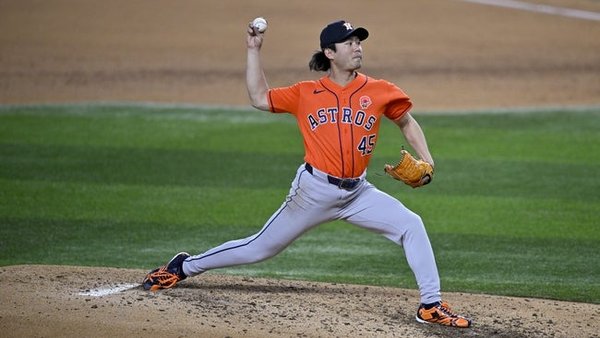
Jacob Misiorowski carries a 1.83 ERA and 14.06 K/9 into a Daikin Park dome start against a Houston lineup gutted by injuries — yet the total sits at 7.5 with the under priced at -104, essentially treating this like an even proposition. The pitching profiles on either side of this ledger are not remotely even.
Jacob Misiorowski vs. Tatsuya Imai: Milwaukee Brewers at Houston Astros Betting Preview
Yesterday’s loss on the Brewers moneyline stings a little — Brandon Sproat got worked, the Astros rolled to a 9-2 win, and the market moved accordingly. Today is a completely different animal. The pitching matchup shifts from one of Milwaukee’s most volatile arms to arguably the hottest starter in baseball right now, and the total sitting at 7.5 is the number the market is handing us an opportunity on.
The moneyline at -190 is simply off the table. That’s not a reflection of how dominant Misiorowski has been — it absolutely is — but there’s no mathematical justification for laying that kind of juice. What the -190 line does, though, is tell you exactly how the market is pricing this game: Milwaukee is expected to win, and win comfortably. The under at -104 lets us express that same thesis without paying through the nose for an outright win.
The core argument here is straightforward: Misiorowski is elite, Houston’s lineup is decimated by injuries, and Daikin Park plays slightly pitcher-friendly at a 0.96 park factor. The numbers project just 8.3 combined runs — right at the number. But Misiorowski’s presence alone skews the distribution heavily toward the low end of that projection, and at -104, the market is essentially pricing this like a coin flip on the total. It’s not a coin flip.
Game Info & Betting Lines
- Date/Time: Sunday, May 31, 2026 | 2:10 PM ET
- Venue: Daikin Park (Park Factor: 0.96 — slightly pitcher-friendly, dome)
- Probable Starters: Jacob Misiorowski (MIL, 5-2, 1.83 ERA) vs. Tatsuya Imai (HOU, 2-2, 6.17 ERA)
- Moneyline: Milwaukee Brewers -190 / Houston Astros +160
- Run Line: Milwaukee Brewers -1.5 (-110) / Houston Astros +1.5 (-110)
- Total: 7.5 (Over -118 / Under -104)
Note on venue: The raw data block lists this game at Minute Maid Park, while the game header and scheduling information reference Daikin Park. This article uses Daikin Park throughout, but editorial should verify whether a naming rights change has taken effect for the 2026 season.
Why This Number Is Close — But Tilted
The market is doing something reasonable by setting this total at 7.5. Houston came off a 9-2 blowout win yesterday, and both the Astros and Brewers have gone 7-3 over their last 10 games. There’s legitimate offensive life in that Houston clubhouse despite the injuries. Yordan Alvarez posted five home runs in three games against Texas last week. Christian Walker had a three-run homer yesterday. The market isn’t ignoring Houston’s recent form — it’s pricing it in.
On the Milwaukee side, the Brewers carry a team OPS of just .691. That’s not a lineup that buries games. Their run creation profile is built on contact and situational hitting, not power. The market knows Imai has been hittable — a 6.17 ERA and 1.50 WHIP over 23.1 innings tells that story — but it also knows Milwaukee won’t run up the score the way a top-tier offense might.
Where the market is slightly off is in how it’s weighting Misiorowski’s contribution. A 1.83 ERA and 14.06 K/9 over 64 innings isn’t noise anymore — it’s signal. The per-game run projections put Houston at just 3.7 against him, and that feels right given the injury carnage in their lineup. The under at -104 is essentially asking you to trust one of the best pitchers in baseball to do what he’s been doing all season. That’s not a leap.
What Separates the Pitching
The gap between these two starters is as wide as any you’ll find on a Sunday afternoon slate. Jacob Misiorowski is operating at a level that demands attention. His four-seam fastball sits at 99.6 mph, deployed 60% of the time, and it holds hitters to a .261 xwOBA while generating a 39.2% whiff rate. That’s not just velocity — that’s a pitch that hitters consistently fail to barrel. His curveball, used 14.1% of the time, produces an even more absurd 43.1% whiff rate with a .213 xwOBA. The slider at 94.2 mph rounds out a three-pitch mix that covers every quadrant of the zone. Over 64 innings this season: 1.83 ERA, 0.83 WHIP, 100 strikeouts, just 4 home runs allowed. The walk rate of 2.67 per nine means baserunners are scarce and big innings are structurally unlikely.
Imai presents the exact opposite profile. His primary offering is a slider at 86.9 mph — 42.3% usage — but the whiff rate of 38.8% is undermined by a .317 xwOBA against it. His four-seam fastball at 94.9 mph is the real vulnerability: a .377 xwOBA against and only a 15.9% whiff rate means hitters are making consistent, quality contact. His sinker is even worse at a .451 xwOBA against. The changeup has seen limited use but has been catastrophic in the sample available. Over 23.1 innings: 6.17 ERA, 1.50 WHIP, 18 walks. That walk total is what separates bad luck from bad execution — 18 free passes in just over 23 innings means Imai is consistently loading the bases and inviting trouble.
Misiorowski creates one type of inning: short ones. Hitters chase, whiff, and go back to the dugout. Imai creates the opposite: runners on, pitches mounting, mistakes punished. In a low-total environment, the Misiorowski side of this ledger functions as an anchor. The question is always whether Imai’s side blows the number open before Misiorowski’s dominance can contain it.
The Pushback
Here’s where I have to be honest about the risk. The biggest threat to this under isn’t the Milwaukee offense — it’s what happens if Imai implodes in the first two innings. Tatsuya Imai’s walk rate isn’t just high, it’s a structural problem. Eighteen walks in 23.1 innings means he’s consistently operating on the edge of a blowup. If he loads the bases in the first inning and Milwaukee punches across three runs before recording two outs, the under is in immediate trouble. That scenario isn’t far-fetched given the way Imai has operated all season.
The Houston injury situation adds a wrinkle on both sides. Jose Altuve, Carlos Correa, Yainer Diaz, and Joey Loperfido are all on the IL heading into this game, and that’s a significant chunk of lineup depth. Loperfido is listed on the 10-Day IL with a quadriceps injury — the projected Houston lineup below is sourced from last game data and may not fully reflect current roster moves, so treat Loperfido as unavailable unless Houston officially activates him before first pitch. The depleted lineup helps the under, but it also means Misiorowski is going up against a soft order that might not give him the strikeout volume he typically generates against stronger competition.
Then there’s Yordan Alvarez. His overall xwOBA sits at .589, but the number that matters here is his .573 xwOBA against right-handed pitching. Misiorowski is a right-hander. Alvarez doesn’t have a meaningful platoon split — he punishes everybody — and his barrel rate of 10.7% combined with a 19.0% whiff rate means he’s not going to be an automatic out the way most of this Houston order will be. One Alvarez swing changes the complexion of the game. That’s the single biggest threat in this matchup, and I’m not dismissing it.
The counter is that Misiorowski’s four-seam whiff rate (39.2%) and curveball whiff rate (43.1%) represent the kind of arsenal that gives even elite hitters problems, and the rest of the Houston lineup — Walker (.389 xwOBA vs. RHP), Trammell (.374), Paredes (.299) — isn’t going to carry a big inning on its own. Alvarez is the danger. Everyone else is gravy.
Houston Projected Lineup Note
The Houston projected lineup for this game is based on last game data and should be treated as a baseline, not a confirmed card. Given that Joey Loperfido (10-Day IL, quadriceps), Yainer Diaz (10-Day IL, oblique), Jose Altuve (10-Day IL, oblique), and Carlos Correa (10-Day IL, ankle) are all currently sidelined, the actual lineup Houston runs out today may look different from what the last-game projection suggests. Verify the confirmed lineup closer to first pitch before finalizing your wager.
Run Environment & Game Shape
The dome context at Daikin Park matters here. Controlled conditions eliminate wind and weather as variables, which means the 0.96 park factor functions as advertised — this is a genuine pitcher’s environment. There’s no gusting wind carrying fly balls out, no humidity making the ball carry, no afternoon heat index inflating exit velocities. What you see in the numbers is what you get.
Both offenses carry recent cold stretches against their season baselines when facing quality arms. Milwaukee’s .691 team OPS is built on contact, not power, and their 445 team strikeouts tell you they’re not immune to elite velocity. Against a 99.6 mph fastball with a 39.2% whiff rate, the Brewers’ patient approach becomes less of an asset and more of a liability — you can’t work counts effectively when the pitcher is generating whiffs at that rate regardless of pitch selection.
Houston’s offense has shown real life over the last 10 games (7-3), but that run has come against a softer slate and with more lineup depth than they’re currently carrying. Strip out Altuve, Correa, Diaz, and Loperfido, and you’re looking at a lineup that leans heavily on Alvarez and Walker to do damage, with Paredes, Trammell, and the bottom of the order functioning as outs waiting to happen against a pitcher of Misiorowski’s caliber.
The shape of this game points toward a low-scoring, pitcher-dominated affair for at least the first five innings, which is exactly the structure that makes an under at 7.5 functional. Even if Imai gives up three runs in a chaotic second inning, Misiorowski’s side of the ledger is likely to hold Houston to two or fewer — and the total stays in range. The under doesn’t need a perfect game from either side. It just needs Misiorowski to be Misiorowski and Imai to avoid a full meltdown. That’s a workable ask at -104.
The Pick: Under 7.5 (-104) — 3 Units. One of the best pitchers in baseball is starting in a dome with a pitcher-friendly park factor against a depleted lineup, and the total is sitting at the same number it would be if this were a league-average matchup. The market is giving you Misiorowski at face value. Take it.