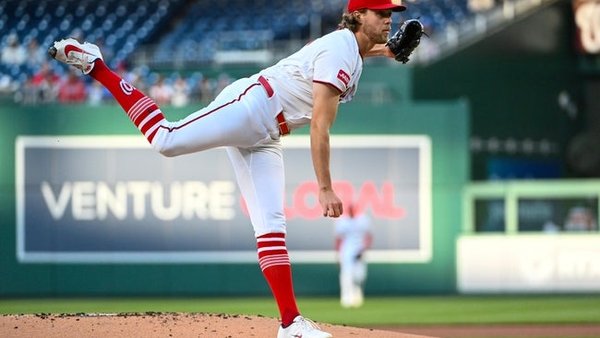
Milwaukee’s Jacob Misiorowski brings a 14.05 K/9 rate and 98.8 mph heat against Jake Irvin’s hittable sinker that allows a .407 xwOBA. The -154 price reflects market respect for the visiting pitchers, but may not fully capture the strikeout gap.
Jacob Misiorowski vs Jake Irvin: Milwaukee Brewers at Washington Nationals Betting Preview
The Brewers roll into D.C. coming off a 13-1 demolition of Arizona, but that offensive explosion masks the real story here — the pitching disparity between Jacob Misiorowski and Jake Irvin. Milwaukee sits as a moderate road favorite at -154, and while that price reflects some market respect for the visitors’ talent edge, I’m not convinced it fully captures the gap between these two arms.
Washington’s recent 5-4 win over the Mets showed their ability to manufacture late-inning rallies, but they’re leaning heavily on a rotation that’s posted a 5.08 ERA as a staff. Irvin’s 4.85 ERA and inconsistent command create the kind of environment where Milwaukee’s patient approach can build pressure early.
Game Info & Betting Lines
- Date/Time: Friday, May 1, 2026 | 6:45 PM ET
- Venue: Nationals Park (Park Factor: 0.98 — neutral)
- Probable Starters: Jacob Misiorowski vs Jake Irvin
- Moneyline: Milwaukee Brewers -154 / Washington Nationals +130
- Run Line: Washington Nationals +1.5 (-134) / Milwaukee Brewers -1.5 (+114)
- Total: 8 (O -118 / U -104)
Why This Number Is Close
The market is balancing Milwaukee’s clear pitching advantage against legitimate concerns about road consistency and Washington’s power potential. The Brewers have gone 4-6 in their last 10 despite superior underlying metrics, and that recent inconsistency gives the Nationals backers a real foothold in this argument.
Washington’s lineup features legitimate threats in James Wood (10 HR), CJ Abrams (8 HR), and Joey Wiemer (.995 OPS), creating the kind of game-changing potential that can flip close contests. The home team getting +130 reflects market respect for their ability to steal games with timely hitting, even against superior pitching.
But here’s where I think the line undersells Milwaukee’s edge: Misiorowski’s 14.05 K/9 represents a strikeout rate that can neutralize Washington’s power threats, while Irvin’s more modest 10.31 K/9 leaves him vulnerable to the kind of patient Milwaukee offense that just hung 13 runs on Arizona.
What Separates the Pitching
The gap between these starters runs deeper than basic ERA suggests. Misiorowski’s four-seam fastball sits at 98.8 mph with a devastating 38.1% whiff rate, while his curveball generates an even more lethal 42.0% whiff rate. That power arsenal translates to genuine swing-and-miss ability against a Washington lineup that’s shown strikeout vulnerability.
Irvin’s arsenal tells a different story — his sinker manages just a 5.5% whiff rate and allows an alarming .407 xwOBA against. That’s the kind of hittable offering that Milwaukee’s patient hitters can exploit, especially considering they’ve shown the ability to work counts and capitalize on mistakes.
The control comparison favors Milwaukee as well. Misiorowski has issued 13 walks across 32.2 innings while Irvin has walked 11 batters in fewer innings (29.2). That edge in strike-throwing becomes magnified when you consider Washington’s 1.460 team WHIP suggests deeper bullpen issues that could surface if Irvin struggles early.
Most telling is how each pitcher performs under pressure. Misiorowski’s .225 xwOBA against his slider shows legitimate put-away ability, while Irvin’s secondary offerings lack that same finishing punch. In a tight game, that difference in closing out at-bats becomes the deciding factor.
The Pushback
Milwaukee’s recent road struggles create genuine concern about backing them at this price. The Brewers’ 4-6 record in their last 10 games includes some head-scratching performances against inferior pitching, and there’s no guarantee they carry over Thursday’s offensive explosion.
Washington’s power trio of Wood, Abrams, and Wiemer represents the kind of lineup depth that can punish mistake pitches, even from quality arms. Wood’s .629 xwOBA and 13.4% barrel rate show legitimate impact potential against any pitcher, including Misiorowski. If the young right-hander nibbles and falls behind in counts, those Washington bats have the pop to make him pay.
The bigger concern is Milwaukee’s bullpen usage after Thursday’s blowout. If manager Craig Counsell had to lean on his relievers despite the lopsided score, that creates potential fatigue issues that could surface late in a close game. That said, the 13-1 nature of that win likely meant most key relievers got a night off, and the underlying talent gap still tilts toward the visitors.
Run Environment & Game Shape
Nationals Park’s 0.98 park factor creates a neutral run environment that should favor the better pitching, which tilts toward Milwaukee. The total of 8 runs suggests the market expects a moderate-scoring affair where starting pitching depth becomes crucial.
This setup amplifies Misiorowski’s strikeout ability — in a game where runs figure to be at a premium, his power arsenal creates more margin for error than Irvin’s contact-heavy approach. The likely scoring range of 4-6 runs per team means avoiding crooked numbers becomes essential, and Milwaukee’s starter is better equipped for that challenge.
I looked at the run line here, but at +114 for Milwaukee to win by two or more, the juice doesn’t compensate for the increased variance in what should be a tight game between division rivals.
Joe Jensen’s Pick
JENSEN’S PICK: Milwaukee Brewers Moneyline — 0 Units
Milwaukee 5, Washington 4
I like the Brewers’ pitching edge and superior run differential, but the -154 price is too steep for a standalone bet in what could easily become a bullpen game. Misiorowski’s strikeout upside and Washington’s rotation struggles create a clear lean toward the road team, but not enough edge to justify the juice.
This falls into beer money territory — a side I’d consider as a small parlay leg but not worth a full unit at this price. The gap between these pitchers is real, but road favorites in the -150 range need to show more separation to justify the investment.