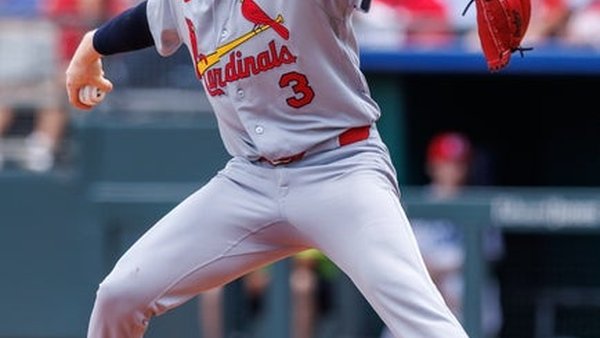
Hurston Waldrep brings two career innings of data to the mound while the Braves carry the best bullpen ERA in baseball at 2.76 — yet the market has barely separated these clubs, pricing Atlanta at just -112. The 100-run differential gap between a +90 Braves club and a Cardinals squad sitting at -10 is a structural signal, not a slump artifact, and the moneyline number has not fully absorbed it.
Dustin May vs. Hurston Waldrep: St. Louis Cardinals at Atlanta Braves Betting Preview
Atlanta closed out Wednesday’s series game with a comfortable 5-1 win. Now the pitching matchup shifts dramatically, with Hurston Waldrep making what amounts to his first meaningful regular-season start. The market has priced the Braves at -112, essentially a coin-flip with a slight lean toward the home side. That price is the argument. For a team sitting at 50-34 with an MLB-best bullpen ERA of 2.76 and a +90 run differential, -112 represents genuine value — not because Waldrep is a known commodity, but because the structural gap between these two clubs is wide enough to carry a volatile starter situation.
The Cardinals come in at 44-39, a winning record but one built on a -10 run differential that tells a different story than the wins column. Dustin May is a serviceable mid-rotation arm, and this is not a blowup spot. But “serviceable” against a Braves lineup built around Matt Olson and Michael Harris II is a different conversation than serviceable against a fringe offense. The gap in roster quality — rotation depth, bullpen dominance, run prevention — is the backbone of this lean, not a single pitcher’s ERA.
Game Info & Betting Lines
- Date/Time: Thursday, July 2, 2026 — 7:15 PM ET
- Venue: Truist Park, Atlanta (Park Factor: 1.01 — neutral, slight hitter lean)
- Probable Starters: Dustin May (STL) vs. Hurston Waldrep (ATL)
- Moneyline: Cardinals -104 / Braves -112
- Run Line: Atlanta Braves +1.5 (-178) / St. Louis Cardinals -1.5 (+146)
- Total: 9 (Over -112 / Under -108)
Why This Number Is Close
The market is doing its job here. It sees a Cardinals starter in Dustin May who has logged 83.2 innings this season with a real track record — 4.30 ERA, 1.20 WHIP, 2.4 BB/9, and an 8.3 K/9 that shows he can miss bats. Against an Atlanta team that has dropped seven of its last ten games and is rolling out a pitcher with two career innings on the mound, the books are right to keep this close. The Cardinals at -104 is not an irrational number.
But here’s where the market slightly undersells Atlanta: the -112 price doesn’t fully account for the run differential gap. A +90 to -10 swing — 100 runs — is not a slump artifact. It’s a structural signal about team quality that persists across the variance of a losing stretch. The Braves’ bullpen enters with that 2.76 ERA, the best mark in baseball, and that asset functions as a stabilizer regardless of who starts. The market is applying Opening-Day-style uncertainty to Waldrep’s sample because it has to — but the roster behind him doesn’t carry that same uncertainty. That’s where -112 becomes a number worth taking.
What Separates the Pitching
Dustin May’s Statcast arsenal is genuinely multi-dimensional. His four-seamer sits at 96.9 mph with an 18.2% whiff rate and .298 xwOBA against — a legitimate weapon. His sweeper is arguably his best pitch: 32.1% whiff rate, .263 xwOBA, with the best put-away rate (23.6%) in his mix. The cutter at 93.2 mph generates a 20.6% whiff rate. On pure stuff, May is not a hitter’s pitcher — he has swing-and-miss at multiple velocity levels.
The concern is the sinker, which carries a .319 xwOBA against and a 14.6% whiff rate — his most hittable offering, and one he uses 18.4% of the time. His changeup is a liability at .379 xwOBA. Against an Atlanta lineup where Matt Olson (.438 xwOBA, .463 vs RHP) and Michael Harris II (.455 xwOBA, .500 vs RHP) are both generating elite expected contact rates off right-handed starters, May’s softer pitches are a real exposure point. Olson has 20 home runs this season and a .875 OPS. That’s not a lineup that will let May coast.
Waldrep’s sample is too thin to rely on heavily. His sinker — used 40% of the time — carries a troubling .432 xwOBA against, while his split-finger generates a 50% whiff rate with .295 xwOBA against. The slider (9.1% usage) produced a 100% whiff rate in his limited sample, though small-sample noise is obvious here. The curveball is a liability at .700 xwOBA. His arsenal has genuine swing-and-miss potential, but the control (4 BB in 2 IP) and the sinker exposure suggest the Cardinals’ top of the order — particularly Jordan Walker (.460 xwOBA, .536 vs LHP) and Lars Nootbaar (.476 xwOBA vs RHP) — will create pressure early. The gap between these two starters is narrow and unreliable, which is exactly why the bullpen differential matters so much in this game.
The Pushback
The honest concern here is Waldrep melting in the first or second inning. Four walks in two innings isn’t a data point I can dismiss — that’s a WHIP of 3.00 on a tiny sample, and the Cardinals’ lineup is patient enough to exploit a starter who can’t find the zone. If Waldrep exits in the second with two or three runs on the board, Atlanta’s premium relievers — Dodd, Fuentes, Lee, Iglesias — are stretched thin covering six-plus innings. The pen is elite in normal game shapes, not emergency shapes.
Atlanta’s 3-7 stretch over the last ten games also deserves honest acknowledgment. And the Ronald Acuna Jr. absence is a genuine subtraction — he’s hitting .251 with a .793 OPS and seven home runs, and replacing that production slot with Dominic Smith in a lineup that already lacks a true cleanup threat behind Harris is a measurable step down in run-creation ceiling. That’s not nothing. Still, Atlanta ranks 50-34 with a +90 run differential despite Acuna spending time on the IL, which means the team’s run-prevention infrastructure is doing the heavy lifting, not any single bat. One hitter’s absence doesn’t close a 100-run gap against a Cardinals club sitting at -10 for the season.
I’m also not going to pretend the run line is attractive. Waldrep’s volatility makes Atlanta -1.5 at -178 a trap — you’re paying a steep price for a starter who could hand the Cardinals a lead by the third inning. That’s a different bet with a different risk profile. The moneyline is the right vehicle here precisely because it tolerates the blowup scenario while still cashing on the structural edge.
Game Shape and the Pick
Game shape here points toward a mid-scoring, bullpen-dependent finish. Truist Park’s 1.01 park factor is effectively neutral — it won’t inflate or suppress run totals enough to shift the calculus. With a total set at nine, the market expects scoring, but the Braves’ 2.76 bullpen ERA is the asset that wins games when starters are uncertain quantities. Waldrep may be a question mark for three or four innings; Atlanta’s relief corps is not a question mark in any inning. That infrastructure edge, priced at just -112, is the bet. The Cardinals have a serviceable rotation piece in May and a lineup that can create pressure through the middle of the order, but a -10 run differential against a +90 club is a structural deficit that a single quality start can’t fully erase.
Pick: Atlanta Braves Moneyline (-112) — 1 unit, lean. The thesis is simple: you’re buying the best bullpen in baseball, a run differential advantage of 100 runs, and a home team with a 50-34 record at a near-even price. Waldrep’s volatility is a real risk, but it’s already baked into the -112 line. At that number, the infrastructure edge is worth taking.