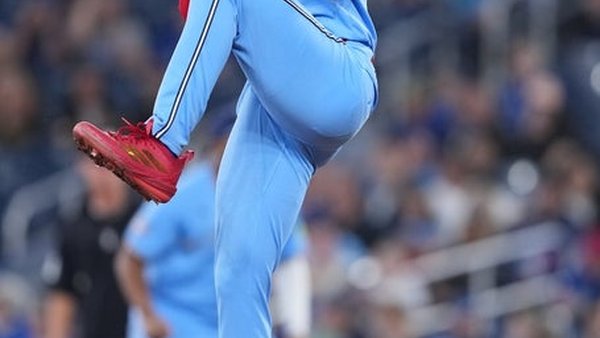
Dylan Cease is posting a 2.71 ERA and 13.56 K/9 — Shota Imanaga has surrendered 17 home runs in just 86.2 innings. The gap between these two starters is undeniable, yet the market has Toronto priced at a modest -124, implying a near coin flip. The number has not caught up to the pitching asymmetry on the mound Sunday at Wrigley.
Dylan Cease vs. Shota Imanaga: Toronto Blue Jays at Chicago Cubs Betting Preview
After yesterday’s stunning 8-6 Toronto comeback, the pitching matchup shifts dramatically. Saturday was chaos — bullpens shredded, five-run leads evaporated, Kazuma Okamoto’s three-run bomb doing the damage. Today is a different game entirely, and the pitcher on the mound for the Blue Jays is the primary reason this number deserves serious attention.
The market has Toronto at -124, a modest favorite price that implies roughly 55% win probability. But when you stack Dylan Cease — a 2.71 ERA, 13.56 K/9 arm with a 2.47 WAR — against Shota Imanaga, who is sitting at a 4.26 ERA with 17 home runs allowed in just 86.2 innings, the gap between these two starters is far wider than a -124 price reflects. This is not a coin flip dressed up as one — the pitching asymmetry is real, and the Blue Jays moneyline at this price is the cleanest entry point.
The numbers project Toronto to edge Chicago 4.5–4.3 in a tight game that the starter gap tips in the visitors’ favor. The juice ceiling holds at -130, and at -124, there’s legitimate value on the right side of a meaningful pitching mismatch.
The Play: Toronto Blue Jays moneyline (-124), 2 units.
Game Info & Betting Lines
- Date/Time: Sunday, June 21, 2026 | 2:20 PM ET
- Venue: Wrigley Field (Park Factor: 1.02 — effectively neutral)
- Probable Starters: Dylan Cease (TOR) vs. Shota Imanaga (CHC)
- Moneyline: Toronto Blue Jays -124 / Chicago Cubs +106
- Run Line: Toronto Blue Jays -1.5 (+146) / Chicago Cubs +1.5 (-178)
- Total: 6.5 (Over -118 / Under -104)
Why This Number Is Close
The market is doing legitimate work here. Chicago has a better record (40-37) than Toronto (38-39), a positive run differential (+21 vs. Toronto’s -25), and the Cubs’ lineup ranks as one of the more productive offenses in the NL at .738 OPS with 90 home runs on the season. Add home field, and the case for keeping Toronto close to a coin-flip price makes sense on the surface.
Then there’s Imanaga’s WHIP: a deceptively clean 1.06. That number tells you he controls baserunners better than his ERA suggests. The 17 home runs allowed look alarming, but if you believe those are partly park-driven or sequencing-unlucky, you can construct an argument that Imanaga bounces back today at Wrigley, a park with a nearly neutral 1.02 factor.
But here’s the problem — the market is giving too much credit to Imanaga’s peripherals and not enough weight to the sheer strikeout and contact suppression gap. Cease is not just slightly better; he’s operating at a different level entirely. His 2.47 WAR against Imanaga’s 0.12 tells the story the ERA doesn’t fully capture. The market has priced this like a close pitcher matchup when the data says otherwise. That’s the inefficiency worth backing at -124.
What Separates the Pitching
The comparison starts with velocity and movement. Cease’s four-seam fastball sits at 97.8 mph with a 24.3% whiff rate — he throws it 34% of the time and generates genuine swing-and-miss at the top of the zone. His slider at 89.4 mph has a 42.5% whiff rate and an xwOBA-against of just .249, making it one of the nastier put-away pitches in the game. The changeup is where it gets truly punishing: 62.5% whiff rate and a .225 xwOBA-against on just 11.1% usage. Cease creates strikeout innings — 110 punchouts in 73 frames — and only five home runs allowed all season speaks to elite contact management.
Imanaga profiles very differently. His four-seam fastball sits at 91.9 mph — nearly six ticks slower than Cease — with an 18% whiff rate and a troubling .351 xwOBA-against. That’s a hittable fastball, and Toronto’s lineup will see it nearly half the time. His splitter is legitimate (41.4% whiff, .234 xwOBA), and his sweeper contributes (37% whiff), but the overall package cannot compensate for a primary pitch getting hit hard. The 17 home runs in 86.2 innings — roughly a 1.77 HR/9 rate — is not sequencing bad luck at that volume.
Head-to-head, the Cubs’ dangerous trio of Pete Crow-Armstrong (.454 xwOBA), Seiya Suzuki (.415 xwOBA), and Michael Busch (.382 xwOBA) gives Cease real problems to solve. But Cease’s 13.56 K/9 means he has the weapons to miss bats even against dangerous hitters — Bregman, in 16 plate appearances against Cease, is hitting .188 with five strikeouts, and Suzuki has punched out 3 times in 5 PA. The matchup data tilts the quality-of-contact edge clearly toward Toronto.
On the other side of the ledger, Toronto’s hitters present genuine barrel threats against Imanaga. Kazuma Okamoto carries a .444 xwOBA this season with a 7.5% barrel rate, and Brandon Valenzuela is right behind him at .411 xwOBA — both Blue Jays hitters are poised to punish that hittable 91.9 mph fastball. At a 1.77 HR/9 rate, Imanaga does not get the benefit of the doubt when barrels are waiting in the lineup.
The Pushback
The concern that keeps this at two units rather than three is Toronto’s offense. The Blue Jays carry a .703 team OPS and a -25 run differential on the season. Despite the comeback win Saturday, Toronto’s offense is running cold in this series overall, and a team that averages 4.1 runs per game doesn’t project to blow the Cubs out. Okamoto provides legitimate pop (16 HR), and Valenzuela and Sanchez are solid contributors — but there’s no lineup depth here that screams “put up five or six.”
Imanaga’s 1.06 WHIP is also a legitimate counterpoint — he limits traffic, which caps Toronto’s ceiling in any given inning. If Cease stumbles early and the Cubs’ bullpen (shaky as it is) holds for six innings, this game flips quickly. Both bullpens are depleted entering Sunday after yesterday’s late-inning chaos, which means neither team can bank on clean late-game relief innings. That uncertainty is real and it’s priced in at -124. The run line at +146 and the total have their own appeal on paper, but the run line asks Cease to be nearly perfect while the total projection of 8.7 runs is pushed upward by bullpen exposure — both secondary bets carry more variance than the straight moneyline play warrants here. The cleanest expression of the pitching edge is the Toronto ML.
The Bet
Wrigley’s 1.02 park factor is a non-issue — it’s effectively a neutral venue, which means no park-driven discount on Cease’s home run suppression. The pitching gap is real. The price is reasonable. The market hasn’t fully accounted for the starter quality differential.
Bet: Toronto Blue Jays moneyline (-124), 2 units (moderate confidence).