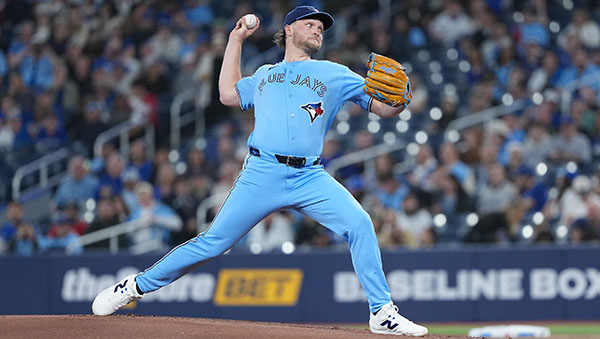
Yesavage’s elite contact prevention profile clashes with Ryan’s documented struggles — the line treats this like a coin flip when the Statcast data tells a different story.
Trey Yesavage vs Joe Ryan: Toronto Blue Jays at Minnesota Twins Betting Preview
The market is pricing this as a near pick’em matchup, with Toronto at -104 and Minnesota sitting at -112. That narrow spread acknowledges the obvious factors — Minnesota’s home field, Toronto’s injury concerns with George Springer day-to-day, and the natural variance of early-season baseball. But the line isn’t accounting for the stark contrast between these two starters.
Trey Yesavage brings a microscopic sample size but dominant results through his first 5.1 innings: a 0.00 ERA, 0.75 WHIP, and zero home runs allowed. Meanwhile, Joe Ryan enters with a 3.76 ERA that reflects genuine struggles with command and contact quality. The Blue Jays’ recent offensive explosion — 18 runs across two games — suggests they’ve found their timing against Minnesota’s pitching staff.
The question isn’t whether Toronto can score. It’s whether this pitching edge is significant enough to overcome the tight pricing and Minnesota’s desperation for a series-saving performance.
Game Info & Betting Lines
- Date/Time: Sunday, May 3, 2026 | 12:45 PM ET
- Venue: Target Field (Park Factor: 1.00)
- Probable Starters: Trey Yesavage (1-0, 0.00 ERA) vs Joe Ryan (2-3, 3.76 ERA)
- Moneyline: Toronto Blue Jays -104 / Minnesota Twins -112
- Run Line: Minnesota Twins +1.5 (-184) / Toronto Blue Jays -1.5 (+150)
- Total: 8.0 (Over -112 / Under -108)
Why This Number Is Close
The market is balancing legitimate concerns about Toronto’s sustainability against Minnesota’s home field desperation. The Twins are 2-8 in their last 10 games and facing a potential series sweep after getting outscored 18-7 across the first two contests. Home teams in this spot typically get line support, especially when the visiting starter has thrown exactly 5.1 professional innings.
Minnesota also benefits from Toronto’s injury situation. George Springer left yesterday’s game after taking a pitch to his surgically repaired foot, removing their most consistent offensive threat from what’s already been a patchwork lineup. The Blue Jays are starting Davis Schneider in left field — a player who was 0-for-27 before breaking out with a double yesterday.
But here’s where the market is slightly off: it’s treating Yesavage’s dominance as pure variance rather than recognizing the arsenal advantages that created those results. His 94.3 mph four-seam fastball sits at 52.7% usage with a .151 xwOBA against, while his 82.1 mph split-finger has generated a 25% whiff rate. Those aren’t fluky numbers — they’re the profile of a pitcher who attacks the zone effectively.
What Separates the Pitching
The gap between these starters is more fundamental than the surface numbers suggest. Yesavage’s arsenal features three distinct offerings that attack different parts of the zone: his 94.3 mph four-seam fastball dominates the strike zone at 52.7% usage with elite contact prevention (.151 xwOBA), while his 82.1 mph splitter creates swing-and-miss at a 25% clip. Even his rarely-used slider shows a 50% put-away rate when deployed in two-strike counts.
Ryan’s approach creates far more vulnerable contact opportunities. His 92.5 mph four-seam fastball generates a .312 xwOBA — more than double Yesavage’s mark — while his secondary offerings lack consistent effectiveness. The sweeper (.255 xwOBA) and knuckle curve (.107 xwOBA) show promise, but his slider and sinker both allow xwOBA marks above .350, creating exploitable sequences for patient hitters.
The Statcast data reveals specific matchup problems for Minnesota. Vladimir Guerrero Jr. carries a .396 xwOBA with hard-hit rates above 34%, while Kazuma Okamoto enters on a three-homer surge over two games with a .457 xwOBA that suggests his recent power display isn’t purely random. Against Ryan’s elevated four-seam fastball tendencies, these contact-driven hitters project for continued success.
This isn’t just about hot bats versus cold arms — it’s about arsenal mismatches that favor Toronto’s approach at the plate.
The Pushback
The concern with backing Toronto here is obvious: Yesavage’s 5.1-inning sample represents the definition of small sample noise. Second starts have historically been brutal for rookies as opposing hitters get their first real look at video and adjustment opportunities. Ryan, despite his struggles, brings the experience of 47 career starts and the ability to adapt mid-game when his initial approach isn’t working.
Minnesota’s lineup also shows more power upside than Toronto’s recent explosion suggests. Byron Buxton has homered in three straight games and carries a .397 xwOBA that suggests legitimate offensive momentum. Ryan Jeffers (.403 xwOBA, .865 OPS) represents the type of high-contact threat that can exploit rookie mistakes when they inevitably arrive.
The bigger issue is Toronto’s offensive sustainability without Springer. Yesterday’s eight-run eighth inning was largely built on Minnesota’s bullpen collapse rather than sustained offensive pressure. Davis Schneider ending his 0-for-27 skid might be regression rather than breakthrough, while the Blue Jays’ season-long .691 OPS suggests their recent run creation isn’t necessarily repeatable.
But even acknowledging these concerns, the line is still mispriced for the available information.
Joe Jensen’s Pick: Toronto Blue Jays -104
I’m taking Toronto Blue Jays -104 over Minnesota rather than pursuing the run line at +150. The run line requires a multi-run margin that puts too much pressure on Yesavage’s second career start and Toronto’s injury-depleted lineup to deliver a decisive performance. The moneyline captures the pitching edge without demanding blowout execution.
The price is right at -104 versus Minnesota’s -112 return. That eight-cent gap reflects exactly the type of subtle misprice that creates sustainable value over time. Yesavage’s arsenal advantages are real, Ryan’s contact-quality issues are documented, and Toronto enters with proven momentum against this pitching staff.
This is moderate confidence rather than a max play because rookie starters carry inherent unpredictability regardless of their arsenal quality. But when the price only asks you to believe in Toronto winning rather than covering multiple runs, the Statcast data and recent form provide enough evidence to justify the investment. Sometimes the best spots are the ones where you don’t need everything to break perfectly — just more things to go right than wrong.