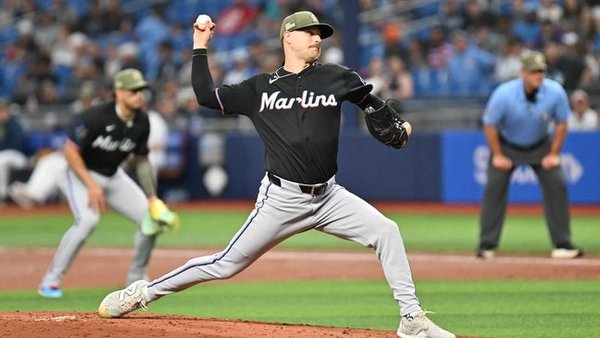
Nolan McLean’s 11.0 K/9 and a .091 xwOBA against his curveball make him a genuine run-suppressor — but Janson Junk’s 4.80 ERA and a Juan Soto lurking with a .520 xwOBA against righties keep this total on a knife’s edge. The raw projection says over, the strikeout profile and park factor say otherwise, and the posted 7.5 hasn’t moved a tick.
Janson Junk vs Nolan McLean: Miami Marlins at New York Mets Betting Preview
The Mets won 6-1 yesterday behind Christian Scott’s dominant six innings — one run allowed, eight strikeouts, no drama. Today’s pitching matchup doesn’t look quite as clean on paper, but the structural argument for a low-scoring game is at least as strong. Nolan McLean brings an 11.0 K/9 and a 1.09 WHIP against a Marlins lineup sitting at a .696 team OPS, and the Mets themselves have managed just .648 OPS with a lineup stripped down by injuries. Neither offense is built to run up totals.
The market opened this game at 7.5, which reflects the pitching quality and park environment accurately. The tension is whether McLean can replicate Scott’s performance with more swing-and-miss and less run-suppression consistency, and whether Janson Junk — a 4.80 ERA arm with limited upside — can survive the one real threat in this Mets lineup long enough to keep the total in check. This is a lean, not a conviction play, but the ingredients point toward under.
Game Info & Betting Lines
- Date/Time: Sunday, May 31, 2026 | 1:40 PM ET
- Venue: Citi Field | Park Factor: 0.97 (mild run suppressor)
- TV: MLB.TV, Marlins.TV, SNY
- Away Starter: Janson Junk (3-5, 4.80 ERA, 1.30 WHIP, 6.45 K/9)
- Home Starter: Nolan McLean (2-4, 4.40 ERA, 1.09 WHIP, 11.0 K/9)
- Moneyline: Miami Marlins +138 / New York Mets -164
- Run Line: New York Mets -1.5 (+132) / Miami Marlins +1.5 (-160)
- Total: 7.5 (Over -110 / Under -110)
Why This Number Is Close
The 7.5 total is not a number the market set carelessly. Books understand that two NL East clubs with sub-.700 OPS lineups, playing in a mild pitcher’s park, in a Sunday afternoon start, tend to grind out low-scoring games. The case for the over is real: Friday’s game produced 16 combined runs, Junk is hittable, and Juan Soto is capable of personally moving the needle by two or three runs on a single swing.
But here’s where the market may be slightly off: it’s pricing Friday’s fireworks into a game where the pitching gap is substantially different. Friday was a bullpen game that devolved into extra innings — entirely different run-scoring conditions. Today McLean starts with genuine strikeout stuff, and the Marlins are missing key offensive contributors while their recent form has been ice cold.
The raw numbers project 8.7 combined runs — technically a 1.2-run lean toward the over against this posted total. I’m not ignoring that. But that raw figure doesn’t account for what changes after you layer in the context: McLean’s elite 11.0 K/9 is a genuine run-suppressor that the aggregate model undersells, both offenses rank among the weakest in the NL, and Citi Field’s 0.97 park factor is a quiet thumb on the under side. At -110 juice on both sides, you’re not getting compensated for the over risk. Once you apply those filters, the under at flat price is the cleaner entry — and the 1.2-run raw edge for the over shrinks to noise against McLean’s strikeout profile.
What Separates the Pitching
The gap between these two starters is real, and it lives in the strikeout column. McLean is generating outs at an elite rate — 11.0 K/9 with a 1.09 WHIP is a genuine suppression profile, not a fluke. His sinker-first approach (36% usage, 94.8 mph) generates a 16% whiff rate and an outstanding .269 xwOBA against. More importantly, his curveball is a weapon — 12.1% usage, 40.7% whiff rate, and an almost cartoonish .091 xwOBA against. That pitch alone is a run-prevention asset. His sweeper checks in at 21.7% whiff, giving him three legitimate put-away options against a Marlins order that whiffs at a league-average clip.
The Marlins’ top of the order has some contact ability — Xavier Edwards (.357 xwOBA) and Otto Lopez (.377 xwOBA) make consistent contact — but their barrel rates are modest (3.7% and 4.7%, respectively), and McLean’s curveball should exploit the strikeout tendencies further down the order. Kyle Stowers at cleanup is a nuanced case: his 32.4% whiff rate is a genuine vulnerability against McLean’s breaking ball, but his .388 xwOBA tells you he’s not simply a free out. When he makes contact, he does real damage. The matchup still favors McLean — he’ll generate swings and misses — but Stowers is the kind of hitter who can punish a hanging sweeper even when he’s been dominated in the count.
Junk, by contrast, is a get-through-innings arm. He leads with his four-seam fastball (33.9% usage, 94.3 mph), which generates only an 11.7% whiff rate and a .310 xwOBA against — effective enough to work the zone but nothing that misses bats consistently. His changeup is his best swing-and-miss offering at 28.0% whiff, and his slider pairs with it at a .325 xwOBA against. He’s thrown 60 innings and allowed 8 home runs, averaging roughly one HR per seven innings. Against a depleted Mets lineup, he’s functional but not dominant. Juan Soto posts a .520 xwOBA against right-handed pitching and an 11.3% barrel rate — he’s the exact type of hitter who can turn a Junk hanging slider into a two-run shot and single-handedly move the total. That type of variance is what makes the under position feel thin rather than locked.
The Pushback
The strongest argument against the under here is that the market already knows everything I just said. A 7.5 total in a pitcher’s park with two weak offenses is not a hidden number — it’s priced to reflect exactly this scenario. When the numbers project 8.7 runs and the total is 7.5, you’re getting 1.2 runs of edge working against you on paper before you even factor in variance. That’s not nothing.
Friday’s game is also a legitimate data point, not just noise. This same Marlins-Mets matchup produced 16 combined runs two nights ago, with real hitters doing real damage off real pitchers. The bats are in there. And Soto’s .974 OPS this season isn’t a stat you dismiss — he’s posted a .457 xwOBA and an 11.3% barrel rate, and Junk has already surrendered 8 home runs in 60 innings. One swing, and suddenly the under needs a shutdown inning from a bullpen that’s been patchy all week.
The Sunday afternoon start is a mild plus for the under — day games with a rested defense and a less energized crowd tend to suppress offense slightly, and Citi Field plays just under neutral at 0.97. But I’m not pretending that’s the reason to bet this. The reason is McLean’s strikeout rate, two offenses that can’t consistently string hits together, and a line that was pushed yesterday at this exact number. The under has a reasonable case. It’s not a strong one.
Rejected Angles
I looked at the Mets moneyline at -164. With a projected win probability north of 70% on the home side, there’s a real edge there in isolation. But -164 juice means you need to be right often to show long-term profit on a team that’s 25-33 on the season and has a rotation that’s been inconsistent. The juice ceiling kills the value even when the directional lean is correct.
The Marlins +1.5 at -160 is equally unattractive. You’re laying significant juice to get a team to simply lose by one run — and the Mets have a legitimate pitching edge today. That’s not a price worth paying for a run-line cushion when the straight moneyline is already expensive.
The total is the play, and it’s the under. Not because the raw numbers scream it, but because the post-context case is cleaner here than anywhere else on the board in this game.
Run Environment & Game Shape
Yesterday’s 6-1 final with Christian Scott on the mound is the right benchmark, not Friday’s extra-inning slug fest. Scott held Miami to one run in six innings — that’s the game shape McLean is capable of replicating, and possibly exceeding given his strikeout advantage. The Marlins have averaged fewer than four runs per game in their last ten, and the Mets offense — missing Lindor, Robert, Polanco, Alvarez, and Taylor — is cobbling together a lineup that’s been held under three runs in multiple recent outings.
The concern is Junk’s inability to miss bats (6.45 K/9), leaving him vulnerable to the Mets stringing together a crooked inning on soft contact and walks rather than pure power. He’s not a disaster waiting to happen — 60 innings pitched suggests he can eat frames — but he’s not a guy who blows the lineup away, and Soto plus Jared Young (.457 xwOBA, 9.5% barrel rate) at the top of the order represents genuine run-scoring upside even for a mediocre Mets offense. The shape of this game most likely runs something like 5-2 or 4-3, with McLean doing the heavy suppression work and Junk surviving on soft contact and sequencing. That gets us home under 7.5.
But it doesn’t take much to blow it up. One Soto bomb, one crooked inning from Junk, and we’re staring at a push or a loss. That’s why this is two units, not three.
The Pick
The case is built on McLean’s elite strikeout rate, two of the weakest offenses in the NL, a mild pitcher’s park, and a Sunday afternoon start that structurally favors low-scoring baseball. The raw numbers lean over by a thin margin, but the context — McLean’s 11.0 K/9, both teams’ anemic OPS figures, and Citi Field’s park suppression — justifies the under position. Yesterday’s push at this same number reinforces that 7.5 is the right neighborhood; today’s pitching matchup is cleaner for suppression than Saturday’s was.
Bet: Under 7.5 | 2 Units | Moderate Confidence | -110