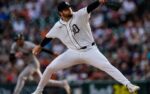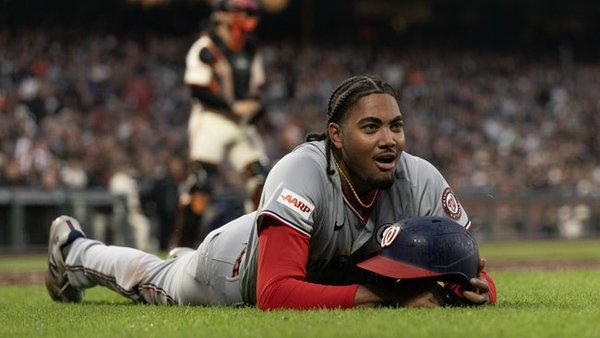
San Francisco is priced at -120 despite sending a pitcher with a 4.12 ERA and a 4.8 BB/9 to the mound against a Nationals lineup built to punish walks. The Giants carry a -49 run differential and a worse starter — the market’s home-field lean doesn’t come close to closing a 30-point WHIP gap between these two pitching profiles.
Foster Griffin vs. Robbie Ray: Washington Nationals at San Francisco Giants Betting Preview
The Nationals have now won back-to-back games in this series, both by narrow margins, and today the pitching matchup shifts dramatically in their favor. Yet sportsbooks are still pricing San Francisco as the favorite at -120, with Washington sitting at +102. That number is wrong, and I can explain exactly why.
The core argument here is straightforward: Foster Griffin (7-2, 3.63 ERA, 1.10 WHIP) is a meaningfully better starting pitcher than Robbie Ray (4-6, 4.12 ERA, 1.40 WHIP), and the market is correcting for Oracle Park’s suppressive environment while leaning on San Francisco’s home field designation — but neither factor closes a 30-point WHIP gap between the starters. When you get plus money on the pitcher who should be favored, the bet makes itself.
The Giants sit at 27-40 with a -49 run differential — a number that signals a team consistently losing games by larger margins than they win them. That’s not a home favorite. That’s a team propped up by name recognition and a pitcher’s park while the underlying performance tells a grimmer story.
Game Info & Betting Lines
- Date/Time: Wednesday, June 10, 2026 | 3:45 PM ET
- Venue: Oracle Park | Park Factor: 0.92 (pitcher-friendly)
- Probable Starters: Foster Griffin (WAS, 7-2, 3.63 ERA) vs. Robbie Ray (SF, 4-6, 4.12 ERA)
- Moneyline: Washington Nationals +102 / San Francisco Giants -120
- Run Line: Washington Nationals -1.5 (+164) / San Francisco Giants +1.5 (-200)
- Total: 8.5 (Over -120 / Under -102)
Why This Number Is Off
The market’s logic is defensible on the surface. Oracle Park suppresses run scoring at a 0.92 factor, and home teams at pitcher-friendly parks historically outperform their raw records slightly — the environment creates a legitimate tilt toward low-scoring games where a single run of home field juice matters more. San Francisco also has the better team batting average (.258 vs. Washington’s .244), and Jung Hoo Lee is riding a 17-game hitting streak that generates real lineup traffic.
But here’s where the market overcorrects: none of those factors address who is actually throwing the baseball today. The Giants’ -120 price implies roughly a 54.5% win probability. The numbers project Washington winning this game 53.1% of the time — the market has the direction inverted. That directional mismatch, combined with the structural pitching edge, is what generates the 7.7% model edge on this line. You’re paying a premium for a team with a worse starter, a worse run differential, and no meaningful lineup advantage. The home field bump in MLB is approximately 0.3 runs — nowhere near enough to overcome a half-run ERA gap and a 30-point WHIP differential.
The concern is that the line might already reflect sharp money on Washington, compressing what was likely a larger edge at open. That’s worth watching, but +102 still clears the value threshold comfortably.
What Separates the Pitching
The gap between these two starters isn’t subtle. Griffin brings a genuinely diverse, command-oriented arsenal: his cutter leads pitch mix at 29.7% usage generating just .353 xwOBA, but his most dangerous offering is the split-finger at 6.6% usage — a true out pitch with a 35.4% whiff rate and .219 xwOBA against. His changeup adds another layer at 33.3% whiff rate. The result is a pitcher who doesn’t overpower but keeps barrels suppressed and attacks counts without issuing free passes — just 21 walks in 72 innings (2.6 BB/9).
Ray operates in a completely different — and far more volatile — profile. His 93.5 mph four-seamer (45.4% usage) is his bread and butter, but it generates a pedestrian 17.0% whiff rate with a .367 xwOBA against. His slider at 85.6 mph whiffs bats at 33.7% but is being hit hard when contact lands — .375 xwOBA. The knuckle curve has elite whiff at 40.6% but produces a troubling .410 xwOBA, suggesting it’s being squared up when hitters wait on it. And none of that addresses the root problem: 36 walks in 67.2 innings, a BB/9 near 4.8.
That walk rate is a direct matchup problem facing a Nationals lineup built on patience. Washington has drawn 242 walks as a team with a .322 OBP. James Wood (.930 OPS, 17 HR) posts a .598 xwOBA with a 12.1% barrel rate — he’s the most dangerous hitter in this game, and Ray’s control issues mean Wood will see hitter’s counts or first-base opportunities. CJ Abrams (.915 OPS, 14 HR) compounds the problem from the four hole. Griffin facing Luis Arraez (.297 xwOBA, 0.2% barrel rate, 7.7% whiff) and Jung Hoo Lee (.348 xwOBA, 1.8% barrel rate) is a manageable assignment — neither hits for power, and Griffin’s command profile is built exactly for contact managers like Arraez. Casey Schmitt leads the Giants’ order and carries a legitimate .417 xwOBA — he’s the real threat in this lineup — but the drop-off after Schmitt and Rafael Devers is steep. Griffin’s 2.6 BB/9 means he won’t hand free bases to the middle of this order.
The Run Line Was Tempting — Here’s Why I Walked Away
I spent time on the Nationals -1.5 at +164 before landing on the moneyline. On paper, it looks attractive: Griffin’s command edge is real, Ray’s walk rate is a liability, and +164 is a number that demands attention when you believe the away team wins more often than not. I get the appeal.
But I walked away for three specific reasons. First, the numbers project this game as a 4.2–4.2 tie — not a Washington blowout, not a comfortable multi-run cushion. The run differential between these teams is essentially zero on a neutral projection. Second, both of Washington’s wins in this series came by a single run — a 4-3 walk-off in the opener and a 6-3 game that was competitive into the seventh before a wild pitch broke it open. The Nationals aren’t rolling over San Francisco, they’re grinding them out. Third, Washington’s .244 team average doesn’t profile for the kind of consistent multi-run separation you need to cover a -1.5 line with any regularity. You’d be laying value on a team that just went 4-3 and 6-3 in games where the margin was never comfortable. The moneyline gives me the same directional thesis — better pitcher, better record, inverted market — without demanding a blowout that the underlying numbers don’t support. The run line is bait. I’m not taking it.
Series Context & Momentum
Washington already has this series won, but the two victories weren’t dominant performances — they were examples of a deeper, more disciplined club outlasting a depleted Giants roster in late innings. The Game 1 win came on a ninth-inning rally against closer Keaton Winn after Logan Webb had shut the Nationals down for eight. Game 2 saw Washington score three times in the seventh on a wild pitch and a bases-loaded walk. These aren’t statement wins — they’re gritty, efficient, and they expose exactly what San Francisco can’t do: strand inherited pressure and close out tight games.
The Giants’ injury list compounds the structural problem. Heliot Ramos and Harrison Bader are both out, thinning the outfield depth. José Butto, Joel Peguero, Reiver Sanmartin, and Matt Gage are all unavailable in the bullpen — meaning a Ray implosion puts San Francisco into difficult leverage territory early. Washington’s bullpen, by contrast, has been functional enough through this series: Brad Lord went 4-0 and retired eight batters in relief during Tuesday’s win.
Run Environment & Game Shape
Oracle Park’s 0.92 park factor tells us the market expects a pitcher-driven, tight-margin game — and the total at 8.5 (Under -102) reflects that. A projected 8.4 combined runs fits the environment, and with Griffin on the mound holding a 3.63 ERA and 2.6 BB/9, the shape of this game likely favors the team that can manufacture a run or two and hold the lead rather than trading crooked numbers.
That profile suits Washington perfectly. Their .322 OBP means they reach base, their 65 stolen bases mean they can manufacture runs without waiting for the three-run homer, and Griffin’s ability to pitch deep into games reduces their bullpen exposure. Ray’s 4.8 BB/9 in a tight game at a suppressed park is a recipe for one bad inning costing San Francisco the game — which is exactly the pattern we’ve already seen twice in this series.
The market is pricing this as a Giants home game with a serviceable pitcher on the mound. The numbers say it’s a Washington game with a better pitcher, a better record, and a lineup built to exploit exactly the kind of control problems Ray puts on display every fifth day. At +102, I’m not looking for a hero — I just need the better team to win a close game, which is exactly what they’ve done the last two nights.
Bet: Washington Nationals Moneyline +102 — 2 units — Moderate confidence