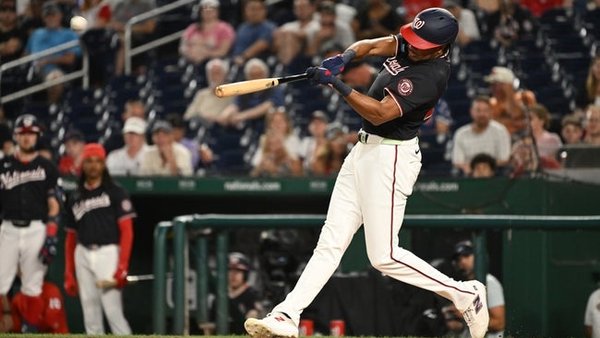
Tropicana Field’s 0.95 park factor provides mild run suppression, but the dome’s neutral environment does nothing to mask the gap between these two starters — Griffin Jax has surrendered 7 home runs in just 44 innings, and Washington’s James Wood carries a .606 xwOBA against right-handers. The Rays are priced at -126 in a game the projections call a dead-even 4.3–4.3 split.
Cade Cavalli vs. Griffin Jax: Washington Nationals at Tampa Bay Rays Betting Preview
Tampa Bay’s 41-30 record earns them the home-favorite billing, and the dome environment at Tropicana Field gives the Rays a comfortable, consistent setting they know well. None of that is wrong. But the market is pricing this as though Tampa Bay has a meaningful edge on the mound tonight, and Griffin Jax simply doesn’t support that conclusion. A 3.68 ERA sounds respectable, but he’s surrendered 7 home runs in just 44 innings — a 1.43 HR/9 rate that makes him one of the most gopher-prone starters in the league. Washington’s lineup is built exactly to exploit that.
The Nationals come in at +108, a plus-money price in a game the numbers project as a true coin flip. That gap between implied probability and projected reality is the entire bet. This isn’t about thinking Washington is the better team — it’s about recognizing that the price offers overlay on a matchup where their offensive profile aligns almost perfectly with Jax’s biggest weakness.
Washington’s rotation has taken injury hits (Gray, Irvin, and Waldichuk are all on the IL), so there’s legitimate concern about depth if Cavalli exits early. But for tonight, Cade Cavalli gives the Nationals a clear edge over the opposing arm, and +108 is the cleanest way to back that gap.
Game Info & Betting Lines
- Date/Time: Friday, June 19, 2026 | 7:10 PM ET
- Venue: Tropicana Field (Park Factor: 0.95 — slight run suppressor, dome)
- Probable Starters: Cade Cavalli (WAS, 4-4, 3.98 ERA) vs. Griffin Jax (TB, 1-5, 3.68 ERA)
- Moneyline: Washington Nationals +108 / Tampa Bay Rays -126
- Run Line: Tampa Bay Rays -1.5 (+176) / Washington Nationals +1.5 (-215)
- Total: 8 (Over -110 / Under -110)
Why This Number Is Off
The -126 on Tampa Bay isn’t irrational. The Rays have a better record (41-30 vs. 39-36), a healthier rotation on paper, and the familiarity advantage of a dome they’ve played in all season. Their pitching staff ERA of 3.95 significantly outpaces Washington’s 4.65, and that’s a real organizational gap. The market isn’t asleep here — it sees a team that plays consistent baseball at home against a road club with a thin rotation and a recent 6-2 drubbing by Kansas City.
But here’s where the number slips: the projected score is a literal dead heat at 4.3 runs apiece, which assigns Tampa Bay a 51.3% win probability — implying a moneyline around -106. The market is at -126, which bakes in roughly 55.8% implied probability. That’s nearly a 5-point gap, and it’s the overlay driving this lean.
The concern is that Tampa Bay’s run differential (+5 over 71 games) is remarkably thin for a 41-30 team. They’ve gone just 4-6 in their last ten games, getting swept by the Dodgers in a three-game series where they scored a combined 7 runs. The Rays aren’t playing like a team that deserves heavy home-favorite treatment right now, and Jax’s record (1-5) isn’t just bad luck — he’s been consistently vulnerable.
What Separates the Pitching
This matchup isn’t close when you look past the surface ERAs. Cade Cavalli carries a 3.98 ERA over 74.2 innings with a 9.76 K/9, backed by a knuckle curve that generates a 39.2% whiff rate and holds hitters to a .269 xwOBA. His four-seam fastball sits at 96.6 mph with 35.2% usage, and while the xwOBA-against on that pitch is .374 — showing it’s hittable — the combination with the knuckle curve creates genuine two-pitch dominance. His WHIP of 1.39 signals he’ll put men on base, and Tampa Bay’s top two hitters can string together damage. Yandy Díaz posts a .380 xwOBA overall and a .404 mark against right-handers. Jonathan Aranda is the more dangerous threat: his overall xwOBA sits at .440, and his split against right-handed pitching climbs to .470 — two separate figures that together paint him as a legitimate run-scoring threat against Cavalli’s high-traffic tendencies.
Griffin Jax presents a different — and more exploitable — profile. His arsenal leans heavily on a sweeper (24.9% usage, 33.8% whiff) and a changeup (20.1% usage, 33.3% whiff) that both produce solid swing-and-miss numbers. The problem is structural: his four-seam fastball sits at 96.3 mph but carries an alarming .454 xwOBA-against, and his cutter has produced a .576 xwOBA against in limited use. When hitters sit on his fastball, they square it up — and Washington’s lineup is built to do exactly that.
James Wood sits at a .587 xwOBA overall and a .606 xwOBA against right-handers, with an 11.9% barrel rate and 35.9% hard-hit rate. Wood has 20 home runs on the season and a .954 OPS. That matchup against Jax’s vulnerable four-seamer is the single biggest mismatch in this game. CJ Abrams adds another dangerous bat at .393 xwOBA, and Curtis Mead (.394 xwOBA) slots in third. Jax has already allowed 7 HR in 44 IP — Wood, Abrams, and Mead represent exactly the kind of contact-quality hitters who punish a pitcher living with a .454 xwOBA on his primary fastball.
The Pushback
I’m not going to pretend Jax’s ERA is a complete fiction. His sweeper and changeup are legitimate weapons — a combined 33%+ whiff rate on your two most-used offerings is real, and against a Nationals lineup that has cooled off lately (they just dropped a 6-2 decision to Kansas City after back-to-back wins), he could work through stretches. The Rays bullpen has also been more reliable than Washington’s relief corps, and in a close game that goes late, that depth matters. If Jax leans on his off-speed stuff and avoids the fastball early in counts, he can limit the damage. The Nationals are 39-36 — a solid team, but not one you fall in love with as a road underdog without reason.
I also looked hard at the run line on both sides and walked away from it. Washington +1.5 at -215 is a juice trap — you’re laying too much on a coin-flip game where either team can win by two. Tampa Bay -1.5 at +176 is theoretically interesting given the home-side lean in the component breakdown, but the dead-even run projection doesn’t support asking Jax to cover 1.5 runs at any price. The run line is a pass in both directions. The value is on the moneyline.
Run Environment & Game Shape
The total is set at 8, and the projected combined runs come in at 8.7 — a modest over lean, but nothing I’m chasing aggressively. Tropicana Field’s park factor of 0.95 is a mild run suppressor, and both starters have the strikeout stuff to keep early innings quiet. The more likely game shape is a mid-range scoring affair where one or two big swings determine the outcome — which actually favors Washington, given that Wood and the top of their order have the barrel-rate and hard-hit profiles to produce those game-changing moments against Jax’s leaky fastball.
Tampa Bay’s offense has been inconsistent in recent weeks. Their last three games produced a combined 7 runs against the Dodgers, and Cavalli’s knuckle curve — 39.2% whiff, .269 xwOBA against — is the kind of secondary pitch that can neutralize a lineup that already leans on contact over power (58 team home runs to Washington’s 96). The Rays’ best hitters, Díaz and Aranda, make contact and get on base, but neither profiles as a likely Cavalli demolition job. The game figures to stay tight through the middle innings, and in a game that comes down to a handful of pitches, Jax’s .454 xwOBA four-seamer against a lineup featuring James Wood is the single biggest vulnerability on the board tonight.
The market is pricing Tampa Bay like they have a real edge here. The numbers say this is 50-50. Jax’s home-run rate, Washington’s power profile, and the dead-even 4.3–4.3 projection all point to a coin-flip game being sold at a -126 price — and the Nationals are available at +108. That’s the bet. Back Washington to win outright at plus money in a game that projects as a dead heat.
Bet: Washington Nationals Moneyline +108 — 1 unit (lean)